

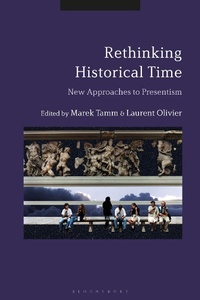
Rethinking Historical Time
New Approaches to Presentism
1st Edition
Published on 22. August 2019
240 pages
978-1-350-06510-9 (ISBN)
Description

Is time out of joint? For the past two centuries, the dominant Western time regime has been future-oriented and based on the linear, progressive and homogeneous concept of time. Over the last few decades, there has been a shift towards a new, present-oriented regime or 'presentism', made up of multiple and percolating temporalities. Rethinking Historical Time engages with this change of paradigm, providing a timely overview of cutting-edge interdisciplinary approaches to this new temporal condition.
Marek Tamm and Laurent Olivier have brought together an international team of scholars working in history, anthropology, archaeology, geography, philosophy, literature and visual studies to rethink the epistemological consequences of presentism for the study of past and to discuss critically the traditional assumptions that underpin research on historical time. Beginning with an analysis of presentism, the contributors move on to explore in historical and critical terms the idea of multiple temporalities, before presenting a series of case studies on the variability of different forms of time in contemporary material culture.
Marek Tamm and Laurent Olivier have brought together an international team of scholars working in history, anthropology, archaeology, geography, philosophy, literature and visual studies to rethink the epistemological consequences of presentism for the study of past and to discuss critically the traditional assumptions that underpin research on historical time. Beginning with an analysis of presentism, the contributors move on to explore in historical and critical terms the idea of multiple temporalities, before presenting a series of case studies on the variability of different forms of time in contemporary material culture.
More details
Edition
1. Auflage
Language
English
Place of publication
London
United Kingdom
Publishing group
Bloomsbury Publishing PLC
Target group
Professional and scholarly
Illustrations
10 bw illus
ISBN-13
978-1-350-06510-9 (9781350065109)
Copyright in bibliographic data and cover images is held by Nielsen Book Services Limited or by the publishers or by their respective licensors: all rights reserved.
Schweitzer Classification
Other editions
Additional editions
Book
03/2021
Bloomsbury Academic
€59.60
Shipment within 15-20 days
Persons
Marek Tamm is Professor of Cultural History at Tallinn University, Estonia. His primary research fields are the cultural history of medieval Europe, theory of history and cultural memory studies. He has recently published Debating New Approaches to History (ed. with Peter Burke, 2018) and an edited volume, Afterlife of Events: Perspectives on Mnemohistory (2015).
Laurent Olivier is Curator in Chief of the Celtic and Gallic Department at the French National Museum of Archaeology in Saint-Germain-en-Laye, France. His main area of research is the archaeology of the European Iron Age, but he is also interested in the history of the archaeological discipline and its place in the building of collective identities. He has recently published Le Pays des Celtes. Mémoires de la Gaule (2018).
Laurent Olivier is Curator in Chief of the Celtic and Gallic Department at the French National Museum of Archaeology in Saint-Germain-en-Laye, France. His main area of research is the archaeology of the European Iron Age, but he is also interested in the history of the archaeological discipline and its place in the building of collective identities. He has recently published Le Pays des Celtes. Mémoires de la Gaule (2018).
Content
List of Figures
List of Contributors
Introduction: Rethinking Historical Time, Marek Tamm (Tallinn University, Estonia) and Laurent Olivier (French National Museum of Archaeology, France)
Part I: Presentism and New Temporalities
1. Out of Time? Some Critical Reflections on François Hartog's Presentism, Chris Lorenz (VU University Amsterdam, The Netherlands)
2. Return to Chronology, Helge Jordheim (University of Oslo, Norway)
3. Coming to Terms with the Present: Exploring the Chrononormativity of Historical Time, Victoria Fareld (Stockholm University, Sweden)
4. The Transformation of Historical Time: Processual and Evental Temporalities, Zoltán Boldizsár Simon (Bielefeld University, Germany)
Part II: Multiple Temporalities
5. Revolutionary Presence: Historicism and the Temporal Politics of the Moment, Hans Ruin (Södertörn University, Sweden)
6. Time Outside History: Politics and Ontology in Franz Rosenzweig's and Mircea Eliade's Reimagined Temporalities, Liisi Keedus (Tallinn University, Estonia)
7. Pictorial Times and the Times of History: On Seeing Images and Experiencing Time, Johannes Grave (Bielefeld University, Germany)
8. Time as History in Twentieth-Century Photography, Anne Fuchs (University College Dublin, Ireland)
Part III: Material Temporalities
9. Heritage and the Untimely, Torgeir Rinke Bangstad (UiT The Arctic University of Norway, Norway)
10. 'Let's Get Rid of That Old Stuff!' Family Heritage Objects in France at the Age of Presentism, Jean-Pierre Legendre (French Ministry of Culture, France) and Laurence Ollivier (French Ministry of Culture, France)
11. Death and Archaeology in the Present, Tense, Shannon Lee Dawdy (University of Chicago, USA)
12. Rewilding Time in the Vale do Côa, Caitlin DeSilvey (University of Exeter, UK)
Conclusion: A Creed That Has Lost its Believers? Reconfiguring the Concepts of Time and History, Aleida Assmann (University of Constance, Germany)
Index
List of Contributors
Introduction: Rethinking Historical Time, Marek Tamm (Tallinn University, Estonia) and Laurent Olivier (French National Museum of Archaeology, France)
Part I: Presentism and New Temporalities
1. Out of Time? Some Critical Reflections on François Hartog's Presentism, Chris Lorenz (VU University Amsterdam, The Netherlands)
2. Return to Chronology, Helge Jordheim (University of Oslo, Norway)
3. Coming to Terms with the Present: Exploring the Chrononormativity of Historical Time, Victoria Fareld (Stockholm University, Sweden)
4. The Transformation of Historical Time: Processual and Evental Temporalities, Zoltán Boldizsár Simon (Bielefeld University, Germany)
Part II: Multiple Temporalities
5. Revolutionary Presence: Historicism and the Temporal Politics of the Moment, Hans Ruin (Södertörn University, Sweden)
6. Time Outside History: Politics and Ontology in Franz Rosenzweig's and Mircea Eliade's Reimagined Temporalities, Liisi Keedus (Tallinn University, Estonia)
7. Pictorial Times and the Times of History: On Seeing Images and Experiencing Time, Johannes Grave (Bielefeld University, Germany)
8. Time as History in Twentieth-Century Photography, Anne Fuchs (University College Dublin, Ireland)
Part III: Material Temporalities
9. Heritage and the Untimely, Torgeir Rinke Bangstad (UiT The Arctic University of Norway, Norway)
10. 'Let's Get Rid of That Old Stuff!' Family Heritage Objects in France at the Age of Presentism, Jean-Pierre Legendre (French Ministry of Culture, France) and Laurence Ollivier (French Ministry of Culture, France)
11. Death and Archaeology in the Present, Tense, Shannon Lee Dawdy (University of Chicago, USA)
12. Rewilding Time in the Vale do Côa, Caitlin DeSilvey (University of Exeter, UK)
Conclusion: A Creed That Has Lost its Believers? Reconfiguring the Concepts of Time and History, Aleida Assmann (University of Constance, Germany)
Index
