

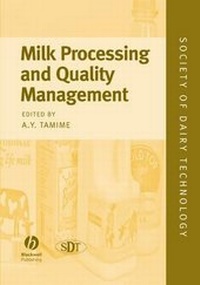
Milk Processing and Quality Management
Description

Reviews / Votes
"It should be noted that this book is undeniable valuable for theproduction of safe food of animal origin because, in spite of theimplement HACCP system, the incidence of food poisoning does notdiminish, which justifies the need to improve these systems."(International Journal of Dairy Technology, February2011) "The book is a welcome and overdue replacement for thePasteurization Manual from the Society of Dairy Technology. It hassucceeded in bringing up to date all aspects of quality managementof liquid milk. The section on HACCP is well documented and is ofconsiderable practical value. It is a must for all those involvedin production of liquid milks, and should become compulsory readingfor students and new entrants to the milk and milk productsindustry." ( Journal of Dairy Technology, August 2009)More details
Other editions
Additional editions
Person
Content
Preface.
Contributors.
1 On-Farm Hygienic Milk Production (M.M.M. VISSERS AND F. DRIEHUIS).
1.1 Introduction.
1.2 Sources of microbial contamination of bulk tank milk.
1.3 Control of microbial contamination of bulk tank milk.
1.4 Future developments in handling of the milk on the farm.
1.5 Conclusions.
2 Properties and Constituents of Cow's Milk (T. HUPPERTZ AND A.L. KELLY).
2.1 Introduction.
2.2 Milk composition.
2.3 Milk constituents.
2.4 Heat-induced changes in physicochemical properties of milk.
2.5 Heat-induced changes in processing characteristics of milk.
2.6 Relationship between the quality of raw milk and that of products.
2.7 Conclusions.
3 Microbiology of Raw and Market Milks (V. TOUCH AND H.C. DEETH).
3.1 Introduction.
3.2 Microflora of raw milk.
3.3 Microflora of pasteurised milk.
3.4 Microflora of UHT milk.
3.5 Microflora of ESL milk.
3.6 Sources of contamination.
3.7 Measures to reduce bacterial contamination of raw and market milks.
3.8 Conclusion.
4 Quality Control (J. BELLOQUE, R. CHICON AND I. RECIO).
4.1 Introduction.
4.2 Quality control of raw milk.
4.3 Quality control of processed milk.
4.4 Methods of analysis.
4.5 Major components analysis.
4.6 Analysis of fraudulent addition of ingredients and authentication.
4.7 Conclusion.
5 Current Legislation of Market Milks (M. HICKEY).
5.1 Introduction.
5.2 EU legislation.
5.3 UK legislation.
5.4 Irish legislation.
5.5 USA legislation.
5.6 The international perspective - Codex Alimentarius.
5.7 Conclusions and possible future developments.
6 The Safety of Raw Liquid Milk (M. O'MAHONY, S. FANNING AND P. WHYTE).
6.1 Introduction.
6.2 Implication of milk in human disease.
6.3 Microbial hazards in milk.
6.4 Chemical contaminants and residues.
6.5 Poorly understood and emerging hazards.
6.6 Risk management strategies to ensure safety of liquid milk.
6.7 Summation.
7 Heat Treatment of Milk (M.J. LEWIS AND H.C. DEETH).
7.1 Introduction.
7.2 Milk composition.
7.3 Reaction kinetics.
7.4 Principles of heat transfer.
7.5 Thermisation and tyndallisation.
7.6 Pasteurisation.
7.7 Sterilisation - safety and spoilage considerations.
7.8 In-container sterilisation.
7.9 UHT processing.
7.10 High-temperature processing (extended shelf life).
7.11 Reconstituted and recombined milk products.
7.12 Conclusions.
7.13 Appendix.
8 Novel Methods of Milk Processing (M. VILLAMIEL, M.A.I. SCHUTYSER AND P. DE JONG).
8.1 Introduction.
8.2 Microwaves.
8.3 High Pressure.
8.4 Pulsed electric fields.
8.5 Ultrasound.
8.6 Microfiltration.
8.7 Innovative steam injection - a novel heating method.
8.8 Combined technologies.
8.9 Computer models for design and implementation of novel milk-processing methods.
9 Hygiene Practices in Liquid Milk Dairies (A.J. VAN ASSELT AND M.C. TE GIFFEL).
9.1 Introduction.
9.2 Principal hazards.
9.3 Hygienic processing.
9.4 Monitoring and control.
9.5 Concluding remarks.
10 Hazard Analysis (Appraisal) Critical Control Point (HACCP) in Milk Processing - A Practical Overview (A. SAYLER).
10.1 Introduction.
10.2 General aspects of the benefits of the HACCP system.
10.3 HACCP definitions.
10.4 Implementation and maintenance of the HACCP programme.
10.5 Steps to HACCP implementation.
10.6 Hazard components.
10.7 Prerequisite programme.
10.8 The principles of an HACCP plan.
10.9 Internal and external auditing in the HACCP process.
10.10 Overview and summary.
11 Sensory Profiling of Market Milks (E. MOLINA, L. AMIGO AND A. QUIROS).
11.1 Introduction.
11.2 Sensory properties of market milks.
11.3 Different types of market milks.
11.4 Conclusion.
Index.
