

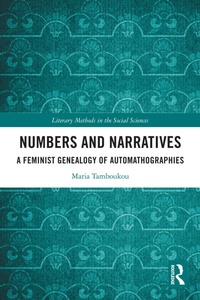
Numbers and Narratives
A Feminist Genealogy of Automathographies
1st Edition
Published on 10. September 2025
338 pages
978-1-040-42031-7 (ISBN)
Description

Why have there been so few women mathematicians? This book does not seek an answer in absence but in the forces, ruptures, and intensities that shape the becoming of a femme philosophe-a mathematician, scientist, and philosopher-within the shifting assemblages of eighteenth- and nineteenth-century Europe. Moving beyond exclusion as mere negation, it traces the conditions of emergence, the differential speeds and slippages through which women entered, inhabited, and transformed the mathematical sciences.
Drawing on auto/biographical documents, literary and philosophical writings, and the materialities of the archive, this book approaches the digital turn not as a tool but as a plane of composition, where new trajectories of memory work unfold. Between historiography and fabulation, it maps a space where women's mathematical thought was not only possible but inevitable-if only in flashes, excesses, and detours.
This book will resonate with scholars in the sociology, history, and philosophy of science and mathematics, particularly those engaged with feminist thought, the politics of knowledge, and experimental archival methods.
Drawing on auto/biographical documents, literary and philosophical writings, and the materialities of the archive, this book approaches the digital turn not as a tool but as a plane of composition, where new trajectories of memory work unfold. Between historiography and fabulation, it maps a space where women's mathematical thought was not only possible but inevitable-if only in flashes, excesses, and detours.
This book will resonate with scholars in the sociology, history, and philosophy of science and mathematics, particularly those engaged with feminist thought, the politics of knowledge, and experimental archival methods.
Reviews / Votes
'What does it mean to uncover the sorry history of women mathematicians? A history littered with marginalisation and even now revealing a struggle of women mathematicians in the present. Maria Tamboukou presents an important, detailed and moving analysis of the lives of some of these women. But most important for us is how we understand that assemblage of feminist genealogies in what it tells us of the present and not only how we got here but what trajectories are open to us to think the future differently, not only in terms of women working as mathematicians but also what those sensibilities bring to our understanding of mathematics and indeed, urgently, our world, itself.'Professor Valerie Walkerdine, Cardiff University, UK
'Negating, silencing and erasing women mathematicians -along with other marginalized people and communities- as key contributors to the emerging epistemic cultures in mathematics, science and philosophy remains a core symptom of current democratic societies. The book Numbers and Narratives: A Feminist Genealogy of Automathographies written and narrated eloquently by Professor Maria Tamboukou, offers a critical feminist genealogy concerning women's agonistic assemblages for becoming mathematicians during the long 18th and 19th centuries. Based on archival epistolography, she brings these genealogies into conversation with feminist theory, science studies and new materialism, Tamboukou offers a unique contribution toward unfolding the gendering of mathematics and mathematics education.'
Professor Anna Chronaki, University of Thessaly, Volos, Greece and Malmoe University, Malmoe, Sweden
'This inspiring feminist genealogy combines meticulous attention to the lives of six women mathematicians with nuanced accounts of the entangled contexts of their work, bringing conceptual and biographical richness to these histories.
In her characteristic style, Maria Tamboukou brings an intimacy to the writing - we can feel her discovery, the immediacy of the archive, the unfolding of threads and the weaving together of new storylines and connections. This is feminist writing at its best, surfacing new and muted histories and opening up other ways of seeing women and mathematics, and of understanding the history of gender and disciplinary fields.'
Professor Julie McLeod, University of Melbourne, Australia
More details
Series
Edition
1. Auflage
Language
English
Place of publication
London
United Kingdom
Publishing group
Taylor & Francis Ltd
Target group
College/higher education
Professional and scholarly
File size
2,85 MB
ISBN-13
978-1-040-42031-7 (9781040420317)
Copyright in bibliographic data and cover images is held by Nielsen Book Services Limited or by the publishers or by their respective licensors: all rights reserved.
Schweitzer Classification
Other editions
Additional editions
Book
09/2025
1st Edition
Routledge
€207.10
Shipment within 10-20 days
Person
Maria Tamboukou is Professor of Feminist Studies at the University of East London and Leverhulme Major Research Fellow (2022-5). She has held academic positions in a number of international institutions, including the 'Hannah Arendt' Centre for Political Studies at the University of Verona, Italy. Her research activity develops in the areas of philosophies and epistemologies in the social sciences, feminist theories, narrative analytics, and archival research. She has published in English, Greek, and French, and her work has been translated in Italian, Norwegian, Portuguese, Spanish, Welsh, and Greek. She is the author of nine monographs, two co-authored books, and four edited volumes on research methods, including her latest monograph, Epistolary Narratives of Love, Gender and Agonistic Politics in 2023. Writing histories of the present is the central focus of her work, currently configured as an assemblage of feminist genealogies.
Content
Introduction: Becoming a mathematician, philosopher and scientist 1. Memory Machines and Archival Traces 2. Epistolary Entanglements: Between the Personal and the Scientific 3. The Dynamics and Politics of Translation 4. Exceptional women? The Agonistics of Knowledge 5. Love and Mathematics: Existential Choices and Intellectual Freedom 6. Philosophical Ruminations and Process Epistemologies 7. Narrative Rhythmanalysis: Listening to the Echo of the Subject Conclusion: Future Pasts: Charting Assemblages
