

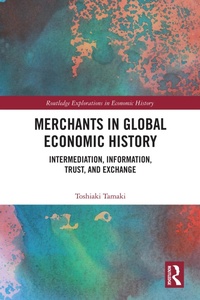
Merchants in Global Economic History
Intermediation, Information, Trust, and Exchange
Will be published approx. on 21. July 2026
234 pages
978-1-040-88760-8 (ISBN)
Description

In this book, Toshiaki Tamaki analyses merchant and entrepreneurial activity from ancient times to the twenty-first century, arguing that these intermediaries drive global market expansion and institutional development, as they help to connect distant regions and reduce information asymmetry.
The book begins by framing global economic history through the lens of Homo mobilis (the mobile human) and Homo faber (the fabricating human). It argues that global trade cannot be understood fully without considering how merchants help markets expand through the transmission of information, trust, reputation and commercial knowledge. The book then contextualises this argument through a global survey of trading empires, exploring how merchants and intermediaries profit not through ownership of goods but through the act of exchange. This long-term narrative spans from Mesopotamian traders to Phoenician seafarers to Asian shipping agents and even the global logistics giants of today. Through this survey, readers gain a deeper understanding of how information, trust and circulation - not just production - have shaped the global economy.
Offering a compelling alternative to static economic models and supply-side theories, this book will be of interest to scholars and students of global history, economic history and the history of capitalism.
The book begins by framing global economic history through the lens of Homo mobilis (the mobile human) and Homo faber (the fabricating human). It argues that global trade cannot be understood fully without considering how merchants help markets expand through the transmission of information, trust, reputation and commercial knowledge. The book then contextualises this argument through a global survey of trading empires, exploring how merchants and intermediaries profit not through ownership of goods but through the act of exchange. This long-term narrative spans from Mesopotamian traders to Phoenician seafarers to Asian shipping agents and even the global logistics giants of today. Through this survey, readers gain a deeper understanding of how information, trust and circulation - not just production - have shaped the global economy.
Offering a compelling alternative to static economic models and supply-side theories, this book will be of interest to scholars and students of global history, economic history and the history of capitalism.
More details
Series
Language
English
Place of publication
London
United Kingdom
Publishing group
Taylor & Francis Ltd
Target group
College/higher education
Professional and scholarly
Illustrations
1 Tables, black and white; 9 Line drawings, black and white; 9 Illustrations, black and white
File size
5,50 MB
ISBN-13
978-1-040-88760-8 (9781040887608)
Copyright in bibliographic data and cover images is held by Nielsen Book Services Limited or by the publishers or by their respective licensors: all rights reserved.
Schweitzer Classification
Other editions
Additional editions
Toshiaki Tamaki
Merchants in Global Economic History
Intermediation, Information, Trust, and Exchange
Book
approx. 07/2026
1st Edition
Routledge
€191.50
Not yet published
Person
Toshiaki Tamaki is Professor of Economic History at Kyoto Sangyo University, where he researches the institutional role of commission-based intermediaries in global trade from antiquity to the digital age.
Content
Introduction: What are the Reasons for Economic Growth? 1. Origins of Commerce and Markets 2. Integrating Eurasia: Islam, the Mongol Empire and the Economic Rise of Song-Yuan China 3. Trade and European External Expansion 4. Four-Continent Chains: The Maritime Revolution of the Fifteenth and Sixteenth Centuries 5. Printing, Price Currents and the Industrious Revolution 6. Family Firms and Institutional Foundations: A Comparative Perspective on Sephardic, Armenian and Japanese Merchants 7. From the Netherlands to Britain: Hegemonic Transition 8. Commission Capitalism and the Making of the Global Economy: Britain, Diasporic Merchants, and Asia, 1415-1914 9. Financialisation, Digital Platforms and the New Inequalities. Conclusion
