

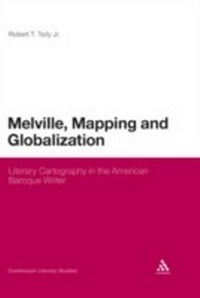
Melville, Mapping and Globalization
Literary Cartography in the American Baroque Writer
1st Edition
Published on 9. August 2009
192 pages
978-1-4411-0330-7 (ISBN)
Description

In Melville, Mapping and Globalization, Robert Tally argues that Melville does not belong in the tradition of the American Renaissance, but rather creates a baroque literary cartography, artistically engaging with spaces beyond the national model. At a time of intense national consolidation and cultural centralization, Melville discovered the postnational forces of an emerging world system, a system that has become our own in the era of globalization.
Drawing on the work of a range of literary and social critics (including Deleuze, Foucault, Jameson, and Moretti), Tally argues that Melville's distinct literary form enabled his critique of the dominant national narrative of his own time and proleptically undermined the national literary tradition of American Studies a century later. Melville's hypercanonical status in the United States makes his work all the more crucial for understanding the role of literature in a post-American epoch.
Offering bold new interpretations and theoretical juxtapositions, Tally presents a postnational Melville, well suited to establishing new approaches to American and world literature in the twenty-first century.
Drawing on the work of a range of literary and social critics (including Deleuze, Foucault, Jameson, and Moretti), Tally argues that Melville's distinct literary form enabled his critique of the dominant national narrative of his own time and proleptically undermined the national literary tradition of American Studies a century later. Melville's hypercanonical status in the United States makes his work all the more crucial for understanding the role of literature in a post-American epoch.
Offering bold new interpretations and theoretical juxtapositions, Tally presents a postnational Melville, well suited to establishing new approaches to American and world literature in the twenty-first century.
Reviews / Votes
"In Melville, Mapping and Globalization: Literary Cartography in the American Baroque Writer, Robert Tally, unlike the vast majority of his predecessors, refuses the temptation to domesticate Herman Melville's polyvalent literary excesses. Instead he goes all out to think them positively. The result is a major contribution to the New Americanist effort to reconstellate Melville's work out of the American nationalist context where it has been mired into the global context where it has always belonged." - Distinguished Professor William V. Spanos, Binghamton University, New York, USA Tally's reading raises provocative questions about neglected dimensions of Melville's work. This book would be helpful for upper-level undergraduates and scholars alike.More details
Series
Edition
1. Auflage
Language
English
Place of publication
New York
United States
Target group
Professional and scholarly
ISBN-13
978-1-4411-0330-7 (9781441103307)
Copyright in bibliographic data and cover images is held by Nielsen Book Services Limited or by the publishers or by their respective licensors: all rights reserved.
Schweitzer Classification
Other editions
Additional editions
Robert T. Tally Jr.
Melville, Mapping and Globalization
Literary Cartography in the American Baroque Writer
Book
12/2011
Continuum Publishing Corporation
€55.80
Shipment within 15-20 days
Person
Robert T. Tally Jr. is Professor of English at Texas State University. He is the author of many books, including The Critical Situation: Vexed Perspectives in Postmodern Literary Studies (2023); For a Ruthless Critique of All That Exists (2022); J.R.R. Tolkien's The Hobbit: Realizing History Through Fantasy (2022); Topophrenia: Place, Narrative, and the Spatial Imagination (2019); Fredric Jameson: The Project of Dialectic Criticism (2014); Poe and the Subversion of American Literature (2014); Spatiality (2013); Utopia in the Age of Globalization (2013); Kurt Vonnegut and the American Novel (2011); and Melville, Mapping, and Globalization (2009). The translator of Bertrand Westphal's Geocriticism: Real and Fictional Spaces (2011), Tally is also the editor or co-editor of Affective Geographies and Narratives of Chinese Diaspora (2022); Spatial Literary Studies in China (2022); Spatial Literary Studies (2020); Teaching Space, Place, and Literature (2018); The Routledge Handbook of Literature and Space (2017); Ecocriticism and Geocriticism (2016); The Geocritical Legacies of Edward W. Said (2015); Literary Cartographies (2014); Kurt Vonnegut: Critical Insights (2013); and Geocritical Explorations (2011). Tally is the general editor of "Geocriticism and Spatial Literary Studies," a Palgrave Macmillan book series.
Content
Acknowledgements
Preface: "When Leviathan's the text"
1. Out of Bounds: Melville's American Baroque
2. Spaces of American Literature: Geography and Narrative Form
3. "An everlasting terra incognita": Globalization and World Literature
4. Anti-Ishmael
5. Marine Nomadology: Melville's Antinomy of Pure Reason
6. "Spaces that before were blank": The Utopia of the Periphery
7. A Prosy Stroll: Overview and the Urban Itinerary
8. The Ambiguities of Place: Local Narrative and the Global City
Conclusion: "Leviathan is not the biggest fish," or, The Cartography of the Kraken
Bibliography
Index
Preface: "When Leviathan's the text"
1. Out of Bounds: Melville's American Baroque
2. Spaces of American Literature: Geography and Narrative Form
3. "An everlasting terra incognita": Globalization and World Literature
4. Anti-Ishmael
5. Marine Nomadology: Melville's Antinomy of Pure Reason
6. "Spaces that before were blank": The Utopia of the Periphery
7. A Prosy Stroll: Overview and the Urban Itinerary
8. The Ambiguities of Place: Local Narrative and the Global City
Conclusion: "Leviathan is not the biggest fish," or, The Cartography of the Kraken
Bibliography
Index
