

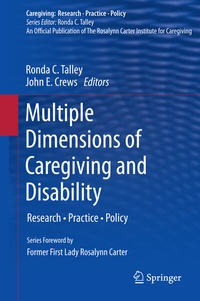
Multiple Dimensions of Caregiving and Disability
Description

Caring for people with disabilities often becomes an all-encompassing responsibility for one or more family members. To manage the multifaceted demands, caregivers must possess strong multitasking skills, including the ability to assist with daily life tasks; provide emotional support; help with financial affairs; mediate and advocate with health care providers. Maintaining balance within their own lives can become incredibly challenging for caregivers. More often than not, providing care for family members or loved ones occurs at the expense of the caregivers' well-being. And for caregivers who themselves have disabilities, it further complicates matters.
Multiple Dimensions of Caregiving and Disability addresses concerns that have been long familiar to the caregiver population and examines the current state of family care for individuals with disabilities. With a lifespan perspective, this concise reference reviews the literature on specific problems of caregivers and explores which care strategies are effective, promising, or lacking in available resources and support interventions. Contributors also explore the more fluid and subjective aspects of caregiving, such as feelings, spirituality, and family roles. Suggestions for future policy improvements, particularly within the public health sector, are discussed as well.
Topics covered include:
Family dynamics and caregiving for people with disabilities.
Parent caregiving of children with disabilities.
Race, ethnicity, socioeconomic status, and caregiving.
Educational, training, and support programs for caregivers.
Emerging technologies to aid caregivers.
Developing partnerships between caregivers and health care providers.
Multiple Dimensions of Caregiving and Disability is a must-have resource for researchers, scientist-practitioners, policy makers, and graduate students across such disciplines as clinicalpsychology, nursing, social work, public health, medicine, and social and education policy.
More details
Other editions
Additional editions
Persons
Content
1. Introduction: Multiple Dimensions of Caregiving and Disability.- 2. Family Dynamics and Caregiving for People with Disabilities.- 3. Feelings of Family Caregivers.- 4. Education, Training, and Support Programs for Caregivers of Individuals with Disabilities.- 5. Parent Caregivers of Children with Disabilities.- 6. Neither Prepared Nor Rehearsed: The Role of Public Health in Disability and Caregiving.- 7. Race/Ethnicity, Culture, and Socioeconomic Status and Caregiving of Persons with Disabilities.- 8. Faith and Spirituality: Supporting Caregivers of Individuals with Disabilities.- 9. Family Caregivers and Health Care Providers: Developing Partnerships for a Continuum of Care and Support.- 10. Legal Issues Related to Caregiving for an Individual with Disabilities.- 11. Long Term Care Planning For Individuals with Developmental Disabilities.- 12. Emerging Technologies for Caregivers of a Person with a Disability.- 13. Multiple Dimensions of Caregiving and Disability: Supporting Those Who Care.
