

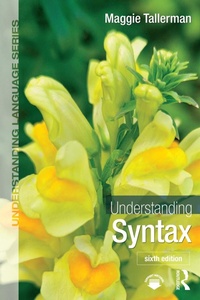
Understanding Syntax
6th Edition
Published on 13. March 2025
382 pages
978-1-040-29585-4 (ISBN)
Description

Assuming no prior grammatical knowledge, Understanding Syntax explains and illustrates the major concepts, categories and terminology involved in the study of cross-linguistic syntax. Taking a largely theory-neutral and descriptive viewpoint throughout, this book:
introduces syntactic typology, syntactic description and the major typological categories found in the languages of the world
clarifies with examples grammatical constructions and relationships between words in a clause, including word classes and their syntactic properties; grammatical relations such as subject and object; case and agreement processes; passives and other valency-changing processes; questions and relative clauses
features in-text and chapter-end exercises to extend the reader's knowledge of syntactic concepts and argumentation, drawing on data from over 100 languages
highlights the principles involved in writing a brief syntactic sketch of language
This sixth edition has been revised to include updated further readings, improved examples and exercises and additional explanations of the most demanding concepts.
Understanding Syntax is an essential textbook for students studying the description of language, cross-linguistic syntax, language typology and linguistic fieldwork, and will be the foundation for all studies of theoretical syntax.
introduces syntactic typology, syntactic description and the major typological categories found in the languages of the world
clarifies with examples grammatical constructions and relationships between words in a clause, including word classes and their syntactic properties; grammatical relations such as subject and object; case and agreement processes; passives and other valency-changing processes; questions and relative clauses
features in-text and chapter-end exercises to extend the reader's knowledge of syntactic concepts and argumentation, drawing on data from over 100 languages
highlights the principles involved in writing a brief syntactic sketch of language
This sixth edition has been revised to include updated further readings, improved examples and exercises and additional explanations of the most demanding concepts.
Understanding Syntax is an essential textbook for students studying the description of language, cross-linguistic syntax, language typology and linguistic fieldwork, and will be the foundation for all studies of theoretical syntax.
More details
Series
Edition
6th edition
Language
English
Place of publication
London
United Kingdom
Publishing group
Taylor & Francis Ltd
Target group
College/higher education
Illustrations
9 Tables, black and white; 3 Line drawings, black and white; 3 Illustrations, black and white
File size
3,48 MB
ISBN-13
978-1-040-29585-4 (9781040295854)
Copyright in bibliographic data and cover images is held by Nielsen Book Services Limited or by the publishers or by their respective licensors: all rights reserved.
Schweitzer Classification
Other editions
Additional editions
Maggie Tallerman
Understanding Syntax
Book
03/2025
6th Edition
Routledge
€207.30
Shipment within 10-20 days
Maggie Tallerman
Understanding Syntax
Book
03/2025
6th Edition
Routledge
€69.30
Shipment within 10-20 days
Person
Maggie Tallerman is Emerita Professor of Linguistics at Newcastle University, UK.
Content
List of tables and figures
Note to the instructor
Note to the student
Acknowledgements
List of abbreviations used in examples
1 What is syntax?
2 Words belong to different classes
3 Looking inside sentences
4 Heads and their dependents
5 How do we identify constituents?
6 Relationships within the clause
7 Processes that change grammatical relations
8 Wh-constructions: questions and relative clauses
9 Asking questions about syntax
Sources of data used in examples
Glossary
References
Language index
Subject index
Note to the instructor
Note to the student
Acknowledgements
List of abbreviations used in examples
1 What is syntax?
2 Words belong to different classes
3 Looking inside sentences
4 Heads and their dependents
5 How do we identify constituents?
6 Relationships within the clause
7 Processes that change grammatical relations
8 Wh-constructions: questions and relative clauses
9 Asking questions about syntax
Sources of data used in examples
Glossary
References
Language index
Subject index
