

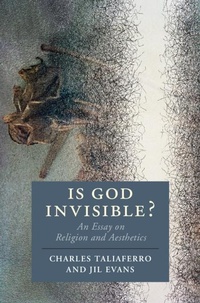
Is God Invisible?
An Essay on Religion and Aesthetics
Published on 31. March 2021
978-1-108-59790-6 (ISBN)
Description

In this volume, Charles Taliaferro and Jil Evans promote aesthetic personalism by examining three domains of aesthetics - the philosophy of beauty, aesthetic experience, and philosophy of art - through the lens of Judaism, Christianity, Islam, theistic Hinduism, and the all-seeing Compassionate Buddha. These religious traditions assume an inclusive, overarching God's eye, or ideal point of view, that can create an emancipatory appreciation of beauty and goodness. This appreciation also recognizes the reality and value of the aesthetic experience of persons and deepens the experience of art works. The authors also explore and contrast the invisibility of persons and God. The belief that God or the sacred is invisible does not mean God or the sacred cannot be experienced through visual and other sensory or unique modes. Conversely, the assumption that human persons are thoroughly visible, or observable in all respects, ignores how racism and other forms of bias render persons invisible to others.
Reviews / Votes
'The theme of this book is unusual and important, and is impressive in its combination of art, philosophy, and religion. Readable, attractive, and interesting, it is an excellent contribution by major scholars to this series.' Keith Ward, University of Roehampton and Christ Church College, Oxford University 'Rich, inventive and multi-layered, Is God Invisible brims with ideas and insights drawn from philosophy and several religious traditions. The comparison between the invisiblility and visibility of God in the world and our own visibility and invisibility to each other through our personal embodiment is highly suggestive. The subsequent discussion of the way works of art can reveal our values and minds, including aspects of a time or culture which, though evident to an all-seeing God, may be hidden to us, is interesting. In sum, a book which will repay study and reflection on many levels.' Anthony O'Hear, University of Buckingham 'This engaging book reflects conversations between the authors - an artist and a philosopher - and with others who offer alternative proposals. A prodigious amount and quality of research establishes the authors' claim that a 'God's eye view,' the 'view from everywhere,' is central to five world religions and secular naturalism, establishing an intimate connection, 'an aesthetic personalism,' at the core of aesthetic and religious experience. Is God Invisible? demonstrates that thinking that God is not a visual object 'does not preclude the idea that God is manifested in visual and other modes of experience.' For the reader, the take-away is enriched and integrated experience that heals the Western tendency to distinguish and thus, in effect to separate religious and aesthetic experience.' Margaret Miles, Emerita Professor of the History of Christianity The Graduate Theological Union, Berkeley 'What does it mean to describe God as invisible? How does this relate to God's transcendence? And in what sense, if any, can God be manifested in experience? Taliaferro and Evans offer an important, timely, and original contribution to these pressing questions, writing with erudition, enthusiasm, and depth, and engaging with a huge variety of thinkers and artists who have engaged with the relevant issues. Their approach is truly interdisciplinary, it cuts across the supposed distinction between analytic and continental philosophy, and it offers a compelling framework in terms of which to comprehend the relation between self and God. This remarkable book is a must-read for anyone interested in philosophy of religion, theology, aesthetics, and the question of life's meaning.' Fiona Ellis, University of Roehampton 'This book offers valuable conceptual resources to challenge the idea that secular worlds are (at least) equal in truth and value to religious worlds.' Clare Carlisle, Times Literary Supplement 'This is an important and creative work which suggests fresh ways to think about how the invisible - whether human or divine persons - can be encountered through what is seen.' Harold A. Netland, Religious Studies Review '... the book is a worthwhile project and repays reading, it is both refreshing to have so many insights brought together and very worthwhile to consider the big picture the authors offer.' Mikolaj Slawkowski-Rode, The Philosophical QuarterlyMore details
Series
Language
English
Place of publication
Cambridge
United Kingdom
Target group
College/higher education
Professional and scholarly
Illustrations
Worked examples or Exercises
File size
12,44 MB
ISBN-13
978-1-108-59790-6 (9781108597906)
Copyright in bibliographic data and cover images is held by Nielsen Book Services Limited or by the publishers or by their respective licensors: all rights reserved.
Schweitzer Classification
Other editions
Additional editions
Book
04/2021
Cambridge University Press
€39.00
Shipment within 15-20 days
Book
04/2021
Cambridge University Press
€107.90
Shipment within 15-20 days
Persons
Content
Introduction: The View from Everywhere; 1. Aesthetic Personalism; 2. Is God Invisible?; 3. The Gates of Perception; 4. The Perception of Gates; 5. The Beautiful Gate; 6. Revealing and Concealing; 7. Public Perception of Religious and Art Objects; 8. A Personal Guide to the Aesthetic Experience of Works of Art; Epilogue.
