

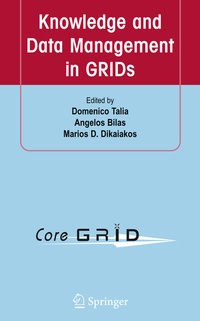
Knowledge and Data Management in GRIDs
Description

Data and knowledge play a key role in both current and future GRIDs. The issues concerning representation, discovery, and integration of data and knowledge in dynamic distributed environments can be addressed by exploiting features offered by GRID Technologies. Current research activities are leveraging the GRID for the provision of generic- and domain-specific solutions and services for data management and knowledge discovery.
Knowledge and Data Management in GRIDs is the third volume of the CoreGRID series and brings together scientific contributions by researchers and scientists working on storage, data, and knowledge management in GRID and Peer-to-Peer systems. This volume presents the latest GRID solutions and research results in key areas of knowledge and data management such as distributed storage management, GRID databases, Semantic GRID and GRID-aware data mining.
Knowledge and Data Management in GRIDs is designed for a professional audience, composed of researchers and practitioners in industry. This book is also suitable for graduate-level students in computer science.
Reviews / Votes
From the reviews:
"This edited book is an early attempt by primarily European researchers to harness and expand the use of grid technologies in accessing distributed sources for sharing, and also to extract and produce knowledge. . Overall, the book is well organized and the selected material represents a very interesting range of topics. The expected audience is academics with interests in distributed systems and databases, or grid practitioners who are interested in extending grid technologies to knowledge extraction management and data manipulation." (George Dimitoglou, Computing Reviews, January, 2008)
More details
Other editions
Additional editions
Content
1. Introduction (p. 20)
The Grid, as an emerging infrastructure for the discovery, access and use of distributed computational resources [15], offers new opportunities and raises new challenges in data management. Many aspects differentiate the Grid from a traditional distributed environment, such aspects include the large scale, dynamic, autonomous, and distributed nature of data sources.
A Grid can include related data resources maintained in different syntaxes, managed by different software systems, and accessible through different protocols and interfaces. Due to this diversity in data resources, one of the most demanding issue in managing data on Grids is reconciliation of data heterogeneity [8].
Therefore, in order to provide facilities for addressing requests over multiple heterogeneous data sources, it is necessary to provide data integration models and mechanisms.
Data integration is one of the most persistent problems that the database and information management community has to deal with. Although significant progress has been made in several aspects of data integration, the increase in availability of web-based data sources has led to new challenges. More specif- ically, efficient techniques have been developed and approaches have been devised to schema mediation languages, query answering algorithms, optimisation strategies, query execution policies, industrial development, and so on [17].
However, effective techniques for the generation and handling of semantic mappings are still in their infancy. The need for semantic correlation of data sources is particularly felt in Grid settings. Moreoever, in a Grid, a centralized structure for coordinating all the nodes may not be practical because it can be- come a bottleneck and, more importantly, it cannot accommodate the dynamic and distributed nature of Grid resources.
Data access and integration services have been attracting significant interest from the Grid community. Data Grids that rely on the coordinated sharing of and interaction across multiple autonomous database management systems play a key role in many industrial and scientific initiatives. To this end, middleware services have been developed.
Two notable examples are the OGSA Data Access and Integration (OGSA-DAI) [6] and the OGSA Distributed Query Processor (OGSA-DQP)' [5,4] projects. These projects have moved toward a servide-oriented architecture quite early in their lifecycle. OGSA-DAI exposes database management systems (including Oracle, MySQL, SQLServer, DB2, and so on) in a uniform way, whereas OGSA-DQP provides distributed query processing functionalities on top of OGSA-DAI. As such, OGSA-DQP can combine and integrate data from multiple data sources. To enhance performance, it employs parallel query execution techniques, nevertheless it relies on the user for the semantic interpretation of the data and does not address any schema integration requirements.
To date, only few projects (e.g., [ l l , 91) actually meet the schemaintegration requirements that are necessary for establishing semantic connections among heterogeneous data sources. To address this limitation, the use of the XMAP framework for integrating heterogeneous data sources distributed over a Grid has been proposed [12] .
