

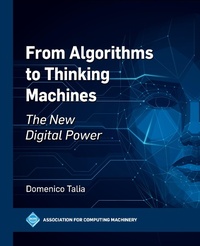
From Algorithms to Thinking Machines
Description

This book introduces and provides an analysis of the basic concepts of algorithms, data, and computation and discusses the role of algorithms in ruling and shaping our world. It provides a clear understanding of the power and impact on humanity of the pervasive use of algorithms.
From Algorithms to Thinking Machines combines a layman's approach with a well-founded scientific description to discuss both principles and applications of algorithms, Big Data, and machine intelligence. The book provides a clear and deep description of algorithms, software systems, data-driven applications, machine learning, and data science concepts, as well as the evolution and impact of artificial intelligence.
After introducing computing concepts, the book examines the relationships between algorithms and human work, discussing how jobs are being affected and how computers and software programs are influencing human life and the labor sphere. Topics such as value alignment, collective intelligence, Big Data impact, automatic decision methods, social control, and political uses of algorithms are illustrated and discussed at length without excessive technical detail. Issues related to how corporations, governments, and autocratic regimes are exploiting algorithms and machine intelligence methods to influence people, laws, and markets are extensively addressed. Ethics principles in software programming and human value insertion into artificial intelligence algorithms are also discussed.
More details
Person
Domenico Talia is a professor of computer engineering at the University of Calabria and an honorary professor at Amity University. His research interests include big data analysis, cloud computing, machine learning, social data mining, parallel and distributed data analysis, mobile computing, and parallel programming. Talia has published 12 books and more than 400 research papers, and is a senior member of ACM and IEEE.
Content
- Intro
- Cover
- Halftitle
- Title Page
- Copyright Page
- Dedication
- Contents
- Prologue
- Acknowledgments
- References
- Chapter 1 Algorithms-From Mathematics to People
- 1.1 Introducing Algorithms
- 1.2 Babylonian Algorithms
- 1.3 Other Ancient Algorithms
- 1.4 Euclid's Algorithm
- 1.5 Fibonacci and His Numbers
- 1.6 A Few Simple Examples of Algorithms
- 1.7 Algorithms and Computers
- 1.8 Algorithms and the Internet
- 1.9 Algorithms in Our Daily Life
- References
- Chapter 2 From Algorithms to Software
- 2.1 Hilbert, Gödel, and Turing
- 2.2 John von Neumann and the EDVAC
- 2.3 Bit, Bytes, and Boolean Algebra
- 2.4 Programs and Software
- 2.5 High-level Languages, Concepts, and Evolution
- 2.6 Source and Executable Code
- 2.7 Software Applications
- References
- Chapter 3 Algorithms and Data-The Pillars of Our Future
- 3.1 Data Storing and Abstract Structures
- 3.2 Data in Files
- 3.3 Data in Databases
- 3.4 Data in the Web
- 3.5 The Era of Big Data
- 3.6 Data Science
- 3.7 Data-intensive Applications
- References
- Chapter 4 The Age of Machine Intelligence
- 4.1 Machine Intelligence
- 4.2 Birth and Evolution of Artificial Intelligence
- 4.3 Learning from Data
- 4.4 Machine Learning Algorithms
- 4.5 Neural Networks and Deep Learning Models
- References
- Chapter 5 Living with Algorithms
- 5.1 Algorithms in Our Lives
- 5.2 Software Intelligence in Searching the Web
- 5.3 Social Media Algorithms
- 5.4 Programming Self-driving Cars
- 5.5 Intelligent Algorithms at School
- 5.6 Algorithmic Art
- References
- Chapter 6 Working with Algorithms
- 6.1 Machine Intelligence for the Fourth Industrial Revolution
- 6.2 Everytime Workers
- 6.3 Working with Robots
- 6.4 AI Algorithms and Gig Workers
- 6.5 Learning Algorithms for Healthcare
- 6.6 AI for Energy and Green AI
- 6.7 AI for Finance and Trading
- 6.8 AI in the Public Sector
- References
- Chapter 7 Algorithm Biases and Values
- 7.1 Human Values in Automatic Procedures
- 7.2 Human Biases and Algorithms
- 7.3 Algorithmic Biases
- 7.4 Toward Responsible Algorithms
- 7.5 Biases in Data
- 7.6 Ethics in Software
- 7.7 Human Alignment of AI
- References
- Chapter 8 Algorithms and Politics
- 8.1 Algorithms, Information, and Democracy
- 8.2 Digitalization of Politics
- 8.3 Algorithmic Hegemony
- 8.4 Marcuse and the Digital Man
- 8.5 Political Influence
- 8.6 Politicians Replaced by AI?
- References
- Chapter 9 Ruling Algorithms
- 9.1 From Surveillance Capitalism to Politics
- 9.2 AI Technology for Citizens' Surveillance
- 9.3 Algocracy
- 9.4 Governmentality and Algorithms
- 9.5 The Chinese Social Credit System and Similar Systems
- References
- Chapter 10 Ruling Algorithms
- 10.1 Introduction to Algorithm Accountability
- 10.2 Algorithm Transparency and Opacity
- 10.3 Explainability of AI Algorithms
- 10.4 Some Final Remarks
- References
- Chapter 11 The Non-computable
- 11.1 The Limits of Computation
- 11.2 Other Non-computable Problems
- 11.3 On the Computability of Machine and Human Intelligence
- 11.4 A Few Final Remarks
- References
- Author's Biography
- Index
