

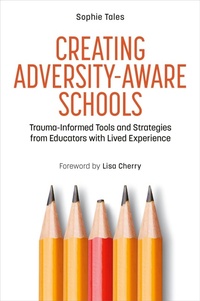
Creating Adversity-Aware Schools
Trauma-Informed Tools and Strategies from Educators with Lived Experience
Published on 18. July 2024
176 pages
978-1-83997-494-6 (ISBN)
Description

*Highly commended in the CPD category for the Teach Awards 2024*
The impact of Adverse Childhood Experiences lie behind many of the most common and bewildering classroom challenges today.
Understanding the why behind students' behaviour can be transformative in shifting school behaviour, as well as the welfare of your students. This book is grounded in the lived experiences of educators who overcame challenges in early life. It combines their insights with easy to implement tools, worksheets and resources drawing on proven Restorative Practice, Transactional Analysis, Cognitive Behavioural Therapy approaches. It will provide you with a fresh perspective - to see what is really going on in your classroom - and will give you the confidence to provide the support your students really need in order to thrive.
Whether you are a school leader, teacher or classroom assistant; primary or secondary; in mainstream, SEND or alternative provision, this book will help you to create positive change.
The impact of Adverse Childhood Experiences lie behind many of the most common and bewildering classroom challenges today.
Understanding the why behind students' behaviour can be transformative in shifting school behaviour, as well as the welfare of your students. This book is grounded in the lived experiences of educators who overcame challenges in early life. It combines their insights with easy to implement tools, worksheets and resources drawing on proven Restorative Practice, Transactional Analysis, Cognitive Behavioural Therapy approaches. It will provide you with a fresh perspective - to see what is really going on in your classroom - and will give you the confidence to provide the support your students really need in order to thrive.
Whether you are a school leader, teacher or classroom assistant; primary or secondary; in mainstream, SEND or alternative provision, this book will help you to create positive change.
More details
Edition
Digital original
Language
English
Place of publication
London
United Kingdom
Target group
College/higher education
Professional and scholarly
Edition type
Digital original
Illustrations
B&W
ISBN-13
978-1-83997-494-6 (9781839974946)
Copyright in bibliographic data and cover images is held by Nielsen Book Services Limited or by the publishers or by their respective licensors: all rights reserved.
Schweitzer Classification
Other editions
Additional editions
Sophie Tales
Creating Adversity-Aware Schools
Trauma-Informed Tools and Strategies from Educators with Lived Experience
Book
07/2024
Jessica Kingsley Publishers
€23.50
Shipment within 3-4 weeks
Persons
Sophie Tales is the Vice Principal of a primary school in Leicester. She has a background as a leader within special, secondary and primary education settings
Content
- Intro
- Creating Adversity-Aware Schools
- Cover
- Of related interest
- Title Page
- Copyright
- Contents
- Figures
- Foreword by Dr Lisa Cherry
- Acknowledgements
- Preface
- 1. Adverse Childhood Experiences
- Physical and mental implications of ACEs
- Covid-19 as a generational adverse childhood experience
- Neurodivergence and adverse childhood experiences
- Summary and conclusions
- 2. Safety
- Case example of safety-seeking behaviours
- Physical safety
- Seating plans
- Personal space
- Self-regulation support
- Conscious breathing
- Physical restraint
- Emotional safety
- Timetables
- Sharing emotions
- Scaling
- Relational safety
- Behaviour policy
- Learning expectations
- Confident teachers
- Approachable teachers
- Relational curiosity
- Reflective activities: safety
- 3. Communication
- Case example of communication-seeking behaviours
- Behaviour
- Finding the why behind behaviour
- Reasonable adjustments
- Deviating from the norm
- Building a communication toolkit
- Transactional analysis
- The Considered Communication Model in practice
- Carers and services
- Communication with carers
- Intergenerational trauma
- Communication with services
- Curriculum
- The limbic system
- Trauma and the limbic system
- Teaching children about the limbic system
- Teaching staff about the limbic system
- Teaching staff how to apply their knowledge of the limbic system
- Reflective activities: Communication
- 4. Connection
- Case example of connection-seeking behaviours
- Home visits
- The importance of home visits
- Questions to consider
- Home visits as a universal offer
- Risk assessments
- Carer training
- Knowledge is power
- External agencies
- Including the carer in interventions
- Staff connection
- The power of sharing
- The purpose of sharing
- What to share
- How to share
- Whether to share
- Reflective activities: Connection
- 5. Belonging
- Case example of belonging-seeking behaviours
- School values
- Who 'we' are
- What 'we' stand for
- Zones of School Belonging
- Uniform
- Looking the part
- Acceptance
- Getting it wrong
- Considering exclusion
- Knowing the system
- Group decisions
- Reflective activities: Belonging
- 6. Identity
- Case example of identity-seeking behaviours
- Unique values
- Identity at the centre
- Individual values and behaviours
- Adversity as part of identity
- Supportive challenge
- Careers
- Outside the comfort zone
- Reward qualities
- Specific praise
- Space for identity
- Reflective activities: Identity
- Afterword
- References
