

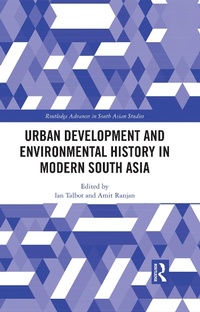
Urban Development and Environmental History in Modern South Asia
1st Edition
Published on 4. November 2022
206 pages
978-1-000-77981-3 (ISBN)
Description

This book provides a pioneering study of the historical interaction between the city and the natural environment from the colonial to the contemporary era in South Asia.
The book provides a multidisciplinary analysis examining the environmental history of the city and bringing together contributions from environmental experts and practitioners as well as academics. Focusing on case studies stretching from the Maldives and Sri Lanka to the Indian subcontinent, the chapters trace linkages between the contemporary and earlier patterns of urban expansion and their environmental effects and consider lessons that can be drawn with respect to preventing future environmental degradation and mitigating the effects of climate change.
An important contribution to the field, this book studies the contemporary environmental issues arising from rapid South Asian urbanization. It will be of interest to researchers in the field of South Asian studies, world history, and environmental history.
The book provides a multidisciplinary analysis examining the environmental history of the city and bringing together contributions from environmental experts and practitioners as well as academics. Focusing on case studies stretching from the Maldives and Sri Lanka to the Indian subcontinent, the chapters trace linkages between the contemporary and earlier patterns of urban expansion and their environmental effects and consider lessons that can be drawn with respect to preventing future environmental degradation and mitigating the effects of climate change.
An important contribution to the field, this book studies the contemporary environmental issues arising from rapid South Asian urbanization. It will be of interest to researchers in the field of South Asian studies, world history, and environmental history.
More details
Series
Edition
1. Auflage
Language
English
Place of publication
London
United Kingdom
Publishing group
Taylor & Francis Ltd
Target group
College/higher education
Product notice
Reflowable
Illustrations
9 Tables, black and white; 14 Halftones, black and white; 14 Illustrations, black and white
ISBN-13
978-1-000-77981-3 (9781000779813)
Copyright in bibliographic data and cover images is held by Nielsen Book Services Limited or by the publishers or by their respective licensors: all rights reserved.
Schweitzer Classification
Other editions
Additional editions
Ian Talbot | Amit Ranjan
Urban Development and Environmental History in Modern South Asia
Book
08/2024
1st Edition
Routledge
€62.00
Shipment within 10-20 days
Ian Talbot | Amit Ranjan
Urban Development and Environmental History in Modern South Asia
Book
11/2022
1st Edition
Routledge
€185.90
Shipment within 10-20 days
Persons
Ian Talbot is Emeritus Professor in History of Modern South Asia at the University of Southampton, UK. He has published ten monographs and three jointly written volumes. His most recent publications include The History of British Diplomacy in Pakistan (Routledge 2021), Punjab and the Raj (2020), A History of Modern South Asia (2016), and Colonial Lahore: a History of the City and Beyond (co-written with Tahir Kamran, 2016). He has jointly edited numerous volumes and produced an extensive number of periodical articles.
Amit Ranjan is Research Fellow at the Institute of South Asian Studies, National University of Singapore. His latest book is Contested Waters: India's Transboundary River Water Disputes in South Asia (Routledge 2020). He is the author of India-Bangladesh Border Disputes: History and Post-LBA Dynamics (2018) and has edited India in South Asia Challenges and Management (2019), Water Issues in Himalayan South Asia: Internal Challenges, Disputes and Transboundary Tensions (2020), and Partition of India: Postcolonial Legacies (Routledge, 2019). In addition to academic articles, he has also written short pieces for the Wire, the Friday Times, the Citizen, and Prabhat Khabar.
Amit Ranjan is Research Fellow at the Institute of South Asian Studies, National University of Singapore. His latest book is Contested Waters: India's Transboundary River Water Disputes in South Asia (Routledge 2020). He is the author of India-Bangladesh Border Disputes: History and Post-LBA Dynamics (2018) and has edited India in South Asia Challenges and Management (2019), Water Issues in Himalayan South Asia: Internal Challenges, Disputes and Transboundary Tensions (2020), and Partition of India: Postcolonial Legacies (Routledge, 2019). In addition to academic articles, he has also written short pieces for the Wire, the Friday Times, the Citizen, and Prabhat Khabar.
Content
List of Figures
List of Tables
List of Contributors
Preface
Acknowledgements
Introduction
IAN TALBOT AND AMIT RANJAN
PART 1
Urban Pasts, Contemporary Legacies
1 Partition, the Environment, and the Early Post-Independence Development of Lahore
IAN TALBOT
2 Written in Stone: Political Geologies of Small-Town India
THOMAS CROWLEY
3 A Shift From the "Devotional" to the "Natural" in Nineteenth-Century Lahore's Art Education
TAHIR KAMRAN
4 Building With a Conscience? Heritage, Design and Urban Space in Bombay
MANJIRI KAMAT
PART 2
The City and River Management
5 The Hooghly River and the Incomplete Mastery of the Natural World in British Colonial India
ROBERT IVERMEE
6 Political Economy of Dams in Colonial and Early Postcolonial India
AMIT RANJAN
7 Locating the Riparian Commons in Eastern South Asia: A Translocal Perspective
IFTEKHAR IQBAL
PART 3
Urban Growth in a Fragile Environment
8 Evolving Islandscapes in a Changing Climate: Male' City, Maldives
MIZNA MOHAMED AND MOHAMED INAZ
9 Analysing Human-Environment Coexistence: Urban Development and the Colombo Wetland Complex
DENNIS MOMBAUER AND VOSITHA WIJENAYAKE
10 Vanishing Rains: Deforestation, Declining Rainfall, and Desiccation in North East India With Special Reference to Cherrapunji, the "Rainiest Spot on the Globe"
SAJAL NAG
11 Reconstructing Thimphu: Balancing Tradition and Transition in Bhutan
SUSAN M. WALCOTT
Index
List of Tables
List of Contributors
Preface
Acknowledgements
Introduction
IAN TALBOT AND AMIT RANJAN
PART 1
Urban Pasts, Contemporary Legacies
1 Partition, the Environment, and the Early Post-Independence Development of Lahore
IAN TALBOT
2 Written in Stone: Political Geologies of Small-Town India
THOMAS CROWLEY
3 A Shift From the "Devotional" to the "Natural" in Nineteenth-Century Lahore's Art Education
TAHIR KAMRAN
4 Building With a Conscience? Heritage, Design and Urban Space in Bombay
MANJIRI KAMAT
PART 2
The City and River Management
5 The Hooghly River and the Incomplete Mastery of the Natural World in British Colonial India
ROBERT IVERMEE
6 Political Economy of Dams in Colonial and Early Postcolonial India
AMIT RANJAN
7 Locating the Riparian Commons in Eastern South Asia: A Translocal Perspective
IFTEKHAR IQBAL
PART 3
Urban Growth in a Fragile Environment
8 Evolving Islandscapes in a Changing Climate: Male' City, Maldives
MIZNA MOHAMED AND MOHAMED INAZ
9 Analysing Human-Environment Coexistence: Urban Development and the Colombo Wetland Complex
DENNIS MOMBAUER AND VOSITHA WIJENAYAKE
10 Vanishing Rains: Deforestation, Declining Rainfall, and Desiccation in North East India With Special Reference to Cherrapunji, the "Rainiest Spot on the Globe"
SAJAL NAG
11 Reconstructing Thimphu: Balancing Tradition and Transition in Bhutan
SUSAN M. WALCOTT
Index
