

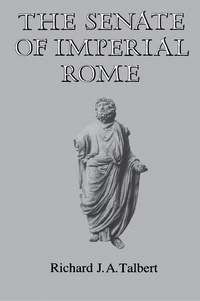
The Senate of Imperial Rome
1st Edition
Published on 31. January 2022
606 pages
978-1-4008-4976-5 (ISBN)
Description

Richard J. A. Talbert examines the composition, procedure, and functions of the Roman senate during the Principate (30 B.C.-A.D. 238). Although it is of central importance to the period, this great council has not previously received such scholarly treatment. Offering a fresh approach to major ancient authors (Pliny and Tacitus in particular), the book also draws on inscriptions and legal writers never before fully exploited for the study of the senate.
More details
Other editions
Additional editions
Book
10/1987
Princeton University Press
€58.20
Article not available at the moment
Richard J.A. Talbert
The Senate of Imperial Rome
Book
07/1984
Princeton University Press
€86.66
Article exhausted; check different version
Person
Richard J.A. Talbert
Content
- Cover Page
- Half-title Page
- Title Page
- Copyright Page
- Dedication Page
- Contents
- List of Illustrations
- Preface
- Abbreviations
- Introduction
- Part One. The Corporate Body
- Chapter 1. The Senate
- 1. Entry
- 2. Advancement
- 3. Withdrawal and restoration
- 4. Composition
- Chapter 2. Senators
- 1. Legal position
- 2. Wealth
- 3. Financial obligations
- 4. Other demands
- 5. Avoidance of a senatorial career by qualified equites
- 6. Estimates of the senate and senators
- Part Two. Sessions
- Chapter 3 . Meeting Places and The Interior of The Curia Julia
- 1. Meeting places
- 2. Seating arrangements and the interior of the Curia Julia
- 3. Senate House staff
- Chapter 4. Attendance
- 1. The total number of senators
- 2. Members' attendance
- 3. Retirement age
- 4. Arms, soldiers, and other non-members
- Chapter 5. The Emperor In The Senate
- 1. The emperor's position
- 2. Attendance and participation by the emperor
- Chapter 6. Routine
- 1. Summons
- 2. Time and duration of sessions
- 3. Confidentiality of sessions
- 4. The annual calendar of business
- 5. Senatorial dress
- Chapter 7. Procedure
- 1. Lex Julia
- 2. Religious ceremonial
- 3. The opening of sessions
- 4. The language of proceedings
- 5. Speeches of thanks
- 6. Communications
- 7. Permission to speak first
- 8. Relatio
- 9. Explanation ("verba facere")
- 10. Interrogatio
- 11. The order in which members were called
- 12. The participation of junior members
- 13. The need to reply
- 14. Delivery of sententiae
- 15. Scope of sententiae
- 16. The right to speak "off the question
- 17. Withdrawal of sententiae
- 18. Delivery of sententiae on oath
- 19. Character of debate
- 20. Expression of feeling
- 21. Style of speaking
- 22. Personal abuse
- 23. The role of the president
- 24. Members' attention
- 25. The taking of votes
- 26. Delegation of business
- 27. Conclusion
- Chapter 8. Procedural Change In The Second Century
- Chapter 9. Records and Their Use
- 1. Form of senatus consulta
- 2. Publication of senatus consulta
- 3. Ada senatus
- 4. Ancient writers' use of acta senatus
- I. Suetonius, Dio, and others
- II. Tacitus
- 5. Known holders of the office ab actis senatus
- Part Three. Functions
- Chapter 10. Elections and The Lot
- 1. Magistracies
- 2. Priesthoods
- 3. The lot
- Chapter 11. Imperial Powers and Other Honors
- 1. Imperial powers and titles
- 2. Honors
- 3. Honorific months
- 4. Triumphs, ovations, triumphal honors, and salutation as imperator
- 5. Statues
- 6. Ornamenta
- 7. Public funeral
- Chapter 12. The Senate's Role In Administration
- 1. Public works and services
- 2. Finance
- 3. Coinage
- 4. Public order
- 5. Religion
- Chapter 1 3 . The Senate's Role In Administration (Continued)
- 6. Provinces
- Chapter 14. Diplomacy, The Army, and Foreign Affairs
- 1. Embassies from the senate
- 2. The reception of embassies and other diplomatic business
- 3. The army and foreign affairs
- Chapter 15. Senatorial Legislation
- 1. Senatus consulta to which titles are devoted in legal works
- 2. Ancient commentaries on senatus consulta and imperial orationes
- 3. Senatus consulta cited by name in legal works
- 4. Imperial orationes cited in legal works
- 5. Senatus consulta and imperial orationes
- A. Datable within a reign
- B. Measures of uncertain date
- I. Senatus consulta and oratio for which there is some indication of date
- II. Senatus consulta for which the earliest citation occurs in second-century jurists
- III. Senatus consulta for which the earliest citation occurs in jurists and imperial constitutions of the third century or later
- 6. General conclusions
- Chapter 16. The Senatorial Court
- 1. Character and scope of senatorial jurisdiction
- 2. Court procedure
- Chapter 17. Conclusion: The Changing Role of The Senate
- Appendices
- 1. Latin and Greek terms for the senate and senators
- 2. The appropriate capital for a senator
- 3. The date on which proconsuls began their year of office
- 4. The attribution of two anonymous speeches to the senate preserved on papyrus
- 5. The duration of hearings in the cases of Marius Priscus and Julius Bassus
- 6. Times of sunrise and sunset at Rome and hours of daylight
- 7. The behavior of M. Aquillius Regulus at the trial of Marius Priscus
- 8. Proconsuls known to have served extended terms
- 9. Table of repetundae cases
- 10. The Roman senate in Rabinnic literature
- Extended Notes
- Information For Non-Specialist Readers
- 1. The Roman emperors from Augustus to Gordian III
- 2. The senatorial magistracies (cursus honorum): a simplified summary
- 3. Glossary of technical terms
- Bibliography
- 1. Senators
- 2. Proconsuls and proconsular legates
- 3. General
- Index of Ancient Sources
- General Index
