

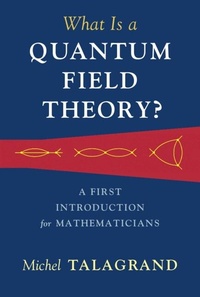
What Is a Quantum Field Theory?
Published on 6. April 2022
978-1-108-24711-5 (ISBN)
Description

Quantum field theory (QFT) is one of the great achievements of physics, of profound interest to mathematicians. Most pedagogical texts on QFT are geared toward budding professional physicists, however, whereas mathematical accounts are abstract and difficult to relate to the physics. This book bridges the gap. While the treatment is rigorous whenever possible, the accent is not on formality but on explaining what the physicists do and why, using precise mathematical language. In particular, it covers in detail the mysterious procedure of renormalization. Written for readers with a mathematical background but no previous knowledge of physics and largely self-contained, it presents both basic physical ideas from special relativity and quantum mechanics and advanced mathematical concepts in complete detail. It will be of interest to mathematicians wanting to learn about QFT and, with nearly 300 exercises, also to physics students seeking greater rigor than they typically find in their courses. Erratum for the book can be found at michel.talagrand.net/erratum.pdf.
Reviews / Votes
'This book accomplishes the following impossible task. It explains to a mathematician, in a language that a mathematician can understand, what is meant by a quantum field theory from a physicist's point of view. The author is completely and brutally honest in his goal to truly explain the physics rather than filtering out only the mathematics, but is at the same time as mathematically lucid as one can be with this topic. It is a great book by a great mathematician.' Sourav Chatterjee, Stanford University 'Talagrand has done an admirable job of making the difficult subject of quantum field theory as concrete and understandable as possible. The book progresses slowly and carefully but still covers an enormous amount of material, culminating in a detailed treatment of renormalization. Although no one can make the subject truly easy, Talagrand has made every effort to assist the reader on a rewarding journey though the world of quantum fields.' Brian Hall, University of Notre Dame 'A presentation of the fundamental ideas of QFT in a manner that is both accessible and mathematically accurate seems like an impossible dream. Well, not anymore! This book goes from basic notions to advanced topics with patience and care. It is an absolute delight to anyone looking for a friendly introduction to the beauty of QFT and its mysteries.' Shahar Mendelson, Australian National University 'I have been motivated to try and learn about quantum field theories for some time, but struggled to find a presentation in a language that I as a mathematician could understand. This book was perfect for me: I was able to make progress without any initial preparation, and felt very comfortable and reassured by the style of exposition.' Ellen Powell, Durham University 'In addition to its success as a physical theory, Quantum Field Theory (QFT) has been a continuous source of inspiration for mathematics. However, mathematicians trying to understand QFT must contend with the fact that some of the most important computations in the theory have no rigorous justification. This has been a considerable obstacle to communication between mathematicians and physicists. It is why despite many fruitful interactions, only very few people would claim to be well versed in both disciplines at the highest level. There have been many attempts to bridge this gap, each emphasizing different aspects of QFT. Treatments aimed at a mathematical audience often deploy sophisticated mathematics. Michel Talagrand takes a decidedly elementary approach to answering the question in the title of his monograph, assuming little more than basic analysis. In addition to learning what QFT is, the reader will encounter in this book beautiful mathematics that is hard to find anywhere else in such clear pedagogical form, notably the discussion of representations of the Poincare group and the BPHZ Theorem. The book is especially timely given the recent resurgence of ideas from QFT in probability and partial differential equations. It is sure to remain a reference for many decades.' Philippe Sosoe, Cornell University 'a wonderful resource for anyone who wants to understand exactly what a quantum field theory is.' Peter Woit, Not Even Wrong blog 'The text has many exercises and sixteen (!) appendices from which one can learn quite a bit. This shows the dedication of the author to the subject and his wish to share his knowledge with others. The book hits the point between mathematics and physics where the first is not too abstract and the second not too phenomenological ... In short, the book is exceptional and might set standards.' Marek Nowakowski, MathSciNet 'The text covers the fundamentals: quantum mechanics, spin, second quantisation, interactions and renormalisation. The book focuses not only on mathematical proof, but justifications of how and why we do things in quantum field theory. The text is well written enough that even a graduate physics student would benefit greatly from reading it.' Kymani Tieral Keden Armstrong-Williams, https://physicsbookreviewer.blogspot.com/ 'Assuming an undergraduate background in mathematics and just the fundamentals of physics, the reader will profit from a very broad and deep exploration of QFT. ... Recommended.' E. Kincanon, ChoiceMore details
Language
English
Place of publication
Cambridge
United Kingdom
Illustrations
Worked examples or Exercises
File size
5,86 MB
ISBN-13
978-1-108-24711-5 (9781108247115)
Copyright in bibliographic data and cover images is held by Nielsen Book Services Limited or by the publishers or by their respective licensors: all rights reserved.
Schweitzer Classification
Other editions
Additional editions
Book
03/2022
Cambridge University Press
€106.20
Shipment within 15-20 days
Content
Introduction; Part I. Basics: 1. Preliminaries; 2. Basics of non-relativistic quantum mechanics; 3. Non-relativistic quantum fields; 4. The Lorentz group and the Poincare group; 5. The massive scalar free field; 6. Quantization; 7. The Casimir effect; Part II. Spin: 8. Representations of the orthogonal and the Lorentz group; 9. Representations of the Poincare group; 10. Basic free fields; Part III. Interactions: 11. Perturbation theory; 12. Scattering, the scattering matrix and cross sections; 13. The scattering matrix in perturbation theory; 14. Interacting quantum fields; Part IV. Renormalization: 15. Prologue - power counting; 16. The Bogoliubov-Parasiuk-Hepp-Zimmermann scheme; 17. Counter-terms; 18. Controlling singularities; 19. Proof of convergence of the BPHZ scheme.
