

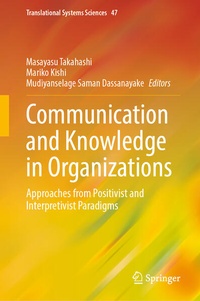
Communication and Knowledge in Organizations
Description

This book is an ambitious research work that incorporates recent findings on communication and knowledge in organizations and includes contributions from global researchers. It brings together researchers from various countries who are active in this field and describes research on communication and knowledge that considers the development of ICT under the positivist paradigm (Part I) as well as research on communication and knowledge that focuses on language under the interpretivist paradigm (Part II). By approaching research on communication and knowledge in organizations using these two paradigms, this book presents a clear and energetic overview of the characteristics of both.
More details
Other editions
Additional editions
Persons
Dr. Masayasu Takahashi, who has reached retirement age at Meiji University's School of Business Administration in Japan. He serves as a Visiting Professor at both The Graduate School of Tokyo Fuji University and The Graduate School for the Creation of New Photonics Industries. Additionally, Dr. Takahashi is the Chairperson and Professor at The Institute of Organization Discourse, and holds positions as a Special Researcher at the Research Institute of Economics and Management, Gakushuin University, and a Research Fellow at the Institute of Modern Business, Showa Women's University. He is also a Visiting Researcher at The Organization for the Strategic Coordination of Research and Intellectual Properties at Meiji University.
Dr. Mariko Kishi is a Professor at Hollywood Graduate School of Beauty Business, Japan, and holds the title of Professor Emeritus at Hosei University, Japan. She also serves as a Visiting Professor at both The Open University of Japan and The Graduate School for the Creation of New Photonics Industries, Japan.
Dr. Mudiyanselage Saman Dassanayake is a Professor (non-tenured) at the Graduate School of Business Administration (GSBA), Meiji University, Japan.
Content
Part 1. Approach From Positivist Paradigm.- Chapter 1. The Value of Corporate History as "Organizational Explicit Knowledge" (Kishi and Fujii).- Chapter 2. Generation Y Employees' Understandings on Artificial Intelligence (AI): Interventions at Workplace (Kodagoda).- Chapter 3. Knowledge-Based Career and Subjective Career Success: From the Career Capital Perspective (Jung).- Chapter 4. Organizational Rationality and the Threat of Information (Hayashi).- Chapter 5. Corporate Financial Consequences of Corporate Scandal: The Case of Japan (Akimov et al).- Chapter 6. Effective Leadership and Leadership Communication in the Era of Digitalization (Kim).- Chapter 7. Marriage between Sustainability and Business Strategy in Organizations: What is the Role of HRM (and HRD) and Communication? (Dassanayake).-Part 2. Approach From Interpretivist Paradigm.- Chapter 8. Discourse, Communication, and Knowledge in Organizations (Takahashi).- Chapter 9. Unlocking Organizational Potential: The Role of Narrative Identity (Samaratunge and Wijewardena).- Chapter 10. Ima Koko (Here and Now) Communication in the Quantum Age (Masuda).- Chapter 11. Knowledge and Communication as "Power Apparatus" in Japanese Organizations (Fukuhara).- Chapter 12. Power of Knowledge and Communication: Townscape Preservation and Modernization in Japan's Historic Tourist Attractions (Takagi and Fujioka).- Chapter 13. The Camel, the Lion, and the Child - Metamorphoses, Perversions, and Trajectories in Cross-cultural Encounters (Lennerfors).- Chapter 14. The Discourse of Commodification and the Commodification of Discourse: Distortion of Communication in Neoliberal Capitalism (Kiyomiya).
