

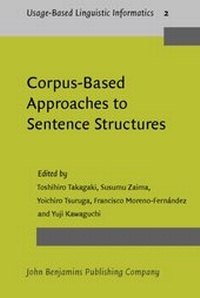
Corpus-Based Approaches to Sentence Structures
1st Edition
Published on 14. April 2005
VI, 317 pages
978-90-272-9441-8 (ISBN)
Description

This is the second volume of the series "Usage-Based Linguistic Informatics", a product of the 21st century COE program held at Tokyo University of Foreign Studies (TUFS). The project has an objective to realize an integration of theoretical and applied linguistics on the basis of computer sciences. With a view to practically applying the results of linguistic analysis to language education, the promotion of individual language research has become a high-priority issue. A new field of linguistic research is intended to be developed by elucidating the state of linguistic usage based on the analysis of large amounts of linguistic data. The volume, thus, consists mainly of language-specific corpus-based analyses on sentence structures in ten different languages such as Nuuchahnulth, Korean, Chinese, Malay, Turkish, Arabic, Russian, French, English and Spanish. It also includes papers that deal with various theoretical issues in contrastive linguistics and typology.
More details
Other editions
Additional editions
Toshihiro Takagaki | Susumu Zaima | Yoichiro Tsuruga
Corpus-Based Approaches to Sentence Structures
Book
04/2005
John Benjamins Publishing Co
€100.70
Shipment within 10-15 days
Persons
Content
- Corpus-Based Approaches to Sentence Structures
- Editorial page
- Title page
- LCC data
- Contents
- Opening Address
- Center of Usage-Based Linguistic Informatics (UBLI)
- 1. Linguistic Informatics
- 2. Organization and Research Projects
- 3. TUFS Language Modules
- 4. First International Conference on Linguistic Informatics
- Preface
- Argument Structure in Discourse - Argument Choice in Possessive Constructions in Nuuchahnulth -
- 1. Introduction
- 2. Nature of the alternation
- 3. Distribution of possessive constructions
- 4. Conclusion
- References
- Grammatical Markers in Early Baihua and Late Mediaeval Korean in Mengshan's Sayings
- 1. Introduction
- 2. Mengshan's Sayings and its Korean Version
- 3. Affixation
- 4. Resultative verb compounds
- 5. Potentiality
- 6. Complex stative construction
- 7. Aspect markers
- 8. Sentence-Final Particles
- 9. Nominalizer
- 10. Preposition
- 11. Serial verb constructions
- 12. Causative constructions
- 13. Classifiers
- 14. Conclusion
- Notes
- Transliteration
- References
- When Words Form Sentences: Linguistic Field Theory
- 1. Introduction
- 2. Language Hierarchy Structure
- 3. Verbs, Word-combinations, Clauses, and Verbal Aspect
- 4. From Morphology to Syntax, then to Supra-Morpho-Syntax: Linguistic Field Morphology
- 5. Conclusion: Linguistic Field Hypothesis and Supra-Morpho-Syntax
- References
- A Usage-Based Analysis of the Causative Verb shi in Mandarin Chinese
- 1. Introduction
- 2. Causal chain between two events
- 3. Some features of the "?" causative construction
- 4. The nature of the subject in the "?" causative construction
- 5. Conclusion
- References
- A Typology of Languages Based on Valence/Voice-marking and Focus
- I. What is the Verb?
- II. What is the Subject? --- Selection of a Noun and Resulting Verb Metamorphosis
- III. What is Focus or Topic? --- Selection of a Noun by Discourse and the Resulting Syntactic Change on the Verb
- IV. The Difference Between the Topic Particle in Japanese and the Focus System in the Philippine-Formosan Aboriginal Languages
- V. Word Order in Chinese and Focus or Topic Among Japanese and Philippine-Formosan Aboriginal Languages
- VI. Topic, Cleft Sentence, and Passive in European languages
- VII. Intransitive Sentence and Passivization
- VIII. On Subjectivization. Preposing or Word-order Topic and Focalization, and their Typological Meaning.
- XI. Conclusion
- References
- Manner Adverb-like Adjectives in Malay
- 1. Introduction
- 2. Features Differentiating AP Complement Sentences
- 3. Distinction between Adjectives and Adverbs
- 4. Extractability of Complement Sentence Object
- 5. Conclusion
- References
- Two Turkish Clause Linkages: -DIK- and -mE-
- Introduction
- 1. Opposition of -DIK and -mE-
- 2. A Corpus-Based Analysis
- 3. Semantics of -DIK- and -mE-
- 4. Conclusion
- References
- Appendix
- Semi-Productivity and Valence Marking in Arabic -The So-Called "verbal themes"-
- 1. The Problem
- 2. Examples and Problems
- 3. Conclusion and a thought for further research
- References
- The Imperfective Passive and Animacy in Russian
- Introduction
- 1.0. Expression of voice in Russian
- 2. Overview of previous work
- 3. Imperfective constructions with animate subjects
- 4. Conclusion
- Acknowledgments
- Notes
- References
- Dictionaries
- A Correspondence between N0-V-N1-de-N2 and N0-V-N2-Loc-N1 in French -The Case of Planter-
- Introduction
- 1. Sentences and phrases of planter
- 2. The 13 verbs of the subclass
- 3. Classification of LADL
- 4. Conclusion
- References
- Corpus
- Annexe
- Verb Constructions in English and Japanese
- 1. The primacy of SVO in English: cause-effect dynamics
- 2. Marked constructions and subjectivity: passives and non-canonical word order
- 3. Particle/metaphorical constructions and state
- 4. Dual functions of the subject in English
- 5. Wa-construction in Japanese: universality of topic-comment structure
- 6. The primacy of V in Japanese: empathy and distance
- 7. Ni as the marker of adjacent other
- 8. Mimic expressions and state
- 9. Conclusion
- References
- Verb Forms in the Lest-Clause in Present-Day English
- 1. Introduction
- 2. Lest in Present-day American and British English
- 3. Lest in the British National Corpus
- 4. Conclusion
- References
- Project for the Sociolinguistic Study of Spanish from Spain and America (PRESEEA)
- 1. Introduction
- 2. Background issues
- 3. Methodological issues
- 4. Data collection: looking for grammar and discourse materials
- 5. Conclusion
- References
- On the Productivity of the Spanish Passive Constructions
- 1. Low productivity of the periphrastic passive
- 2. Properties of the passive with ser and the passive with se
- 3. Aspect in tense forms and lexical aspect
- 4. Occurrences of the passive constructions-Corpus findings
- 5. Conclusion
- Notes
- References
- Index of Proper Nouns
- Index of Subjects
- Contributors
