

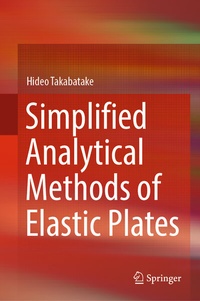
Simplified Analytical Methods of Elastic Plates
Description

This book presents simplified analytical methodologies for static and dynamic problems concerning various elastic thin plates in the bending state and the potential effects of dead loads on static and dynamic behaviors. The plates considered vary in terms of the plane (e.g. rectangular or circular plane), stiffness of bending, transverse shear and mass. The representative examples include void slabs, plates stiffened with beams, stepped thickness plates, cellular plates and floating plates, in addition to normal plates. The closed-form approximate solutions are presented in connection with a groundbreaking methodology that can easily accommodate discontinuous variations in stiffness and mass with continuous function as for a distribution. The closed-form solutions can be used to determine the size of structural members in the preliminary design stages, and to predict potential problems with building slabs intended for human beings' practical use.
More details
Other editions
Additional editions
Person
Hideo Takabatake is a professor and a advisor of Institute of Disaster and Environmental Science at Kanazawa Institute of Technology, Japan. After completing the doctoral course at Kyoto University graduate school in 1973, he received a doctorate degree in engineering from Nagoya University in 1979.He has been a professor at Kanazawa Institute of Technology from 1978 until now. Concurrent post of director (2008-2017) and advisor (2017-2018) at Institute of Disaster and Environmental Science. He has authored several books on the many subjects of structural seismic design and structural mechanic. He presented a creative position in studies, such as static and dynamic problems of plates and beams, the clarification of thrown-out boulders for earthquake shaking, the relaxation method for earthquake pounding action between adjacent buildings, simple analytical method of skyscrapers, and a general analytical methodology for lateral buckling of partially stiffened beams.His researchstyle is characterized by a pioneering idea from a new viewpoint and a logical development of it and presenting it in a concise form against many problems in building engineering. The methods developed in this book are part of his pioneering idea. He served on the board of directors of the Architectural Institute of Japan (AIJ) and the chairman of several committees in the AIJ structural commission.
