

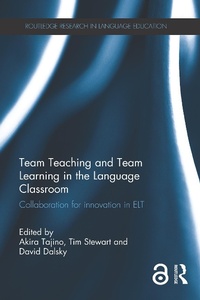
Team Teaching and Team Learning in the Language Classroom
Collaboration for innovation in ELT
Published on 14. December 2015
216 pages
978-1-317-51318-6 (ISBN)
Description

This book reignites discussion on the importance of collaboration and innovation in language education. The pivotal difference highlighted in this volume is the concept of team learning through collaborative relationships such as team teaching. It explores ways in which team learning happens in ELT environments and what emerges from these explorations is a more robust concept of team learning in language education. Coupled with this deeper understanding, the value of participant research is emphasised by defining the notion of 'team' to include all participants in the educational experience. Authors in this volume position practice ahead of theory as they struggle to make sense of the complex phenomena of language teaching and learning. The focus of this book is on the nexus between ELT theory and practice as viewed through the lens of collaboration. The volume aims to add to the current knowledge base in order to bridge the theory-practice gap regarding collaboration for innovation in language classrooms.
Reviews / Votes
'Team Teaching and Team Learning in the Language Classroom not only provides a comprehensive review of team teaching over its initial decades and valuable classroom strategies and techniques, it also highlights innovations in content learning, the integration of new technologies, curriculum design and teacher training all in the context of furthering education as a collaborative social endeavor.In the midst of top-down policy interventions in education, this volume confronts the trends toward standardization and personal competitiveness by embracing the social nature of education, collaboration and innovation, and provides a framework for quality learner outcomes in an array of language learning contexts throughout Asia and Europe.' - Larry Walker, Kyoto Prefectural University, Japan
'This volume is a remarkably informative collection of conceptual applications and theoretical approaches of interdisciplinary collaboration in English language teaching (ELT)...It provides a useful start to researchers and teachers looking to incorporate teamteaching into their classroompractice and also inspires teachers and researchers to further develop working models of team teaching that fit their own classes and fields of study.' - Hongyan Qu, Yanbian University, China
More details
Series
Language
English
Place of publication
London
United Kingdom
Publishing group
Taylor & Francis Ltd
Target group
College/higher education
Professional and scholarly
Illustrations
6 Tables, black and white; 2 Halftones, black and white; 10 Illustrations, black and white
File size
5,97 MB
ISBN-13
978-1-317-51318-6 (9781317513186)
Copyright in bibliographic data and cover images is held by Nielsen Book Services Limited or by the publishers or by their respective licensors: all rights reserved.
Schweitzer Classification
Other editions
Additional editions
Akira Tajino | Tim Stewart | David Dalsky
Team Teaching and Team Learning in the Language Classroom
Collaboration for innovation in ELT
Book
10/2017
1st Edition
Routledge
€74.30
Shipment within 10-20 days
Akira Tajino | Tim Stewart | David Dalsky
Team Teaching and Team Learning in the Language Classroom
Collaboration for innovation in ELT
Book
11/2015
1st Edition
Routledge
€231.50
Shipment within 10-20 days
Persons
Akira Tajino, Ph.D., is Professor of Educational Linguistics and a founding member of the International Academic Research and Resource Center for Language Education (i-ARRC), as well as the Graduate Course of Foreign Language Acquisition and Education at Kyoto University, Japan. His research interests include EAP, pedagogical grammar, and classroom research. He has served on the editorial panel of several journals including ELT Journal.
Tim Stewart is a founding member of the International Academic Research and Resource Center for Language Education (i-ARRC) at Kyoto University. He has been an associate editor of TESOL Journal since 2009 and is the editor of the new TESOL International Association book series Voices from the TESOL Classroom.
David Dalsky, Ph.D., is Associate Professor of Social Psychology and a founding member of the International Academic Research and Resource Center for Language Education (i-ARRC) at Kyoto University. He publishes internationally in both cross-cultural psychology and applied linguistics. His research interests include EAP, indigenous psychology and cross-cultural psychology.
Tim Stewart is a founding member of the International Academic Research and Resource Center for Language Education (i-ARRC) at Kyoto University. He has been an associate editor of TESOL Journal since 2009 and is the editor of the new TESOL International Association book series Voices from the TESOL Classroom.
David Dalsky, Ph.D., is Associate Professor of Social Psychology and a founding member of the International Academic Research and Resource Center for Language Education (i-ARRC) at Kyoto University. He publishes internationally in both cross-cultural psychology and applied linguistics. His research interests include EAP, indigenous psychology and cross-cultural psychology.
Content
Foreword: Dick Allwright Preface: Akira Tajino Part 1: Characterising ELT collaboration and innovation 1. Introduction: Situating collaboration, team teaching, team learning and innovation in ELT practice, Tim Stewart 2. Beyond team teaching: An introduction to team learning in language education, Akira Tajino and Craig Smith Part 2: Team teaching collaborations 3. A sociocultural analysis of effective team teaching in a Japanese language classroom, Tatsuhiro Yoshida 4. Collaboration between English language and content teachers: Breaking the boundaries, Chris Davison 5. Doing international development through team teaching, Bill Perry 6. Beyond the deficit model: Co-constructing team teaching to address learner goals and needs, Francesco Bolstad and Lori Zenuk-Nishide 7. Interdisciplinary collaboration to promote L2 science literacy in Hong Kong, Chaoqi Fan and Yuen Yi Lo Part 3: Collaborative innovations beyond team teaching 8. Communication, technology and collaboration for innovation, Julian Edge and Mariam Attia 9. The dynamics of team learning in the creation of a higher education learning community: A narrative inquiry, Tim Stewart 10. The leregogy of curriculum design: Teaching and learning as relational endeavours, David Rehorick and Sally Rehorick 11. A 5000-mile virtual collaboration of team teaching and team learning, David Dalsky and Mikel Garant 12. Peer mentoring for beginning teachers: Factors contributing to professional identity development, Hoa Thi Mai Nguyen
