

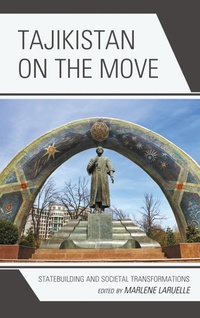
Tajikistan on the Move
Statebuilding and Societal Transformations
Lexington Books (Publisher)
1st Edition
Published on 25. May 2018
1 pages
978-1-9787-8802-2 (ISBN)
Description

The southernmost and poorest state of the Eurasian space, Tajikistan collapsed immediately upon the fall of the Soviet Union and plunged into a bloody five-year civil war (1992-1997) that left more than 50,000 people dead and more than half a million displaced. After the 1997 Peace Agreements, Tajikistan stood out for being the only post-Soviet country to recognize an Islamic party-the Islamic Renaissance Party of Tajikistan (IRPT)-as a key actor in the civil war as well as in postwar reconstruction and democratization. Tajikistan's linguistic and cultural proximity to Iran notwithstanding, the balance of external powers over the country remains fairly typical of Central Asia, with Russia as the major security provider and China as its principal investor.
Another specificity of Tajikistan is its massive labor migration flows toward Russia. Out of a population of eight million, about one million work abroad seasonally-one of the highest rates of departure in the world. Migration trends have impacted Tajikistan's economy and rent mechanisms: half of the country's GDP comes from migrant remittances, a higher share than anywhere else in the world. However, it is in the societal and cultural realms that migration has had the most transformative effect. Migrants' cultural and societal identities are on the move, with a growing role given to Islam as a normative tool for regulating the cultural shock of migration. Islam, and especially a globalized fundamentalist pietist movement, regulates both physical and moral security in workplace and other settings, and brings migrants together to make their interactions meaningful and socio-politically relevant. It offers a new social prestige to those who work in an environment seen as threatening to their Islamic identity.
The first section of this volume investigates the critical question of the nature of the Tajik political regime, its stability, legitimacy mechanisms, and patterns of centralization. In the volume's second part, we move away from studying the state to delve into the societal fabric of Tajikistan, shaped by local rural specificities and social vulnerabilities in the health sector and gender relationships. The third section of the volume is devoted to identity narratives and changes. While the Tajik regime works hard to control the national narrative and the interpretation of the civil war, society is literally and figuratively on the move, as migration profoundly reshapes societal structures and cultural values.
Another specificity of Tajikistan is its massive labor migration flows toward Russia. Out of a population of eight million, about one million work abroad seasonally-one of the highest rates of departure in the world. Migration trends have impacted Tajikistan's economy and rent mechanisms: half of the country's GDP comes from migrant remittances, a higher share than anywhere else in the world. However, it is in the societal and cultural realms that migration has had the most transformative effect. Migrants' cultural and societal identities are on the move, with a growing role given to Islam as a normative tool for regulating the cultural shock of migration. Islam, and especially a globalized fundamentalist pietist movement, regulates both physical and moral security in workplace and other settings, and brings migrants together to make their interactions meaningful and socio-politically relevant. It offers a new social prestige to those who work in an environment seen as threatening to their Islamic identity.
The first section of this volume investigates the critical question of the nature of the Tajik political regime, its stability, legitimacy mechanisms, and patterns of centralization. In the volume's second part, we move away from studying the state to delve into the societal fabric of Tajikistan, shaped by local rural specificities and social vulnerabilities in the health sector and gender relationships. The third section of the volume is devoted to identity narratives and changes. While the Tajik regime works hard to control the national narrative and the interpretation of the civil war, society is literally and figuratively on the move, as migration profoundly reshapes societal structures and cultural values.
More details
Series
Edition
1. Auflage
Language
English
Place of publication
United States
Publishing group
Bloomsbury Publishing Plc
Target group
Professional and scholarly
Illustrations
1 b/w illustrations; 3 b/w photos; 1 maps; 11 tables; 7 charts;
ISBN-13
978-1-9787-8802-2 (9781978788022)
Copyright in bibliographic data and cover images is held by Nielsen Book Services Limited or by the publishers or by their respective licensors: all rights reserved.
Schweitzer Classification
Other editions
Additional editions
Book
05/2018
Lexington Books
€149.00
Shipment within 15-20 days
Persons
Marlene Laruelle is research professor, director of the Central Asia Program, and associate director of the Institute for European, Russian, and Eurasian Studies (IERES) at the Elliott School of International Affairs of George Washington University.
Content
Introduction, Marlene Laruelle
Part I: State Dynamics. Policies, their Actors and their Spaces
Chapter 1: Hobbesian Neopatrimonialism, Jesse Driscoll
Chapter 2: Rebels without a Cause? Authoritarian Conflict Management in Tajikistan, 2008-2015, John Heathershaw and Parviz Mullojonov
Chapter 3: From Moscow to Madrid: Governing Security Threats Beyond Tajikistan's Borders, Edward Lemon
Chapter 4: Tajikistan's Multi-Vector Foreign Policy: Constructing Relations with Russia, China, and the United States, Kirill Nourzhanov
Part II: Tajik Society: Local Developments and Social Vulnerabilities
Chapter 5: Dushanbe Is Quite Far: Deconcentrated Agrarian Reform in Rural Tajikistan, Brent Hierman
Chapter 6: Local Governance in Khatlon, Tajikistan, Suzanne Levi-Sanchez
Chapter 7: Development Practices, Insecurity, and Risks: Injectable Drug Users in Gorno-Badakhshan, Sophie Hohmann
Chapter 8: "A Woman Without a Man is a Kazan Without a Lid": Polygyny in Tajikistan, Michele Commercio
Part III: State Memory and M
Part I: State Dynamics. Policies, their Actors and their Spaces
Chapter 1: Hobbesian Neopatrimonialism, Jesse Driscoll
Chapter 2: Rebels without a Cause? Authoritarian Conflict Management in Tajikistan, 2008-2015, John Heathershaw and Parviz Mullojonov
Chapter 3: From Moscow to Madrid: Governing Security Threats Beyond Tajikistan's Borders, Edward Lemon
Chapter 4: Tajikistan's Multi-Vector Foreign Policy: Constructing Relations with Russia, China, and the United States, Kirill Nourzhanov
Part II: Tajik Society: Local Developments and Social Vulnerabilities
Chapter 5: Dushanbe Is Quite Far: Deconcentrated Agrarian Reform in Rural Tajikistan, Brent Hierman
Chapter 6: Local Governance in Khatlon, Tajikistan, Suzanne Levi-Sanchez
Chapter 7: Development Practices, Insecurity, and Risks: Injectable Drug Users in Gorno-Badakhshan, Sophie Hohmann
Chapter 8: "A Woman Without a Man is a Kazan Without a Lid": Polygyny in Tajikistan, Michele Commercio
Part III: State Memory and M
