

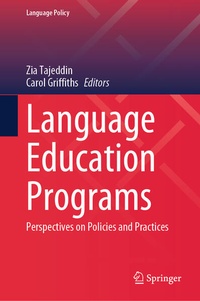
Language Education Programs
Description

This book delves into the realm of effective language education programs, examining them from both macro and micro-policy-making perspectives. It unravels the distinguishing features of exemplary language programs and explores how these programs are implemented in diverse international contexts. The book comprehensively explores various facets of language education programs, encompassing well-crafted language education policies, robust curriculum and syllabus design, impactful teaching materials, effective approaches to English for specific purposes (ESP), English as a medium of instruction (EMI), content and language integrated learning (CLIL), and English as a Lingua Franca (ELF)-informed instruction.
The book also delves into fruitful school/institute-university partnerships, the judicious use of technology, strategies for teacher recruitment and professional development, as well as efficient policies for learner assessment, among other topics of significance. The contributions within this book are firmly grounded in data, incorporating findings from empirical studies. The insights provided draw upon valuable data obtained from a range of diverse contexts in which effective language education programs have been implemented.
More details
Other editions
Additional editions
Persons
Zia Tajeddin is Professor of Applied Linguistics at Tarbiat Modares University, Iran. He is the co-editor of the book series Studies in Language Teacher Education (Springer). He co-edits two international journals: Applied Pragmatics (John Benjamins) and Second Language Teacher Education (Equinox). His research interests center on teacher education, language education policies and practices, and L2 pragmatics pedagogy in the context of EIL/ELF. The books he has recently published include Lessons from Good Language Teachers (Cambridge University Press, 2020), Pragmatics Pedagogy in English as an International Language (Routledge, 2021), and Teacher Reflection: Policies, Practices and Impacts (Multilingual Matters).
Carol Griffiths has been a teacher, manager and teacher trainer of ELT for many years. She has taught in many places around the world, including New Zealand, Indonesia, Japan, China, North Korea, Turkey and UK. She is currently working as Professor of ELT for Girne American University in North Cyprus. She has presented at numerous conferences and published widely, including Lessons from Good Language Learners and The Strategy Factor in Successful Language Learning .
Content
SECTION ONE: POLICIES.- University-School Partnerships; Kayoko Hashimoto and Samantha Disbray.- State Language Education Systems; D avid Hayes.- Language Curriculum Evaluation; Jason Loh and Willy Renandya.- T eacher Education; Zia Tajeddin and Samaneh Eslamdoost.- Plurilingualism; Sarah Moore.- Intercultural Language Teaching; Zia Tajeddin and Neda Khanlarzadeh.- Minority Language Learners' Needs; Eun Sung Park.- Language Assessment; Hassan Mohebbi.- SECTION TWO: PRACTICES.- English for Specific Purposes (ESP); Helen Basturkmen.- Content and Language Integrated Learning (CLIL); Ronald Kemsies and Georg Hellmayr .- English-Medium Instruction (EMI); Vildan Inci Kavak & Yasemin Kirkgöz.- English as a Lingua Franca Pedagogy; Paul McBride and Glenn Toh.- Learner Agency Empowerment; Thuy Thi Ngoc Bui andThom Thom Thi Nguyen.- Online Language Education Courses; L u Yunru and Qing Ma.- D igital Technology in Language Teaching; I.G.A. Lokita Purnamika Utami and Sarah Prestridge.
