

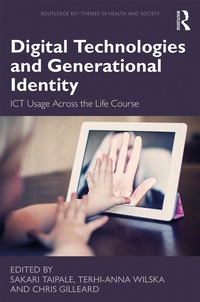
Digital Technologies and Generational Identity
ICT Usage Across the Life Course
Published on 28. July 2017
244 pages
978-1-315-39860-0 (ISBN)
Description

The short lifetime of digital technologies means that generational identities are difficult to establish around any particular technologies let alone around more far-reaching socio-technological 'revolutions'. Examining the consumption and use of digital technologies throughout the stages of human development, this book provides a valuable overview of ICT usage and generational differences. It focuses on the fields of home, family and consumption as key arenas where these processes are being enacted, sometimes strengthening old distinctions, sometimes creating new ones, always embodying an inherent restlessness that affects all aspects and all stages of life.
Combining a collection of international perspectives from a range of fields, including social gerontology, social policy, sociology, anthropology and gender studies, Digital Technologies and Generational Identity weaves empirical evidence with theoretical insights on the role of digital technologies across the life course. It takes a unique post-Mannheimian standpoint, arguing that each life stage can be defined by attitudes towards, and experiences of, digital technologies as these act as markers of generational differences and identity.
It will be of particular value to academics of social policy and sociology with interests in the life course and human development as well as those studying media and communication, youth and childhood studies, and gerontology.
Combining a collection of international perspectives from a range of fields, including social gerontology, social policy, sociology, anthropology and gender studies, Digital Technologies and Generational Identity weaves empirical evidence with theoretical insights on the role of digital technologies across the life course. It takes a unique post-Mannheimian standpoint, arguing that each life stage can be defined by attitudes towards, and experiences of, digital technologies as these act as markers of generational differences and identity.
It will be of particular value to academics of social policy and sociology with interests in the life course and human development as well as those studying media and communication, youth and childhood studies, and gerontology.
Reviews / Votes
'How does your age influence how you use technology and why does it matter? This timely volume assembles leading scholars from a diversity of disciplines to address the issue of ICTs and generational identity. It builds on the bedrock of existing scholarship to offer fresh and thought-provoking insights on this fascinating topic.' - Sun Sun Lim, PhD, Professor of Media & Communication, Singapore University of Technology and Design'Taipale's edited volume provides a compelling look at the way that the "other half" uses mobiles and with what consequences. Too often, researchers have failed to explore how the elderly, the aging, and even young adults use this transformative technology. As a result, both social policy and daily life practices are shortchanged. As an antidote, this incisive, timely and accessible collection deserves wide reading.' - James E. Katz, PhD, DrHC, Feld Family Professor of Emerging Media, Director of Division of Emerging Media Studies, Executive Director of Center for Mobile Communication Studies, College of Communication, Boston University, US
More details
Series
Language
English
Place of publication
London
United Kingdom
Publishing group
Taylor & Francis Ltd
Target group
College/higher education
Product notice
Reflowable
Illustrations
9 s/w Tabellen, 9 s/w Zeichnungen
9 Tables, black and white; 9 Line drawings, black and white
File size
1,54 MB
ISBN-13
978-1-315-39860-0 (9781315398600)
Copyright in bibliographic data and cover images is held by Nielsen Book Services Limited or by the publishers or by their respective licensors: all rights reserved.
Schweitzer Classification
Other editions
Additional editions
Sakari Taipale | Terhi-Anna Wilska | Chris Gilleard
Digital Technologies and Generational Identity
ICT Usage Across the Life Course
Book
05/2019
1st Edition
Routledge
€65.70
Shipment within 15-20 days
Sakari Taipale | Terhi-Anna Wilska | Chris Gilleard
Digital Technologies and Generational Identity
ICT Usage Across the Life Course
Book
08/2017
1st Edition
Routledge
€206.40
Shipment within 10-20 days
Persons
Sakari Taipale works as an Academy of Finland Research Fellow at the University of Jyvaeskylae, Finland. He is also an Adjunct Professor at the University of Eastern Finland.
Terhi-Anna Wilska is a Professor of Sociology at the Department of Social Sciences and Philosophy, University of Jyvaeskylae, Finland.
Chris Gilleard is a Visiting Research Fellow at the Division of Psychiatry, University College London and a Visiting Senior Research Fellow at the Department of Social and Policy Sciences, University of Bath, UK.
Terhi-Anna Wilska is a Professor of Sociology at the Department of Social Sciences and Philosophy, University of Jyvaeskylae, Finland.
Chris Gilleard is a Visiting Research Fellow at the Division of Psychiatry, University College London and a Visiting Senior Research Fellow at the Department of Social and Policy Sciences, University of Bath, UK.
Content
Chapter 1. Introduction (Sakari Taipale, Terhi-Anna Wilska and Chris Gilleard)
Section I: Historical, theoretical, and methodological perspectives
Chapter 2. The place of age in the digital revolution (Chris Gilleard)
Chapter 3. Generational analysis as a methodological approach to study mediatised social change (Goeran Bolin)
Chapter 4. Generational analysis of people's experience of ICTs (Leslie Haddon)
Section II: Family generations and ICT
Chapter 5. Mobile life of middle-aged employees: fragmented time and softer schedules (Mia Tammelin and Timo Anttila)
Chapter 6. Intergenerational solidarity and ICT usage: empirical insights from Finnish and Slovenian families (Sakari Taipale, Andraz Petrovcic and Vesna Dolnicar)
Chapter 7. Gendering the mobile phone: a life course approach (Carla Ganito)
Chapter 8. How young people experience elderly people's use of digital technologies in everyday life (Leopoldina Fortunati)
Chapter 9. ICTs and client trust in the care of old people in Finland (Helena Hirvonen)
Chapter 10. Mobile phone use and social generations in rural India (Sirpa Tenhunen)
Section III Consumption, lifestyles and markets
Chapter 11. Necessities to all? The role of ICTs in the everyday life of the middle-aged and elderly between 1999 and 2014 (Terhi-Anna Wilska and Sanna-Mari Kuoppamaeki)
Chapter 12. A risk to privacy or a need for security? Digital domestic technologies in the lives of young adults and late middle-agers (Sanna-Mari Kuoppamaeki, Outi Uusitalo and Tiina Kemppainen)
Chapter 13. Personality traits and computer use in midlife: leisure activities and work characteristics as mediators (Tiia Kekaelaeinen and Katja Kokko)
Chapter 14. Electronic emotions, age and the life course (Jane Vincent)
Chapter 15. Conclusions (Chris Gilleard, Terhi-Anna Wilska and Sakari Taipale)
Section I: Historical, theoretical, and methodological perspectives
Chapter 2. The place of age in the digital revolution (Chris Gilleard)
Chapter 3. Generational analysis as a methodological approach to study mediatised social change (Goeran Bolin)
Chapter 4. Generational analysis of people's experience of ICTs (Leslie Haddon)
Section II: Family generations and ICT
Chapter 5. Mobile life of middle-aged employees: fragmented time and softer schedules (Mia Tammelin and Timo Anttila)
Chapter 6. Intergenerational solidarity and ICT usage: empirical insights from Finnish and Slovenian families (Sakari Taipale, Andraz Petrovcic and Vesna Dolnicar)
Chapter 7. Gendering the mobile phone: a life course approach (Carla Ganito)
Chapter 8. How young people experience elderly people's use of digital technologies in everyday life (Leopoldina Fortunati)
Chapter 9. ICTs and client trust in the care of old people in Finland (Helena Hirvonen)
Chapter 10. Mobile phone use and social generations in rural India (Sirpa Tenhunen)
Section III Consumption, lifestyles and markets
Chapter 11. Necessities to all? The role of ICTs in the everyday life of the middle-aged and elderly between 1999 and 2014 (Terhi-Anna Wilska and Sanna-Mari Kuoppamaeki)
Chapter 12. A risk to privacy or a need for security? Digital domestic technologies in the lives of young adults and late middle-agers (Sanna-Mari Kuoppamaeki, Outi Uusitalo and Tiina Kemppainen)
Chapter 13. Personality traits and computer use in midlife: leisure activities and work characteristics as mediators (Tiia Kekaelaeinen and Katja Kokko)
Chapter 14. Electronic emotions, age and the life course (Jane Vincent)
Chapter 15. Conclusions (Chris Gilleard, Terhi-Anna Wilska and Sakari Taipale)
