

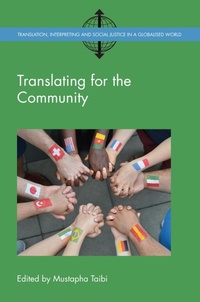
Translating for the Community
Published on 15. November 2017
200 pages
978-1-78309-915-3 (ISBN)
Description

Written by translation practitioners, teachers and researchers, this edited volume is a much-needed contribution to the under-researched area of community translation. Its chapters outline the specific nature and challenges of community translation (e.g. language policies, language variation within target communities, literacy levels), quality standards, training and the relationship between community translation as a professional practice and volunteer or crowd-sourced translation. A number of chapters also provide insights into the situation of community translation and initiatives taking place in different countries (e.g. Australia, South Africa, Spain, the USA or the UK). The book is of interest to translation practitioners, researchers and trainers, particularly those working or interested in the specific field of community translation, as well as to translation students on undergraduate, postgraduate or further education courses covering translation in general or community translation in particular.
Reviews / Votes
This book constitutes a timely addition to the literature on community translation. It provides an excellent introduction to the multifaceted role of community translators, which is vital in ensuring social justice for minority and marginalised groups. The contributions included in this book deal with a wide range of under-researched topics, and, therefore, it should become a key reference for future explorations of an activity that has become essential in our linguistically and culturally diverse societies. * Raquel de Pedro Ricoy, Heriot-Watt University, UK * Mustapha Taibi and his colleagues have combined incisive scrutiny and powerful evidence to outline the necessity of Public Service Translation to bridge the communication gap between public services and speakers of non-dominant languages in our linguistically diverse communities. This is the kind of work that inspires and energises its readers. * Pascal Rillof, President of ENPSIT - European Network for Public Service Interpreting and Translation * This much-needed edition provides theoretical and practical perspectives on a wide range of topics that have posed challenges to various stakeholders involved in community translation including translators, public authorities, translator educators and researchers. This insightful coverage advances our understanding of the complexities of community translation, which has a critical role in narrowing down socio-cultural, socio-economic as well as socio-educational gaps in multilingual and multicultural societies. Many thanks to the editors and all the other authors for this great contribution! * Mira Kim, The University of New South Wales, Australia * This well-structured and innovative book presents a series of informative and highly illuminating studies into community translation. The diversity of relevant issues covered in the collection together with the governing aim of community translation provide a rich repository for community translation researchers. -- Luo Tian, Chongqing Jiaotong University, China * Babel, Vol. 64:4 *More details
Series
Language
English
Place of publication
Bristol
United Kingdom
Publishing group
Channel View Publications Ltd
Target group
College/higher education
Professional and scholarly
ISBN-13
978-1-78309-915-3 (9781783099153)
Copyright in bibliographic data and cover images is held by Nielsen Book Services Limited or by the publishers or by their respective licensors: all rights reserved.
Schweitzer Classification
Other editions
Additional editions
Mustapha Taibi
Translating for the Community
Book
11/2017
Multilingual Matters
€48.00
Shipment within 10-20 days
Person
Mustapha Taibi is Associate Professor in Interpreting and Translation at Western Sydney University, Australia. He is the leader of the International Community Translation Research Group and Editor-in-Chief of the journal Translation & Interpreting. Among his recent books is New Insights into Arabic Translation and Interpreting (2016, Multilingual Matters).
Content
Gerhard Budin: Foreword
Mustapha Taibi: Introduction
Mustapha Taibi: Quality Assurance in Community Translation
Dorothy Kelly: Education for Community Translation: Thirteen Key Ideas
Alicia Rueda-Acedo: From the Classroom to the Job Market: Integrating Service-Learning and Community Translation in a Legal Translation Course
Harold Lesch: From Practice to Theory: Societal Factors as a Norm Governing Principle for Community Translation
Ignacio Garcia: Volunteers and Public Service Translation
Brooke Townsley: Community Translation in the UK: An Enquiry into Practice
Carmen Valero Garces and Raquel Lazaro Gutierrez: Community Translation in Spanish Penitentiaries: A Co-Ordinated Approach
Leong Ko: Community Translation in the Australian Context
Jean Burke: Linguistic Diversity amongst Swahili-Speakers: A Challenge for Translation in Australia
Mustapha Taibi: Concluding Remarks
Mustapha Taibi: Introduction
Mustapha Taibi: Quality Assurance in Community Translation
Dorothy Kelly: Education for Community Translation: Thirteen Key Ideas
Alicia Rueda-Acedo: From the Classroom to the Job Market: Integrating Service-Learning and Community Translation in a Legal Translation Course
Harold Lesch: From Practice to Theory: Societal Factors as a Norm Governing Principle for Community Translation
Ignacio Garcia: Volunteers and Public Service Translation
Brooke Townsley: Community Translation in the UK: An Enquiry into Practice
Carmen Valero Garces and Raquel Lazaro Gutierrez: Community Translation in Spanish Penitentiaries: A Co-Ordinated Approach
Leong Ko: Community Translation in the Australian Context
Jean Burke: Linguistic Diversity amongst Swahili-Speakers: A Challenge for Translation in Australia
Mustapha Taibi: Concluding Remarks
