

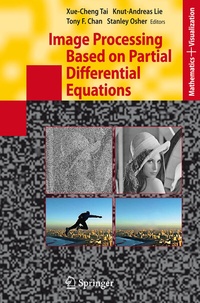
Image Processing Based on Partial Differential Equations
Proceedings of the International Conference on PDE-Based Image Processing and Related Inverse Problems, CMA, Oslo, August 8-12, 2005
1st Edition
Published on 22. November 2006
X, 440 pages
978-3-540-33267-1 (ISBN)
Description

The book contains twenty-two original scienti?c research articles that address the state-of-the-art in using partial di?erential equations for image and signal processing. The articles arose from presentations given at the inter- tional conference on PDE-Based Image Processing and Related Inverse Pr- lems, held at the Centre of Mathematics for Applications, University of Oslo, Norway, August 8-12, 2005. The purpose of the conference was to bring together international - searchers to present various aspects of new developments in using numerical techniques for partial di?erential equations to analyse and process digital - ages. Various aspects of new trends and techniques in this ?eld were discussed in the conference, covering the following topics: Level set methods and applications Total variation regularization and other nonlinear ?lters Noise analysis and removal Image inpainting Image dejittering Optical ?ow estimation Image segmentation Image registration Analysis and processing of MR images and brain mapping Image construction techniques Level set methods for inverse problems Inverse problems for partial di?erential equations have large areas of app- cations. Although image analysis and PDE inverse problems seem to be - related at a ?rst glance, there are many techniques used in one of these two areas that are useful for the other. One goal of the conference was to highlight some of the recent e?orts in merging some of the techniques for these two research areas.
More details
Series
Language
English
Place of publication
Berlin
Germany
Publishing group
Springer Berlin
Target group
College/higher education
Illustrations
X, 440 p. 174 illus., 22 illus. in color.
File size
74,04 MB
ISBN-13
978-3-540-33267-1 (9783540332671)
DOI
10.1007/978-3-540-33267-1
Schweitzer Classification
Other editions
Additional editions
Xue-Cheng Tai | Knut-Andreas Lie | Tony F. Chan
Image Processing Based on Partial Differential Equations
Proceedings of the International Conference on PDE-Based Image Processing and Related Inverse Problems, CMA, Oslo, August 8-12, 2005
Book
12/2006
Springer
€213.99
Shipment within 10-15 days
Content
Digital Image Inpainting, Image Dejittering, and Optical Flow Estimation.- Image Inpainting Using a TV-Stokes Equation.- Error Analysis for H1 Based Wavelet Interpolations.- Image Dejittering Based on Slicing Moments.- CLG Method for Optical Flow Estimation Based on Gradient Constancy Assumption.- Denoising and Total Variation Methods.- On Multigrids for Solving a Class of Improved Total Variation Based Staircasing Reduction Models.- A Method for Total Variation-based Reconstruction of Noisy and Blurred Images.- Minimization of an Edge-Preserving Regularization Functional by Conjugate Gradient Type Methods.- A Newton-type Total Variation Diminishing Flow.- Chromaticity Denoising using Solution to the Skorokhod Problem.- Improved 3D Reconstruction of Interphase Chromosomes Based on Nonlinear Diffusion Filtering.- Image Segmentation.- Some Recent Developments in Variational Image Segmentation.- Application of Non-Convex BV Regularization for Image Segmentation.- Region-Based Variational Problems and Normal Alignment - Geometric Interpretation of Descent PDEs.- Fast PCLSM with Newton Updating Algorithm.- Fast Numerical Methods.- Nonlinear Multilevel Schemes for Solving the Total Variation Image Minimization Problem.- Fast Implementation of Piecewise Constant Level Set Methods.- The Multigrid Image Transform.- Minimally Stochastic Schemes for Singular Diffusion Equations.- Image Registration.- Total Variation Based Image Registration.- Variational Image Registration Allowing for Discontinuities in the Displacement Field.- Inverse Problems.- Shape Reconstruction from Two-Phase Incompressible Flow Data using Level Sets.- Reservoir Description Using a Binary Level Set Approach with Additional Prior Information About the Reservoir Model.
Error Analysis for H1 Based Wavelet Interpolations (p. 23)
Tony F. Chan, Hao-Min Zhou, and Tie Zhou
Summary.
We rigorously study the error bound for the H1 wavelet interpolation problem, which aims to recover missing wavelet coe.cients based on minimizing the H1 norm in physical space. Our analysis shows that the interpolation error is bounded by the second order of the local sizes of the interpolation regions in the wavelet domain.
1 Introduction
In this paper, we investigate the theoretical error estimates for variational wavelet interpolation models. The wavelet interpolation problem is to calculate unknown wavelet coe.- cients from given coeficients. It is similar to the standard function interpolations except the interpolation regions are defined in the wavelet domain. This is because many images are represented and stored by their wavelet coeficients due to the new image compression standard JPEG2000.
The wavelet interpolation is one of the essential problems of image processing and closely related to many tasks such as image compression, restoration, zooming, inpainting, and error concealment, even though the term "interpolation" does not appear very often in those applications. For instance, wavelet inpainting and error concealment are to fill in (interpolate) damaged wavelet coe.cients in given regions in the wavelet domain.
Wavelet zooming is to predict (extrapolate) wavelet coeficients on a finer scale from a given coarser scale coeficients. A major difference between wavelet interpolations and the standard function interpolations is that the applications of wavelet interpolations often impose regularity requirements of the interpolated images in the pixel domain, rather than the wavelet domain.
For example, natural images (not including textures) are often viewed as piecewise smooth functions in the pixel domain. This makes the wavelet interpolations more challenging as one usually cannot directly use wavelet coeficients to ensure the required regularity in the pixel domain. To overcome the difficulty, it seems natural that one can use optimization frameworks, such as variational principles, to combine the pixel domain regularity requirements together with the popular wavelet representations to accomplish wavelet interpolations.
A different reason for using variational based wavelet interpolations is from the recent success of partial differential equation (PDE) techniques in image processing, such as anisotropic difusion for image denoising (25), total variation (TV) restoration (26), Mumford-Shah and related active contour segmentation (23, 10), PDE or TV image inpainting (1, 8, 7), and many more that we do not list here. Very often these PDE techniques are derived from variational principles to ensure the regularity requirements in the pixel domain, which also motive the study of variational wavelet interpolation problems.
Many variational or PDE based wavelet models have been proposed. For instance, Laplace equations, derived from H1 semi-norm, has been used for wavelet error concealment (24), TV based models are used for compression (5, 12), noise removal (19), post-processing to remove Gibbs' oscillations (16), zooming (22), wavelet thresholding (11), wavelet inpainting (9), l1 norm optimization for sparse signal recovery (3, 4), anisotropic wavelet filters for denoising (14), variational image decomposition (27).
Tony F. Chan, Hao-Min Zhou, and Tie Zhou
Summary.
We rigorously study the error bound for the H1 wavelet interpolation problem, which aims to recover missing wavelet coe.cients based on minimizing the H1 norm in physical space. Our analysis shows that the interpolation error is bounded by the second order of the local sizes of the interpolation regions in the wavelet domain.
1 Introduction
In this paper, we investigate the theoretical error estimates for variational wavelet interpolation models. The wavelet interpolation problem is to calculate unknown wavelet coe.- cients from given coeficients. It is similar to the standard function interpolations except the interpolation regions are defined in the wavelet domain. This is because many images are represented and stored by their wavelet coeficients due to the new image compression standard JPEG2000.
The wavelet interpolation is one of the essential problems of image processing and closely related to many tasks such as image compression, restoration, zooming, inpainting, and error concealment, even though the term "interpolation" does not appear very often in those applications. For instance, wavelet inpainting and error concealment are to fill in (interpolate) damaged wavelet coe.cients in given regions in the wavelet domain.
Wavelet zooming is to predict (extrapolate) wavelet coeficients on a finer scale from a given coarser scale coeficients. A major difference between wavelet interpolations and the standard function interpolations is that the applications of wavelet interpolations often impose regularity requirements of the interpolated images in the pixel domain, rather than the wavelet domain.
For example, natural images (not including textures) are often viewed as piecewise smooth functions in the pixel domain. This makes the wavelet interpolations more challenging as one usually cannot directly use wavelet coeficients to ensure the required regularity in the pixel domain. To overcome the difficulty, it seems natural that one can use optimization frameworks, such as variational principles, to combine the pixel domain regularity requirements together with the popular wavelet representations to accomplish wavelet interpolations.
A different reason for using variational based wavelet interpolations is from the recent success of partial differential equation (PDE) techniques in image processing, such as anisotropic difusion for image denoising (25), total variation (TV) restoration (26), Mumford-Shah and related active contour segmentation (23, 10), PDE or TV image inpainting (1, 8, 7), and many more that we do not list here. Very often these PDE techniques are derived from variational principles to ensure the regularity requirements in the pixel domain, which also motive the study of variational wavelet interpolation problems.
Many variational or PDE based wavelet models have been proposed. For instance, Laplace equations, derived from H1 semi-norm, has been used for wavelet error concealment (24), TV based models are used for compression (5, 12), noise removal (19), post-processing to remove Gibbs' oscillations (16), zooming (22), wavelet thresholding (11), wavelet inpainting (9), l1 norm optimization for sparse signal recovery (3, 4), anisotropic wavelet filters for denoising (14), variational image decomposition (27).
