

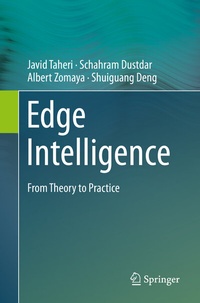
Edge Intelligence
Description

This graduate-level textbook is ideally suited for lecturing the most relevant topics of Edge Computing and its ties to Artificial Intelligence (AI) and Machine Learning (ML) approaches. It starts from basics and gradually advances, step-by-step, to ways AI/ML concepts can help or benefit from Edge Computing platforms.
The book is structured into seven chapters; each comes with its own dedicated set of teaching materials (practical skills, demonstration videos, questions, lab assignments, etc.). Chapter 1 opens the book and comprehensively introduces the concept of distributed computing continuum systems that led to the creation of Edge Computing. Chapter 2 motivates the use of container technologies and how they are used to implement programmable edge computing platforms. Chapter 3 introduces ways to employ AI/ML approaches to optimize service lifecycles at the edge. Chapter 4 goes deeper in the use of AI/ML and introduces ways to optimize spreading computational tasks alongedge computing platforms. Chapter 5 introduces AI/ML pipelines to efficiently process generated data on the edge. Chapter 6 introduces ways to implement AI/ML systems on the edge and ways to deal with their training and inferencing procedures considering the limited resources available at the edge-nodes. Chapter 7 motivates the creation of a new orchestrator independent object model to descriptive objects (nodes, applications, etc.) and requirements (SLAs) for underlying edge platforms.
To provide hands-on experience to students and step-by-step improve their technical capabilities, seven sets of Tutorials-and-Labs (TaLs) are also designed. Codes and Instructions for each TaL is provided on the book website, and accompanied by videos to facilitate their learning process.
More details
Other editions
Additional editions
Persons
Schahram Dustdar is Full Professor of Computer Science heading the Research Division of Distributed Systems at the TU Wien, Austria. From 1999 - 2007 he worked as the co-founder and chief scientist of Caramba Labs Software AG in Vienna, a venture capital co-funded software company that was nominated for several international and national awards: World Technology Award in the category of Software (2001); Top-Startup companies in Austria (Cap Gemini Ernst & Young) (2002); MERCUR Innovation award of the Austrian Chamber of Commerece (2002). Schahram is the recipient of the ACM Distinguished Scientist award (2009), the IBM Faculty Award (2012), an elected member of the Academia Europaea: The Academy of Europe, where he is the chairman of the Informatics Section, and an IEEE Fellow (2016).
Albert Y. Zomaya is Peter Nicol Russell Chair Professor of Computer Science and Director of the Centre for Distributed and High-Performance Computing at the University of Sydney. To date, he has published more than 700 scientific papers and articles and is (co-)author/editor of more than 30 books. A sought-after speaker, he has delivered more than 250 keynote addresses, invited seminars, and media briefings. He is currently the Editor in Chief of the ACM Computing Surveys and served in the past as Editor in Chief of the IEEETransactions on Computers (2010-2014) and the IEEE Transactions on Sustainable Computing (2016-2020). Albert is a decorated scholar with numerous accolades including Fellowships of the IEEE, American Association for the Advancement of Science, and Institution of Engineering and Technology. He is a Fellow of the Australian Academy of Science, Royal Society of New South Wales, Foreign Member of Academia Europaea, and Member of the European Academy of Sciences and Arts. His research interests lie in distributed computing, networking, and complex systems.
Shuiguang Deng is currently Full Professor at the College of Computer Science and Technology of Zhejiang University, China. His research interests include Edge Computing, Service Computing, Mobile Computing, and Business Process Management. Up to now, he has published more than 100 papers in journals and refereed conferences. In 2018, he was granted the Rising Star Award by IEEE TCSVC. He is a fellow of IET and a senior member of IEEE.
