

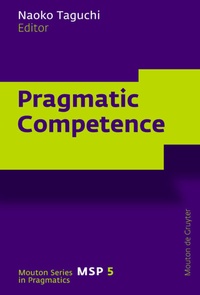
Pragmatic Competence
Description

In the disciplines of applied linguistics and second language acquisition (SLA), the study of pragmatic competence has been driven by several fundamental questions: What does it mean to become pragmatically competent in a second language (L2)? How can we examine pragmatic competence to make inference of its development among L2 learners? In what ways do research findings inform teaching and assessment of pragmatic competence?
This book explores these key issues in Japanese as a second/foreign language. The book has three sections. The first section offers a general overview and historical sketch of the study of Japanese pragmatics and its influence on Japanese pedagogy and curriculum. The overview chapter is followed by eight empirical findings, each dealing with phenomena that are significant in Japanese pragmatics. They target selected features of Japanese pragmatics and investigate the learners' use of them as an indicator of their pragmatic competence.
The target pragmatic features are wide-ranging, among them honorifics, speech style, sentence final particles, speech acts of various types, and indirect expressions. Each study explicitly prompts the connection between pragmalinguistics (linguistic forms available to perform language functions) and sociopragmatics (norms that determine appropriate use of the forms) in Japanese. By documenting the understanding and use of them among learners of Japanese spanning multiple levels and time durations, this book offers insight about the nature and development of pragmatic competence, as well as implications for the learning and teaching of Japanese pragmatics. The last section presents a critical reflection on the eight empirical papers and prompts a discussion of the practice of Japanese pragmatics research.
More details
Other editions
Additional editions
Person
Content
2 - Contents [Seite 6]
3 - (Instead of a) Foreword [Seite 14]
4 - Pragmatic competence in Japanese as a second language: An introduction [Seite 23]
5 - From a! to zo: Japanese pragmatics and its contribution to JSL/JFL pedagogy [Seite 41]
6 - Indexing stance in interaction with the Japanese desu/masu and plain forms [Seite 63]
7 - Advanced learners' honorific styles in emails and telephone calls [Seite 91]
8 - Subjectivity and pragmatic choice in L2 Japanese: Emulating and resisting pragmatic norms [Seite 123]
9 - Requesting in Japanese: The effect of instruction on JFL learners' pragmatic competence [Seite 151]
10 - Influence of learning context on L2 pragmatic realization: A comparison between JSL and JFL learners' compliment responses [Seite 189]
11 - Refusals in Japanese telephone conversations [Seite 221]
12 - Comprehending utterances in Japanese as a foreign language: Formulaicity and literality [Seite 249]
13 - Comprehension of indirect opinions and refusals in L2 Japanese [Seite 271]
14 - Blended learning for Japanese reactive tokens: Effects of computer-led, instructor-led, and peerbased instruction [Seite 297]
15 - Development of the use of Japanese sentence-final particles through email correspondence [Seite 323]
16 - Commentary: The social turn in second language acquisition and Japanese pragmatics research: Reflection on ideologies, methodologies and instructional implications [Seite 357]
17 - Backmatter [Seite 381]
