

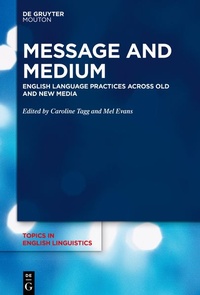
Message and Medium
English Language Practices Across Old and New Media
1st Edition
Published on 8. June 2020
XIII, 385 pages
978-3-11-067083-7 (ISBN)
Description

No detailed description available for "Message and Medium".
More details
Series
Language
English
Place of publication
Berlin/Boston
Germany
Publishing group
de Gruyter Mouton
Target group
Professional and scholarly
US School Grade: College Graduate Student
Illustrations
31 b/w and 6 col. ill., 19 b/w and 1 col. tbl.
File size
6,70 MB
ISBN-13
978-3-11-067083-7 (9783110670837)
Schweitzer Classification
Other editions
Additional editions
Book
01/2022
1st Edition
De Gruyter Mouton
€34.95
Shipment within 7-9 days
E-Book
06/2020
1st Edition
De Gruyter Mouton
€149.95
Available for download
Book
05/2020
1st Edition
De Gruyter Mouton
€149.95
Shipment within 7-9 days
Persons
Caroline Tagg, The Open University, Milton Keynes, UK; Mel Evans, University of Leicester, UK
Content
- Intro
- Acknowledgments
- Contents
- List of contributors
- Introducing transhistorical approaches to digital language practices
- Section 1: Rethinking Perspectives
- Introduction to rethinking perspectives
- 1 The rise of the Pragmatic Web: Implications for rethinking meaning and interaction
- 2 Interpreting "historicisation" in the digital context: On the interface of diachronic and synchronic pragmatics
- 3 Spelling in context: A transhistorical pragmatic perspective on orthographic practices in English
- 4 Reflections on historicity, technology and the implications for method in (historical) pragmatics
- Section 2: Historicizing Discourses
- Introduction to historicising discourses
- 5 Towards a transhistorical approach to analysing discourse about and in motion
- 6 "New" media and self-fashioning: The construction of a political persona by Elizabeth I and Donald Trump
- 7 From Rest in Peace to #RIP: Tracing shifts in the language of mourning
- 8 Digital literacies and the long history of the academic article
- 9 Reflections on historicizing discourses: Connections, linkages, continuities
- Section 3: Media Trajectories
- Introduction to media trajectories
- 10 Unstable content, remediated layout: Urban laws in Scotland through manuscript and print
- 11 Visual pragmatics of an early modern book: Printers' paratextual choices in the editions of The School of Vertue
- 12 Paratextual presentation of Christopher St German's Doctor and Student 1528-1886
- 13 Reflections on visuality and textual reception
- Section 4: New to Old
- Introduction to new to old
- 14 Information design and information structure in the Middle English prose Brut
- 15 Disruptive practice: Multimodality, innovation and standardisation from the medieval to the digital text
- 16 "It makes it more real": A comparative analysis of Twitter use in live blogs and quotations in older news media from a reader response perspective
- 17 New methods, old data: Using digital technologies to explore nineteenth century letter writing practices
- 18 Transhistoricizing multimodality: Reflections on the how-to
- Postscript: You say you want a revolution? Histories and futures of researching the digital, a view from the south
- Index
