

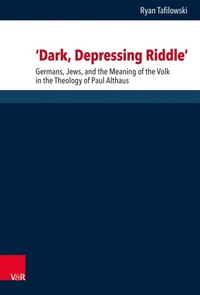
'Dark, Depressing Riddle'
Germans, Jews, and the Meaning of the Volk in the Theology of Paul Althaus
1st Edition
Published on 7. October 2019
256 pages
978-3-647-56471-5 (ISBN)
Description

At the twilight of the Weimar Republic, politicians, scientists, and theologians were engaged in debates surrounding the so-called 'Jewish Question.' When the Nazi Party came to power in 1933, these discussions took on a new sense of urgency and poignancy. As state measures against Jews unfolded, theological conceptions of the meaning of 'Israel' and 'Judaism' began to impact living, breathing Jewish persons. In this study, Ryan Tafilowski traces the thought of the Lutheran theologian Paul Althaus (1888-1966), who once greeted the rise of Hitler as a 'gift and miracle of God,' as he negotiated the 'Jewish Question' and its meaning for his understanding of Germanness across the Weimar Republic, the Nazi years, and the post-war period. In particular, the study uncovers the paradoxical categories Althaus used to interpret the ongoing theological significance of the Jewish people, whom he considered both an imminent threat to German ethnic identity and yet a mysterious cipher by which Germans might decode their own spiritual destiny in world history. Sketching the peculiar contours of Althaus' theology of Israel, this study offers a fresh interpretation of the Erlangen Opinion on the Aryan Paragraph, which is an important artifact not only of the Kirchenkampf, but also of the complex and ambivalent history of Christian antisemitism. By bringing Althaus into conversation with some of the most influential theologians of the twentieth century-from Karl Barth and Emil Brunner to Rudolf Bultmann and Dietrich Bonhoeffer-Tafilowski broadens the scope of his inquiry to vital questions of political theology, ethnic identity, social ethics, and ecclesiology. As Christian theologians must once again reckon with questions of national self-understanding under the pressures of mass migration and resurgent nationalisms, this investigation into the logic of ethno-nationalist theologies is a timely contribution.
Dr. Ryan Tafilowski has obtained his PhD at the University of Edinburgh and is Instructor in the Division of Christian Thought at Denver Seminary.
Dr. Ryan Tafilowski has obtained his PhD at the University of Edinburgh and is Instructor in the Division of Christian Thought at Denver Seminary.
More details
Other editions
Additional editions
Ryan Tafilowski
'Dark, Depressing Riddle'
Germans, Jews, and the Meaning of the Volk in the Theology of Paul Althaus
Book
10/2019
1st Edition
Vandenhoeck & Ruprecht
€100.00
Shipment within 5-7 days
Person
Dr. Ryan Tafilowski has obtained his PhD at the University of Edinburgh and is Instructor in the Division of Christian Thought at Denver Seminary.
Content
- Intro
- Title Page
- Copyright
- Table of Contents
- Body
- Chapter I | Introduction
- One | Statement of the research question
- Two | biography and intellectual influences
- Three | between guilt and innocence: the legacy of Paul Althaus
- A | suspicion
- B | sympathy
- C | ambivalence
- Four | Method, scope, and structure
- A | A dialectical approach
- B | A chronological approach
- Movement I: The Volk who belong everywhere and nowhere: Althaus' societal vision for the Jews during the Weimar Republic (1919-1933)
- Section I Introduction | Inclusive quarantine and the dialectic of pathology and performance
- Chapter II | Invisible others: the "Jewish Question" in the Althausian imagination
- Introduction
- One | Althaus in the context of the Weimar Republic
- Two | The Jews as social and spiritual threat: Kirche und Volkstum (1927)
- Three | The Jews as the bearers of a "difficult fate": Leitsätze zur Ethik (1929)
- Conclusion | Inclusion and exclusion
- Chapter III | "Open wounds": the mysterious purpose of Jewish existence
- Introduction
- One | The Jews as exploders of "ethnic national community": Gott und Volk (1932)
- Two | The Jews as riddle of the coming Kingdom: Der Brief an die Römer (1932)
- Conclusion | Pathology and performance
- Movement II: At the church's "German hour": Germans, Jews, and ecclesial space under National Socialism (1933-1945)
- Section II Introduction | Pathology and performance in microcosm
- Chapter IV | Volk before church: the Erlangen Opinion on the Aryan Paragraph and the Ansbach Memorandum
- Introduction
- One | Althaus in the context of the Kirchenkampf
- Two | The theological framework of the Erlangen Opinion on the Aryan Paragraph and the Ansbach Memorandum
- Three | ethnicity and ecclesiology within the orders of creation
- Conclusion | Ambivalence and ambiguity
- Chapter V | Inclusive quarantine in microcosm: Jewish pathology and performance in the German churches
- Introduction
- One | Between election and curse: Jewish persons and Jewish scripture as keys to German self-understanding
- Two | Enemies of the state: the "Germanness" of Jews and the purpose of civil authority
- Three | Inclusive quarantine in microcosm
- Four | Pathology and performance beyond the Erlangen Opinion
- Conclusion | Destiny and tragedy
- Movement III: The death throes of Judaism: reflection on the "Jewish Question" in the postwar years (1945-1966)
- Section III Introduction | Taking back and making good again
- Chapter VI | Catastrophe and conscience: Jews and Germans as fellow travelers
- Introduction
- One | Downfall and aftermath: denazification and reinstatement
- Two | Together under the curse: The identification of the German and Jewish destinies in Althaus' postwar preaching
- Three | The public/private paradox: Althaus' personal relationship to Jews
- Conclusion | A tension unresolved
- Chapter VII | The collapse of the dialectic: dogmatic and exegetical works
- Introduction
- One | Theological ethics and dogmatics
- Two | Exegetical works
- Conclusion | Judaism trapped between life and death
- Movement IV: Althaus and the challenge of (pseudo-)Lutheran ethics
- Section IV Introduction | The ironies of Althausian theology
- Chapter VIII | self-defeating tendencies in the Althausian theology of Volk
- Introduction
- One | Challenging a Troeltschian cliché
- Two | The Althausian Schöpfungsordnungslehre and its critics
- A | Althausian answers to Lundensian questions
- B | "The most evil of all theological doctrines"? Dialogue with Barth and Brunner
- Conclusion | Against his better judgment
- Chapter IX | The makings of a Lutheran corrective: Bonhoeffer, Bultmann, and Sasse
- Introduction | Diseased imagination and ethnic taxonomy
- One | The Volk in the face of the One Reality: Dietrich Bonhoeffer (1906-1945)
- Two | Bound by baptism: Rudolf Bultmann (1884-1976)
- Three | Against völkisch heresy: Hermann Sasse (1895-1976)
- Conclusion | Althaus as pseudo-Lutheran?
- Chapter X | Conclusion
- One | "Dark, depressing riddle": Althaus, Jews, and the post-Shoah imagination
- Two | "Open wounds": toward an ecclesiology of the cross
- Appendix I | Theologisches Gutachten über die Zulassung von Christen jüdischer Herkunft zu den Ämtern der Deutschen Evangelischen Kirche (Erlanger Gutachten)
- Appendix II | Der "Ansbacher Ratschlag" zu der Barmer "Theologischen Erklärung"
- Bibliography
- Primary Literature
- Weimar Republic (1918-1932)
- The National Socialist Years (1933-1945)
- The Postwar Years (1946-1966)
- Posthumous publications
- Secondary Literature
- Index
