

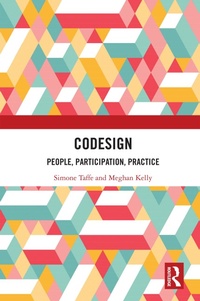
CoDesign
People, Participation, Practice
1st Edition
Published on 29. April 2025
212 pages
978-1-040-35212-0 (ISBN)
Description

CoDesign: People, Participation, Practice explores the past, present, trends, and future potential of codesign and participatory practices globally. Rooted in participatory design traditions, the book emphasizes the importance of inclusivity in the creation of systems, products, services, and technologies, offering a fresh perspective on codesign's dynamic, multifaceted nature. Drawing on interviews with leading scholars and real-world case studies, it examines how collaboration among designers, academics, students, and industry partners leads to successful outcomes.
The book identifies three core themes - People, Participation, and Practice - each unpacked into subthemes. People focusses on engaging and facilitating stakeholders; Participation explores power dynamics and politics; and Practice addresses how infrastructure constraints - such as time, budget, and context - shape the codesign process. The codesign process is organized into eight phases - funding, arranging, preparing, workshopping, translating, testing, executing, and evaluating - providing a structured framework for understanding how projects unfold. The themes under the core elements - People, Participation, and Practices - serve as adjustable 'levers' to address project challenges and guide change. These levers encourage reflection on roles, power dynamics, and decision-making to ensure alignment with goals. CoDesign: People, Participation, Practice concludes with a CoDesign Terminology Toolkit, clarifying essential terms to improve communication and foster understanding across the field.
This comprehensive resource serves as a valuable guide for practitioners, students, and researchers, supporting the ongoing development of codesign in an ever-evolving world.
The book identifies three core themes - People, Participation, and Practice - each unpacked into subthemes. People focusses on engaging and facilitating stakeholders; Participation explores power dynamics and politics; and Practice addresses how infrastructure constraints - such as time, budget, and context - shape the codesign process. The codesign process is organized into eight phases - funding, arranging, preparing, workshopping, translating, testing, executing, and evaluating - providing a structured framework for understanding how projects unfold. The themes under the core elements - People, Participation, and Practices - serve as adjustable 'levers' to address project challenges and guide change. These levers encourage reflection on roles, power dynamics, and decision-making to ensure alignment with goals. CoDesign: People, Participation, Practice concludes with a CoDesign Terminology Toolkit, clarifying essential terms to improve communication and foster understanding across the field.
This comprehensive resource serves as a valuable guide for practitioners, students, and researchers, supporting the ongoing development of codesign in an ever-evolving world.
More details
Edition
1. Auflage
Language
English
Place of publication
London
United Kingdom
Publishing group
Taylor & Francis Ltd
Target group
College/higher education
Illustrations
21 Tables, black and white; 29 Halftones, black and white; 29 Illustrations, black and white
File size
9,11 MB
ISBN-13
978-1-040-35212-0 (9781040352120)
Copyright in bibliographic data and cover images is held by Nielsen Book Services Limited or by the publishers or by their respective licensors: all rights reserved.
Schweitzer Classification
Other editions
Persons
Simone Taffe is Professor of Communication Design and Associate Director of Research in the School of Design and Architecture at Swinburne University of Technology, Melbourne, Australia. She has fifteen years of experience as a graphic designer and design manager in local councils and branding consultancies. Taffe is an award-winning design academic who, for ten years, has tailored real-world learning for design students, resulting in university-wide and Australian government outstanding teacher recognition awards. Taffe's research focusses on understanding how participatory methods intersect with communication design practices. Her work has been published in the fields of Participatory Design, Codesign, and Communication Design. Taffe co-created with Berrett and Pedell and the city of Casey the award-winning real-time digital data visualization project called 3 Corners of the City (2022).
Meghan Kelly is Professor of Communication Design in the School of Communication and Creative Arts at Deakin University, Melbourne, Australia. She has extensive industry experience as a graphic designer, where her passion for a global understanding of design began. Her research has focussed on identity creation and representation in a cross-cultural context and the process to achieve respectful, culturally owned outcomes in professional design practice. Kelly co-authored with Dr Russell Kennedy, Professor Brian Martin, and Jefa Greenaway the award-winning Australian Indigenous Design Charter and International Indigenous Design Charter documents. Kelly's publications include the co-authored book Museum Development and Cultural Representation: Developing the Kelabit Highlands Community Museum (2018).
Meghan Kelly is Professor of Communication Design in the School of Communication and Creative Arts at Deakin University, Melbourne, Australia. She has extensive industry experience as a graphic designer, where her passion for a global understanding of design began. Her research has focussed on identity creation and representation in a cross-cultural context and the process to achieve respectful, culturally owned outcomes in professional design practice. Kelly co-authored with Dr Russell Kennedy, Professor Brian Martin, and Jefa Greenaway the award-winning Australian Indigenous Design Charter and International Indigenous Design Charter documents. Kelly's publications include the co-authored book Museum Development and Cultural Representation: Developing the Kelabit Highlands Community Museum (2018).
Content
Section 1 Past 1 Terms 2 People 3 Concepts Section 2 Present 4 Methodology 5 Case Studies Section 3 Trends 6 People 7 Participation 8 Practices Section 4 Future 9 Toolkits. Conclusion. Biographies
