

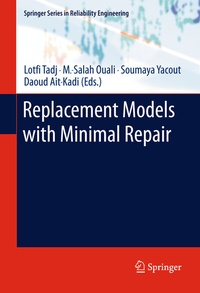
Replacement Models with Minimal Repair
Description

Replacement Models with Minimal Repair is a collection of works by several well-known specialists on the subject of minimal repair in replacement policies. It gives an exhaustive list of minimal repair models for the effective planning of minimal repair and maintenance actions.
Written in an engaging style, Replacement Models with Minimal Repair balances complex mathematical models with practical applications. It is divided into six parts that cover:
- mathematical modeling of minimal repair;
- preventive maintenance models and optimal scheduling of imperfect preventive maintenance activities;
- a new warranty servicing strategy with imperfect repair;
- mathematical models combining burn-in procedure and general maintenance policies;
- methods for parameters' estimation of minimal repair models; and
- product support.
Replacement Models with Minimal Repair is for anyone with an interest in minimal repair and its impact on maintenance policies and strategies. It is a particularly useful resource for researchers, practitioners, and graduate students.
More details
Other editions
Additional editions
Persons
Lotfi Tadj is Professor of Decision Sciences at the Department of Management and E-Business at the American University in Dubai (United Arab Emirates). He holds a BSc in Mathematics from the University of Algiers (Algeria), where he was also lecturer, an MSc in Applied Mathematics from Carnegie-Mellon University (USA) and a PhD in Operations Research from the Florida Institute of Technology (USA), where he was Research Assistant and then Adjunct Professor.
M.-Salah Ouali is Associate Professor at the Department of Mathematical and Industrial Engineering in the École Polytechnique de Montreal (Canada). He received his doctorate from the Institut Nationale Polytechnique de Grenoble (France). M.-Salah Ouali has also worked at the École Nationale des Science Appliquées de Strasbourg (France), Université Laval (Canada), the École Nationale d'Ingénieurs de Metz (France) and the École Nationale d'Ingénieurs de Tunis (Tunisia).
Daoud Ait-Kadi is Professor at the Department of Mechanical Engineering at Université Laval (Canada). Professor Ait-Kadi received his PhD in Computer Science and Operational Research, Industrial Engineering from the Université de Montréal (Canada). He was Visiting Researcher at Renault in France and has also worked at the Facultés Universitaire Catholique de Mons (Belgium), North Carolina State University (USA), the Université d'Artois à Béthune (France), the Université de Sao Paulo (Brazil) and the École Polytechnique Fédérale de Lausanne (Switzerland).
Soumaya Yacout is Professor of Industrial Engineering at the École Polytechnique de Montréal (Canada). She received her BSc and MSc from Cairo University (Egypt), and her doctorate from The George Washington University (USA). During her time at Cairo University she was Teaching and Research Assistant prior to becoming Assistant Professor of Industrial Engineering. She then moved to the Université de Moncton (Canada), whereshe was Associate Professor of Industrial Engineering, before taking up her present position in 1999.
