

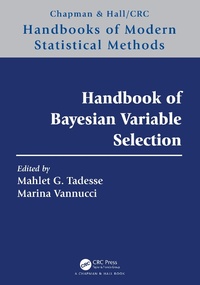
Handbook of Bayesian Variable Selection
1st Edition
Published on 24. December 2021
490 pages
978-1-000-51020-1 (ISBN)
Description

Bayesian variable selection has experienced substantial developments over the past 30 years with the proliferation of large data sets. Identifying relevant variables to include in a model allows simpler interpretation, avoids overfitting and multicollinearity, and can provide insights into the mechanisms underlying an observed phenomenon. Variable selection is especially important when the number of potential predictors is substantially larger than the sample size and sparsity can reasonably be assumed.
The Handbook of Bayesian Variable Selection provides a comprehensive review of theoretical, methodological and computational aspects of Bayesian methods for variable selection. The topics covered include spike-and-slab priors, continuous shrinkage priors, Bayes factors, Bayesian model averaging, partitioning methods, as well as variable selection in decision trees and edge selection in graphical models. The handbook targets graduate students and established researchers who seek to understand the latest developments in the field. It also provides a valuable reference for all interested in applying existing methods and/or pursuing methodological extensions.
Features:
Provides a comprehensive review of methods and applications of Bayesian variable selection.
Divided into four parts: Spike-and-Slab Priors; Continuous Shrinkage Priors; Extensions to various Modeling; Other Approaches to Bayesian Variable Selection.
Covers theoretical and methodological aspects, as well as worked out examples with R code provided in the online supplement.
Includes contributions by experts in the field.
Supported by a website with code, data, and other supplementary material
The Handbook of Bayesian Variable Selection provides a comprehensive review of theoretical, methodological and computational aspects of Bayesian methods for variable selection. The topics covered include spike-and-slab priors, continuous shrinkage priors, Bayes factors, Bayesian model averaging, partitioning methods, as well as variable selection in decision trees and edge selection in graphical models. The handbook targets graduate students and established researchers who seek to understand the latest developments in the field. It also provides a valuable reference for all interested in applying existing methods and/or pursuing methodological extensions.
Features:
Provides a comprehensive review of methods and applications of Bayesian variable selection.
Divided into four parts: Spike-and-Slab Priors; Continuous Shrinkage Priors; Extensions to various Modeling; Other Approaches to Bayesian Variable Selection.
Covers theoretical and methodological aspects, as well as worked out examples with R code provided in the online supplement.
Includes contributions by experts in the field.
Supported by a website with code, data, and other supplementary material
More details
Series
Edition
1. Auflage
Language
English
Place of publication
London
United Kingdom
Publishing group
Taylor & Francis Ltd
Target group
College/higher education
Illustrations
21 Tables, black and white; 91 Line drawings, black and white; 91 Illustrations, black and white
ISBN-13
978-1-000-51020-1 (9781000510201)
Copyright in bibliographic data and cover images is held by Nielsen Book Services Limited or by the publishers or by their respective licensors: all rights reserved.
Schweitzer Classification
Other editions
Additional editions
Mahlet G. Tadesse | Marina Vannucci
Handbook of Bayesian Variable Selection
Book
01/2024
1st Edition
Chapman & Hall/CRC
€125.50
Shipment within 15-20 days
Mahlet G. Tadesse | Marina Vannucci
Handbook of Bayesian Variable Selection
Book
12/2021
1st Edition
Chapman & Hall/CRC
€230.60
Shipment within 15-20 days
Persons
Mahlet Tadesse is Professor and Chair in the Department of Mathematics and Statistics at Georgetown University, USA. Her research over the past two decades has focused on Bayesian modeling for high-dimensional data with an emphasis on variable selection methods and mixture models. She also works on various interdisciplinary projects in genomics and public health. She is a recipient of the Myrto Lefkopoulou Distinguished Lectureship award, an elected member of the International Statistical Institute and an elected fellow of the American Statistical Association.
Marina Vannucci is Noah Harding Professor of Statistics at Rice University, USA. Her research over the past 25 years has focused on the development of methodologies for Bayesian variable selection in linear settings, mixture models and graphical models, and on related computational algorithms. She also has a solid history of scientific collaborations and is particularly interested in applications of Bayesian inference to genomics and neuroscience. She has received an NSF CAREER award and the Mitchell prize by ISBA for her research, and the Zellner Medal by ISBA for exceptional service over an extended period of time with long-lasting impact. She is an elected Member of ISI and RSS and an elected fellow of ASA, IMS, AAAS and ISBA.
Marina Vannucci is Noah Harding Professor of Statistics at Rice University, USA. Her research over the past 25 years has focused on the development of methodologies for Bayesian variable selection in linear settings, mixture models and graphical models, and on related computational algorithms. She also has a solid history of scientific collaborations and is particularly interested in applications of Bayesian inference to genomics and neuroscience. She has received an NSF CAREER award and the Mitchell prize by ISBA for her research, and the Zellner Medal by ISBA for exceptional service over an extended period of time with long-lasting impact. She is an elected Member of ISI and RSS and an elected fellow of ASA, IMS, AAAS and ISBA.
Content
1. Discrete Spike-and-Slab Priors: Models and Computational Aspects
2. Recent Theoretical Advances with the Discrete Spike-and-Slab Priors
3. Theoretical and Computational Aspects of Continuous Spike-and-Slab Priors
4. Spike-and-Slab Meets LASSO: A Review of the Spike-and-Slab LASSO
5. Adaptive Computational Methods for Bayesian Variable Selection
6. Theoretical guarantees for the horseshoe and other global-local shrinkage priors
7. MCMC for Global-Local Shrinkage Priors in High-Dimensional Settings
8. Variable Selection with Shrinkage Priors via Sparse Posterior Summaries
9. Bayesian Model Averaging in Causal Inference
10. Variable Selection for Hierarchically-Related Outcomes: Models and Algorithms
11. Bayesian variable selection in spatial regression models
12. Effect Selection and Regularization in Structured Additive Distributional Regression
13. Sparse Bayesian State-Space and Time-Varying Parameter Models
14. Bayesian estimation of single and multiple graphs
15. Bayes Factors Based on g-Priors for Variable Selection
16. Balancing Sparsity and Power: Likelihoods, Priors, and Misspecification
17. Variable Selection and Interaction Detection with Bayesian Additive Regression Trees
18. Variable Selection for Bayesian Decision Tree Ensembles
19. Stochastic Partitioning for Variable Selection in Multivariate Mixture of Regression Models
2. Recent Theoretical Advances with the Discrete Spike-and-Slab Priors
3. Theoretical and Computational Aspects of Continuous Spike-and-Slab Priors
4. Spike-and-Slab Meets LASSO: A Review of the Spike-and-Slab LASSO
5. Adaptive Computational Methods for Bayesian Variable Selection
6. Theoretical guarantees for the horseshoe and other global-local shrinkage priors
7. MCMC for Global-Local Shrinkage Priors in High-Dimensional Settings
8. Variable Selection with Shrinkage Priors via Sparse Posterior Summaries
9. Bayesian Model Averaging in Causal Inference
10. Variable Selection for Hierarchically-Related Outcomes: Models and Algorithms
11. Bayesian variable selection in spatial regression models
12. Effect Selection and Regularization in Structured Additive Distributional Regression
13. Sparse Bayesian State-Space and Time-Varying Parameter Models
14. Bayesian estimation of single and multiple graphs
15. Bayes Factors Based on g-Priors for Variable Selection
16. Balancing Sparsity and Power: Likelihoods, Priors, and Misspecification
17. Variable Selection and Interaction Detection with Bayesian Additive Regression Trees
18. Variable Selection for Bayesian Decision Tree Ensembles
19. Stochastic Partitioning for Variable Selection in Multivariate Mixture of Regression Models
