

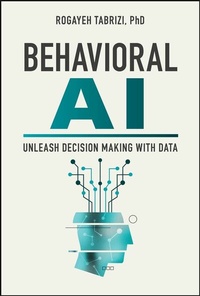
Behavioral AI
Description

Implement AI and big data at your organization using principles from behavioral economics
In Behavioral AI: Unleash Decision Making with Data, behavioral economist Dr. Rogayeh Tabrizi delivers an intuitive roadmap to help organizations disentangle the complexity of their data to create tangible and lasting value. The book explains how to balance the multiple disciplines that power AI and behavioral economics using a combination of the right questions and insightful problem solving.
You'll learn why intellectual diversity and combining subject matter experts in psychology, behavior, economics, physics, computer science, and engineering is essential to creating advanced AI solutions. You'll also discover:
- How behavioral economics principles influence data models and governance architectures and make digital transformation processes more efficient and effective
- Discussions of the most important barriers to value in typical big data and AI projects and how to bring them down
- The most effective methodology to help shorten the long, wasteful process of "boiling the ocean of data"
An exciting and essential resource for managers, executives, board members, and other business leaders engaged or interested in harnessing the power of artificial intelligence and big data, Behavioral AI will also benefit data and machine learning professionals.
More details
Other editions
Additional editions
Person
ROGAYEH TABRIZI, PHD, is the founder and CEO of Theory+Practice, a technology company with deep expertise in AI and data and specializes in helping large CPG and Retail enterprises utilize their data to radically enhance revenue optimization decisions. She has a PhD in Economics and a MSc in Particle Physics and worked on the ATLAS detector at CERN.
Content
Preface xi
Chapter 1 Magic Happens at the Intersections 1
Asking the Right Questions: Data, Intuition, and Strategy 3
Simplifying the Complexity 6
Connecting the Dots 8
Uncovering Hidden Patterns: Models and Algorithms in Action 10
Decoding Consumer Behavior: The Interplay of Psychology and Economics 11
Empowering Behavioral Economics: The Synergy of Data Analytics, ML, and AI 14
Crafting a Customer- Centric Paradigm: The Fusion of Technology and Behavioral Insights 17
Chapter 2 It Is All Connected: Behavioral Economics, Decision-Making, Biases, and Heuristics 19
History and Origins of Behavioral Economics 20
Early Days 21
Entering Mainstream Economics 23
Current Research and Practical Applications 26
Back to the Beginning 30
Psychology of Decision- Making 33
Dual- Process Theories 33
Heuristics and Biases 35
Noise 39
Prospect Theory 40
Nudging 42
Experimentation 46
How It Works 47
Uber and Experimentation 49
Chapter 3 Minimal Data, Maximal Impact: From Big Data to Minimum Viable Data 53
How Much Data Are We Talking About? Lots and Lots 55
You Do Not Need a Lot of Data to Get Started, You Need the MVD 58
Asking the Right Questions, Again! 59
Synthetic Data: What It Is and What It Isn't 63
Survey Data to the Rescue 67
Chapter 4 Building Intelligence: AI and ML Essentials, Transforming Data into Intelligence 73
Classical AI 76
ML 78
Deep Learning 82
Generative AI 86
Machine Intelligence and Biologically Inspired Models 90
Chapter 5 Real-World Impact: Harnessing AI and ml for Practical Solutions 95
Unleashing the Full Potential of AI: Beyond the Hype 96
Rethinking Segmentation: Beyond Demographics and Life Stages 97
Uncovering Unexpected Customer Patterns 101
Predicting Intent and Mapping Customer Journeys 104
Overcoming Challenges in Predicting Customer Intent 106
Predicting and Managing Returns 108
The Power and Nuances of Recommendation Models 111
Broadening Horizons: Beyond Category Killers 114
Enhancing In- Store Experience with Recommendation Models 116
Leveraging Propensity Models for Targeted Campaigns 118
Personalized Pricing: Influencing Behaviors and Financial Outcomes 121
Behavioral Economics in Personalized Pricing Strategies 124
Forecasting: Understanding the Dynamics of Demand 127
The Power of Forecasting and Optimization 131
Transparent MMMs 132
Ensembling Models for Enhanced Forecasting 133
The Interplay of Demand Forecasting and Inventory Optimization 133
Conclusion 135
Chapter 6 Decoding Complexity: Leveraging Systems Thinking in Modern Organizations 137
Only a Wet Baby Likes Change: Loss Aversion + Status Quo Bias 140
It Gets Better! Commitment Device, Peer Effect, and Sunk Cost Fallacy 145
Conclusion 151
Chapter 7 Unlocking Scale: Overcoming Operational and Organizational Complexity in Scaling AI Projects 155
Enablers of Success 156
Communication and Intellectual Diversity 159
Building Trust, Experimentation, and Adoption 164
Interpretation Layers 166
The Power of Experimentation 169
Measuring ROI Through Experimentation 171
Conclusion 173
Epilogue 175
Notes 179
Additional Reading 189
Bibliography 197
Acknowledgments 205
About the Author 207
Index 209
Preface
"I have no special talents. I am only passionately curious."
- Albert Einstein
Much of this book has been written during plane rides to and from client meetings and conferences and is filled with stories, examples, reflections, and considerations drawn from countless conversations with clients, executives, and practitioners.
In these pages, I aim to take you on a journey through the realms of data science, behavioral economics, and organizational complexity. Together, we'll explore how to harness the power of predictive models and AI to uncover hidden patterns in data, drive informed decision-making, and ultimately create value within your organization. By sharing real-world examples and case studies from various industries, my goal is to provide you with practical insights and strategies that you can readily apply to your own work.
We will discover how to effectively combine data-driven insights with an understanding of human behavior to overcome challenges and drive change within organizations. We will explore concepts such as game theory, cognitive biases, and behavioral economics, and how they can be combined with machine learning and AI models to enhance decision-making processes and improve customer experiences.
Navigating organizational complexities and overcoming silos can make it challenging to identify the right datasets, build high-quality models, and implement them effectively to achieve tangible results. Through the numerous stories and experiences shared in this book, I aim to provide you with actionable strategies to harness the power of your data. Additionally, you will gain a deeper understanding of the significance of addressing cognitive biases and fostering a collaborative, transparent environment to ensure the success of your initiatives.
Ultimately, this book aims to equip the practitioners and executives with the tools and knowledge needed for AI and behavioral economics to navigate the complexities of modern organizations, make data-driven decisions, and lead your team to success. Through the lessons and stories shared, I hope to inspire you to embrace innovation, challenge the status quo, and unlock the full potential of your organization.
My own story starts on a plane ride from Tehran to Vancouver. I grew up in Tabriz, a city in the northwest of Iran, at the intersection of many cultures: Turkish, Azari, Persian, Kurdish, among others. As a young kid, due to my father's job, we traveled and lived in many different cities where we often didn't speak the native language, and frequently moved in the middle of the school year.
Being competitive with a natural drive for excellence, combined with my love for mathematics, made me pay extra attention - not just to my teachers, but to everything around me - to make sense of things and stay a top student. I remember paying attention to what drove my classmates, recognizing similarities and differences across cultures and language barriers. Without realizing it, I was being trained in behavioral sciences, but it took me almost 20 years to connect the dots.
I arrived in Vancouver when I was 21 to pursue my master's in physics, specifically in string theory. I had fallen in love with a particular area of mathematics called algebra, group theory, and algebraic topology, which lends itself beautifully to string theory and particle physics. This might sound strange, but the beauty, elegance, and power that this area of mathematics has to simplify the complexities of our physical world have guided my thinking and approach all these years later in the work I do with Fortune 100 companies.
Shortly after starting my master's, I switched to particle physics. This was partly because, no matter how much I love math and theoretical physics, I need to see the physical manifestation of these fascinating theories - I need to see their impact or reality in practice. I want to experiment and see what happens. I call this my impact bug. The timing was also perfect: CERN was up and running, almost! I was one of the last groups of people who got to see the ATLAS detector open. It was a moment that I will never forget, one that changed my life and my relationship with the word impossible. I remember thinking that if we can build this machine that helps us understand what happened 10-16 seconds after the big bang, we can do anything!
I sometimes jokingly say, "Impossible doesn't quite occur to me!" and it's thanks to that moment. I also will never forget the first time I saw the Tier 3 facilities at CERN: a computer farm so vast that you couldn't see the end of it. That was my introduction to big data. The first real data we received after the initial collisions was 7 terabytes (TB), and it didn't even occur to me that it was big. It was just what it was! We had to figure out how to parallelize our "jobs" over however many cores and pray to God that we had caught all the bugs in our codes before submitting them!
There were many other lucky moments for me during my time at CERN. Getting to know the senior management at CERN was one, and having the opportunity to be the youngest member of the organizing committee of the First African School of Physics was another. I got to see the inner workings of one of the most sophisticated and complex scientific collaborations: 10 000 scientists from more than 100 countries coming together for 40 years to make a Nobel Prize-winning discovery. Only years later did I realize how I was being trained in systems thinking and life at 32° Fahrenheit, as described in Loonshots by Safi Bahcall,1 by some of the best scientists in the world.
In Loonshots, Bahcall talks about phase transitions, where small changes in conditions can lead to dramatic shifts in behavior. This concept was evident in the way CERN managed to align diverse talents and resources to achieve groundbreaking discoveries. I also got to see how some of these very same physicists came together and asked a simple question, leading to a decade-long journey: How can we build foundational capabilities in fundamental physics in a continent, Africa, with massive potential? With careful planning, building relationships, and networks of the right people and institutions, I witnessed more than 700 graduate students participate in a three-week summer school in fundamental physics over 10 years. More than 70% of them ended up doing their PhDs and postdocs in Europe and North America, with 35% returning to their home countries. I got to see how a movement starts and spreads across a continent, much like a phase transition where initial efforts create a ripple effect, leading to significant and sustained impact.
All this and more led me to decide to study economics for my PhD. I wanted to delve into development economics. The reason was simple: How is it that we spent $20 billion and 40 years to build a machine that can answer what happened 10-16 seconds after the big bang, but spent $3 trillion over 40 years in international aid in Africa and still can't keep a polio vaccine cold enough to reach a village? I wanted to understand what we can do better, what we can do differently. The impact bug had hit me yet again.
Determined to pursue the economics of development, I started my PhD only to fall in love with game theory in the first semester. Game theory is the study of why people do what they do, the way they do it. It was the second most beautiful thing I had ever encountered after the standard model of particle physics. I was particularly fascinated by social and economic networks and how games of incomplete and asymmetric information unfold within these networks. I wanted to understand what drives behavior when individuals are influenced by those around them, or why a particular technology takes off rapidly in one society but never gains traction in another. What makes some people more influential than others, and what are the underlying conditions that lead to positive spillovers or strategic complementarities?
These questions led me to explore the interconnectedness of human behavior and economic outcomes, as beautifully articulated in Social and Economic Networks by Matthew Jackson,2 one of my mentors and advisors. His work provided profound insights into how networks form, evolve, and influence economic activity, shaping my understanding of the complex web of interactions that drive development and innovation.
As much as game theory was different from particle physics - as if I only wished people would behave like atoms - I was still a model generation machine. It took me nearly three years to realize that I was undergoing a paradigm shift, trying to understand how an economist thinks and why it differs from the mindset of a physicist. Every week, I arrived at my supervisor's office with my shiny new model. After patiently listening to me explain it, he'd invariably ask, "But what is the question?!" or "What is the intuition behind the model?" I painfully anticipated this question every time. It wasn't that I didn't have an answer; I just didn't understand the question! I had a model with a clear set of assumptions explaining a particular dynamic, equilibrium state, or evolution in the behavior of my "agents." Very physicist of me!
It took me three years to understand what he meant because, slowly, I was developing an intuition. I was learning, ever so subtly, to question the questions, to listen, and to...
