

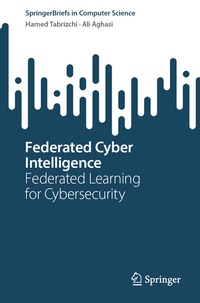
Federated Cyber Intelligence
Description

This book offers a detailed exploration of how federated learning can address critical challenges in modern cybersecurity. It begins with an introduction to the core principles of federated learning. Then it highlights a strong foundation by exploring the fundamental components, workflow, and algorithms of federated learning, alongside its historical development and relevance in safeguarding digital systems.
The subsequent sections offer insight into key cybersecurity concepts, including confidentiality, integrity, and availability. It also offers various types of cyber threats, such as malware, phishing, and advanced persistent threats. This book provides a practical guide to applying federated learning in areas such as intrusion detection, malware detection, phishing prevention, and threat intelligence sharing. It examines the unique challenges and solutions associated with this approach, such as data heterogeneity, synchronization strategies and privacy-preserving techniques.
This book concludes with discussions on emerging trends, including blockchain, edge computing and collaborative threat intelligence. This book is an essential resource for researchers, practitioners and decision-makers in cybersecurity and AI.
More details
Other editions
Additional editions
Persons
Hamed Tabrizchi earned his Bachelor's and Master's degrees in Computer Science from Shahid Bahonar University of Kerman, Iran, in 2017 and 2019, respectively. At the present time, he is a Ph.D. candidate and university lecturer in the computer science department at the University of Tabriz. As a person who was awarded as a talented student of the University of Tabriz in 2020 and a national elite in 2023. In addition to being an experienced artificial intelligence researcher, Hamed has served as a consultant in fields such as cloud computing and cloud computing security for various startups and industrial projects since 2017. Beyond his research endeavors, he has lectured at universities, led workshops, and contributed extensively to leading scientific journals, amassing over 900 citations. Furthermore, he has reviewed more than 300 papers as verified in Web of Science for international journals and conferences.
Ali Aghasi holds a PhD in Computer Engineering from the University of Isfahan, with a research focus on optimizing energy consumption in cloud data centers using AI-driven methods. Currently serving as the Cybersecurity Manager at the IT Center of Shahid Bahonar University of Kerman, Ali Aghasi leads innovative projects deploying artificial intelligence to detect malicious activities and enhance the resilience of IT infrastructures. His expertise bridges the domains of AI, cybersecurity, and energy-efficient computing, making him a leader in advancing secure, efficient systems.
Content
Preface.- Chapter 1 Introduction to Federated Learning.- Chapter 2 Core Concepts of Federated Learning.- Chapter 3 Fundamentals of Cybersecurity.- Chapter 4 Cyber Security Intelligent Systems Based on Federated Learning.- Chapter 5 Closing Thoughts, and Future Directions in Federated Cyber Intelligence.
