

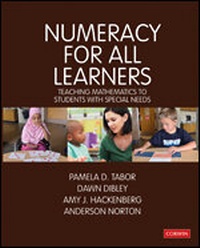
Numeracy for All Learners
Teaching Mathematics to Students with Special Needs
1st Edition
Published on 30. September 2020
224 pages
978-1-5297-5225-0 (ISBN)
Description

Numeracy for All Learners is a wide-ranging overview of how Math Recovery (R) theory, pedagogy, and tools can be applied meaningfully to special education to support learners with a wide range of educational needs.
It builds on the first six books in the Math Recovery series and presents knowledge, resources, and examples for teachers working with students with special needs from Pre-K through secondary school.
Key topics include: dyscalculia, what contemporary neuroscience tells us about mathematical learning, and differentiating assessment and instruction effectively to meet the needs of all students in an equitable framework.
It builds on the first six books in the Math Recovery series and presents knowledge, resources, and examples for teachers working with students with special needs from Pre-K through secondary school.
Key topics include: dyscalculia, what contemporary neuroscience tells us about mathematical learning, and differentiating assessment and instruction effectively to meet the needs of all students in an equitable framework.
More details
Series
Language
English
Place of publication
London
United Kingdom
Publishing group
Sage Publications Ltd
Target group
Professional and scholarly
ISBN-13
978-1-5297-5225-0 (9781529752250)
Copyright in bibliographic data and cover images is held by Nielsen Book Services Limited or by the publishers or by their respective licensors: all rights reserved.
Schweitzer Classification
Other editions
Additional editions
Pamela D. Tabor | Dawn Dibley | Amy J. Hackenberg
Numeracy for All Learners
Teaching Mathematics to Students with Special Needs
Book
11/2020
1st Edition
Corwin UK
€170.90
Shipment within 15-20 days
Pamela D. Tabor | Dawn Dibley | Amy J. Hackenberg
Numeracy for All Learners
Teaching Mathematics to Students with Special Needs
Book
10/2020
1st Edition
Corwin UK
€85.90
Shipment within 15-20 days
Persons
Dr. Pamela D. Tabor holds a Bachelor of Science degree in elementary education and Bible from Kentucky Christian University, a Master of Arts degree in elementary education from East Tennessee State University, and a Doctor of Philosophy in mathematics education from Southern Cross University. Her supervisor was Robert J. Wright, the developer of Mathematics Recovery. She has recently worked as Research and Evaluation Specialist for the US Math Recovery Council in which she has had the pleasure of working with instructional leaders from districts around the US and internationally to think deeply about the impact of Math Recovery in their school contexts. Previously, she spent nearly two decades as a school-based math specialist, interventionist and instructional coach. In that capacity she worked with administrators, teachers of mathematics, teachers of special education, students, and parents to improve the quality of mathematics instruction in a public elementary school in Maryland. She is also a coauthor of the Math Recovery series book Developing Number Knowledge, a contributor of Teaching Number in the Classroom with 4-8 year Olds, one of the original developers of USMRC's Add+VantageMR Professional Development Courses, and one of the developers of USMRC's Student Numeracy Assessment Progressions (SNAP).
Dawn Dibley, a special educator with thirty years of experience as a music therapist, classroom teacher, and mathematics coach, is currently an instructional coach for the US Math Recovery Council. From the time of her initial training as a Math Recovery Intervention Specialist in 2007, Dawn began exploring the use of the LFIN in teaching numeracy to students with disabilities. She spent several years facilitating the USMRC's Add+VantageMR Professional Development Courses to specifically address the concerns of teachers of students with special needs. She holds a Bachelor's degree in Music Therapy and Master's degrees in Music Therapy and Developmental Cognitive Disabilities from the University of Minnesota.
Dr. Amy J. Hackenberg taught mathematics to middle and high school students for 9 years in L.A. and Chicago, prior to earning a Ph.D. in mathematics education from the University of Georgia. Amy is currently an associate professor of mathematics education at Indiana University-Bloomington. She conducts research on how middle school students construct fractions knowledge and algebraic reasoning and on how teachers can learn to develop productive student-teacher relationships. In her current project she is investigating how to differentiate instruction for diverse middle school students (see https://idream.sitehost.iu.edu/), studying her own teaching as well as working with practicing teachers. She is the proud co-author of the Math Recovery series book, Developing Fractions Knowledge.
Dr. Anderson Norton is a professor in the Department of Mathematics at Virginia Tech. His research focuses on building models of students' mathematical development. This work has generated interdisciplinary collaborations with psychologists and neuroscientists. Prior to this volume, Norton served as chair of the steering committee for the North American Chapter of the International Group for the Psychology of Mathematics Education, co-editor on a pair of publications bridging psychology and mathematics education, and co-author of the Math Recovery series book, Developing Fractions Knowledge.
Dawn Dibley, a special educator with thirty years of experience as a music therapist, classroom teacher, and mathematics coach, is currently an instructional coach for the US Math Recovery Council. From the time of her initial training as a Math Recovery Intervention Specialist in 2007, Dawn began exploring the use of the LFIN in teaching numeracy to students with disabilities. She spent several years facilitating the USMRC's Add+VantageMR Professional Development Courses to specifically address the concerns of teachers of students with special needs. She holds a Bachelor's degree in Music Therapy and Master's degrees in Music Therapy and Developmental Cognitive Disabilities from the University of Minnesota.
Dr. Amy J. Hackenberg taught mathematics to middle and high school students for 9 years in L.A. and Chicago, prior to earning a Ph.D. in mathematics education from the University of Georgia. Amy is currently an associate professor of mathematics education at Indiana University-Bloomington. She conducts research on how middle school students construct fractions knowledge and algebraic reasoning and on how teachers can learn to develop productive student-teacher relationships. In her current project she is investigating how to differentiate instruction for diverse middle school students (see https://idream.sitehost.iu.edu/), studying her own teaching as well as working with practicing teachers. She is the proud co-author of the Math Recovery series book, Developing Fractions Knowledge.
Dr. Anderson Norton is a professor in the Department of Mathematics at Virginia Tech. His research focuses on building models of students' mathematical development. This work has generated interdisciplinary collaborations with psychologists and neuroscientists. Prior to this volume, Norton served as chair of the steering committee for the North American Chapter of the International Group for the Psychology of Mathematics Education, co-editor on a pair of publications bridging psychology and mathematics education, and co-author of the Math Recovery series book, Developing Fractions Knowledge.
Content
Chapter 1: The Learning Framework in Number for the Classroom
Chapter 2: Professional Principles and Practices
Chapter 3: Good Instruction for All Students
Chapter 4: Numeracy and Functional Mathematics
Chapter 5: Assessing Students with Disabilities
Chapter 6: Using the Learning Framework in Number to Write Individualized Education Programs
Chapter 7: Brain Research: Implications for Teaching and Learning Mathematics
Chapter 8: Dyscalculia
Chapter 9: Differentiating Instruction
Chapter 10: Teaching Students with Disabilities
Chapter 11: The Constructivist as Teacher
Chapter 12: Supporting Students with Other Special Needs
Chapter 2: Professional Principles and Practices
Chapter 3: Good Instruction for All Students
Chapter 4: Numeracy and Functional Mathematics
Chapter 5: Assessing Students with Disabilities
Chapter 6: Using the Learning Framework in Number to Write Individualized Education Programs
Chapter 7: Brain Research: Implications for Teaching and Learning Mathematics
Chapter 8: Dyscalculia
Chapter 9: Differentiating Instruction
Chapter 10: Teaching Students with Disabilities
Chapter 11: The Constructivist as Teacher
Chapter 12: Supporting Students with Other Special Needs
