

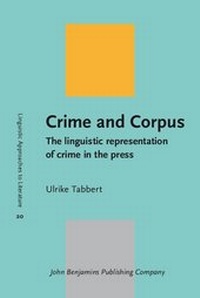
Crime and Corpus
The linguistic representation of crime in the press
1st Edition
Published on 15. April 2015
XVII, 181 pages
978-90-272-6876-1 (ISBN)
Description

Reports on crime in newspapers do not provide a neutral representation of criminals and their offences but instead construct them in accordance with societal discourse surrounding this issue. This book takes an interdisciplinary approach at the intersection of Linguistics, Criminology, and Media Studies and demonstrates how Linguistics can contribute to the study of crime in the media. By combining the tools offered by Corpus Linguistics and Critical Stylistics (a text-based framework for Critical Discourse Analysis), evidence is provided for predominant perceptions of crime and their underlying ideologies in both British and German society. This study names and illustrates the most significant linguistic devices used to construct offenders, victims, and crimes in two newspaper corpora compiled from the German and British press. These devices are then linked to criminological frameworks.
More details
Other editions
Additional editions
Book
04/2015
John Benjamins Publishing Co
€100.70
Shipment within 10-15 days
Person
Content
- Crime and Corpus
- Editorial page
- Title page
- LCC data
- Dedication page
- Epigraph page
- Table of contents
- Preface
- Acknowledgements
- List of figures
- List of tables
- Introduction
- 1.1 Crime as a social phenomenon
- 1.2 Language and crime theories
- 1.3 The structure of this book
- Crime theories and the media
- 2.1 Introduction
- 2.2 Crime theories
- 2.2.1 Offender theories
- 2.2.1.1 Offenders and labelling theory
- 2.2.2 Victims and victimology
- 2.3 Recent tendencies and restorative justice
- 2.4 Risk and fear of crime
- 2.5 The fascination of crime
- 2.6 Moral panics
- 2.7 Criteria of newsworthiness
- Critical language studies and critical stylistics
- 3.1 Concepts and definitions
- 3.1.1 Text
- 3.1.2 Ideology
- 3.1.3 Discourse
- 3.1.4 Power
- 3.2 Critical language studies
- 3.2.1 Critical linguistics
- 3.2.2 Critical discourse analysis and its major approaches
- 3.2.2.1 The marxist approach
- 3.2.2.2 The socio-cognitive approach
- 3.2.2.3 The discourse-historical approach
- 3.2.2.4 The socio-semantic approach
- 3.2.3 The cultural, the multimodal, and the cognitive approach to CDA
- 3.2.4 Critical views on CDA
- 3.3 Critical Stylistics
- 3.3.1 The methods of critical stylistics
- 3.3.1.1 Naming and describing
- 3.3.1.2 Representing actions/events/states - Transitivity analysis and verb voice
- 3.3.1.3 Equating and contrasting
- 3.3.1.4 Implying and assuming
- 3.3.1.5 Hypothesising - Modality
- 3.3.1.6 Presenting other's speech, thoughts, and writing
- Corpus linguistics
- 4.1 Introduction
- 4.2 Different approaches to corpus linguistics
- 4.3 Different types of corpora
- 4.4 Reference corpora
- 4.5 The software package WordSmith tools
- 4.5.1 Wordlist/frequency list
- 4.5.2 Dispersion plots
- 4.5.3 Concordances, collocates, colligates, connotations, and semantic prosody
- 4.5.4 Keywords
- 4.6 Advantages and dangers of corpus linguistics
- Conducting the analysis
- 5.1 Introduction
- 5.2 Combining Corpus Linguistics and Critical Stylistics
- 5.3 Data collection
- 5.3.1 Newspapers
- 5.3.2 Selection criteria
- 5.3.3 Constructing comparable corpora
- 5.4 Differences in the languages
- 5.4.1 Type/token ratio (TTR)
- 5.5 Reference corpora
- 5.6 Analysing the data
- 5.6.1 Wordlist
- 5.6.2 Collocation and concordances
- 5.6.3 Constructing a specialised keyword list
- 5.6.4 Extracting the most significant sentences
- 5.7 Critical Stylistics
- 5.8 Determining statistical significance by using log-likelihood ratio
- 5.8.1 Log-likelihood ratio
- 5.8.1 Calculating a confidence interval
- Linguistic construction in the British press
- 6.1 Introduction
- 6.2 Offenders
- 6.2.1 Naming and equating
- 6.2.2 Contrasting
- 6.2.3 Processes and states
- 6.2.4 Opinions
- 6.2.5 Summary
- 6.3 Victims
- 6.3.1 Naming and equating
- 6.3.2 Processes and states
- 6.3.3 Opinions
- 6.3.4 Differences between victims and offenders
- 6.4 Summary
- Linguistic construction in the German press
- 7.1 Introduction
- 7.2 Offenders
- 7.2.1 Naming and equating
- 7.2.2 Processes and states
- 7.2.3 Opinions
- 7.2.4 Assuming and implying
- 7.2.5 Contrasting
- 7.2.6 Comparing the ENC and the GNC
- 7.2.7 Summary
- 7.3 Victims
- 7.3.1 Naming and equating
- 7.3.2 Processes and states
- 7.3.3 Opinions
- 7.3.4 Time and space
- 7.3.5 Assuming and implying
- 7.3.6 Comparing victims and offenders
- 7.3.7 Comparing the GNC and ENC
- 7.3.8 Summary
- 7.4 Crimes
- 7.4.1 Naming
- 7.4.2 Processes and states
- 7.4.3 Opinions
- 7.4.4 Time and space
- 7.4.5 Summary
- Final considerations
- 8.1 Linguistic constructions
- 8.2 Innovations
- 8.3 Critical thoughts and outlook
- Appendix
- Table A1
- Table A2
- Index
