

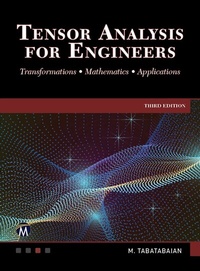
Tensor Analysis for Engineers
Transformations - Mathematics - Applications
1st Edition
Published on 15. June 2023
234 pages
978-1-68392-963-5 (ISBN)
Description

No detailed description available for "Tensor Analysis for Engineers".
More details
Language
English
Place of publication
Herndon, VA
United States
Target group
Professional and scholarly
US School Grade: College Graduate Student
Edition type
Digital original
File size
9,20 MB
ISBN-13
978-1-68392-963-5 (9781683929635)
Copyright in bibliographic data and cover images is held by Nielsen Book Services Limited or by the publishers or by their respective licensors: all rights reserved.
Schweitzer Classification
Other editions
Additional editions

Book
12/2024
1st Edition
Mercury Learning & Information
€89.95
Article not available at the moment
Previous edition
E-Book
10/2020
2nd Edition
Mercury Learning & Information
€98.49
Available for download
Person
Mehrzad Tabatabaian holds a PhD from McGill University and is currently Chair of the BCIT School of Energy Research Committee. He has published several papers for scientific journals and conferences, and he has written textbooks on multiphysics and turbulent flow modelling, thermodynamics, and direct energy conversion. He holds several registered patents in the energy field and currently teaches courses in renewable energy and thermal engineering.
Content
- Cover
- Halftitle
- Title
- Copyright
- Dedication
- Contents
- Chapter 1: Introduction
- 1.1 Index Notation-The Einstein Summation Convention
- Chapter 2: Coordinate Systems Definition
- Chapter 3: Basis Vectors and Scale Factors
- Chapter 4: Contravariant Components and Transformations
- Chapter 5: Covariant Components and Transformations
- Chapter 6: Physical Components and Transformations
- Chapter 7: Tensors-Mixed and Metric
- Chapter 8: Metric Tensor Operation on Tensor Indices
- 8.1 Example: Cylindrical Coordinate Systems
- 8.2 Example: Spherical Coordinate Systems
- Chapter 9: Dot and Cross Products of Tensors
- 9.1 Determinant of an N × N Matrix Using Permutation Symbols
- Chapter 10: Gradient Vector Operator-Christoffel Symbols
- 10.1 Covariant Derivatives of Vectors-Christoffel Symbols of the 2nd Kind
- 10.2 Contravariant Derivatives of Vectors
- 10.3 Covariant Derivatives of a Mixed Tensor
- 10.4 Christoffel Symbol Relations and Properties-1st and 2nd Kinds
- Chapter 11: Derivative Forms-Curl, Divergence, Laplacian
- 11.1 Curl Operations on Tensors
- 11.2 Physical Components of the Curl of Tensors-3D Orthogonal Systems
- 11.3 Divergence Operation on Tensors
- 11.4 Laplacian Operations on Tensors
- 11.5 Biharmonic Operations on Tensors
- 11.6 Physical Components of the Laplacian of a Vector-3D Orthogonal Systems
- Chapter 12: Cartesian Tensor Transformation-Rotations
- 12.1 Rotation Matrix
- 12.2 Equivalent Single Rotation: Eigenvalues and Eigenvectors
- Chapter 13: Coordinate Independent Governing Equations
- 13.1 The Acceleration Vector-Contravariant Components
- 13.2 The Acceleration Vector-Physical Components
- 13.3 The Acceleration Vector in Orthogonal Systems-Physical Components
- 13.4 Substantial Time Derivatives of Tensors
- 13.5 Conservation Equations-Coordinate Independent forms
- Chapter 14: Collection of Relations for Selected Coordinate Systems
- 14.1 Cartesian Coordinate System
- 14.2 Cylindrical Coordinate Systems
- 14.3 Spherical Coordinate Systems
- 14.4 Parabolic Coordinate Systems
- 14.5 Orthogonal Curvilinear Coordinate Systems
- Chapter 15: Rigid Body Rotation: Euler Angles, Quaternions, and Rotation Matrix
- 15.1 Active and Passive Rotations
- 15.2 Euler Angles
- 15.3 Categorizing Euler Angles
- 15.4 Gimbal Lock-Euler Angles Limitation
- 15.5 Quaternions-Applications for Rigid Body Rotation
- 15.6 From a Given Quaternion to Rotation Matrix
- 15.7 From a Given Rotation Matrix to Quaternion
- 15.8 From Euler Angles to a Quaternion
- 15.9 Putting it all Together
- Chapter 16: Mechanical Stress Transformation: Analytical and Mohr's Circle Methods
- 16.1 Plane Stress Condition
- 16.2 Principal Stresses and Directions: Eigenvalues and Eigenvectors
- 16.3 Analysis of Transformed Stresses: Mohr's Circle Graphical Method
- 16.4 3D Stress Transformation and Analysis
- 16.5 Principal Directions: Eigenvectors
- 16.6 Octahedral Stresses in Principal Coordinate System
- 16.7 Octahedral Stresses and Deviatoric Stresses
- 16.8 von Mises Yield Criterion vs Octahedral Shear Stress
- Chapter 17: The Worked Examples
- 17.1 Example: Einstein Summation Conventions
- 17.2 Example: Conversion from Vector to Index Notations
- 17.3 Example: Oblique Rectilinear Coordinate Systems
- 17.4 Example: Quantities Related to Parabolic Coordinate System
- 17.5 Example: Quantities Related to Bi-Polar Coordinate Systems
- 17.6 Example: Application of Contravariant Metric Tensors
- 17.7 Example: Dot and Cross Products in Cylindrical and Spherical Coordinates
- 17.8 Example: Relation between Jacobian and Metric Tensor Determinants
- 17.9 Example: Determinant of Metric Tensors Using Displacement Vectors
- 17.10 Example: Determinant of a 4 × 4 Matrix Using Permutation Symbols
- 17.11 Example: Time Derivatives of the Jacobian
- 17.12 Example: Covariant Derivatives of a Constant Vector
- 17.13 Example: Covariant Derivatives of Physical Components of a Vector
- 17.14 Example: Continuity Equations in Several Coordinate Systems
- 17.15 Example: 4D Spherical Coordinate Systems
- 17.16 Example: Complex Double Dot-Cross Product Expressions
- 17.17 Example: Covariant Derivatives of Metric Tensors
- 17.18 Example: Active Rotation Using Single-Axis and Quaternions Methods
- 17.19 Example: Passive Rotation Using Single-Axis and Quaternions Methods
- 17.20 Example: Successive Rotations Using Quaternions Method
- Chapter 18: Exercises
- References
- Index
