

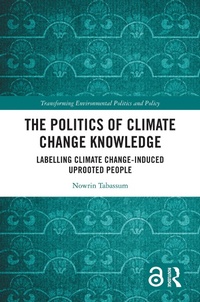
The Politics of Climate Change Knowledge
Labelling Climate Change-induced Uprooted People
1st Edition
Published on 3. March 2022
180 pages
978-1-000-54607-1 (ISBN)
Description

This book addresses political knowledge of climate change and its relation to labelling people affected by climate change, either as 'climate refugees' or as 'climate change-induced displaced people or migrants'.
By questioning the knowledge of climate change and subsequent labelling of people, this book will spark debate in studies of global climate politics and transnational policy networks. Rather than considering the issue of climate change as a given phenomenon, the author explores how the politicized knowledge of climate change has been produced in international negotiations and how that knowledge is transmitted from global forums to local country levels via climate change action plans and resilience projects. This book introduces the concept of multi-scalar knowledge brokers (MKBs) - individual actors who work at multiple levels (local, national, and international) to transmit the knowledge of climate change from global level to local level.
The author uses the primary case study of Bangladesh to demonstrate how the dominant actors in global climate politics - the Intergovernmental Panel on Climate Change (IPCC), the United Nations Framework Convention on Climate Change (UNFCCC), and the World Bank, as well as the USA and the UK - interact with the government and local NGOs in Bangladesh regarding transmitting the knowledge of climate change, labelling the uprooted people, and implementing resilience projects.
This book will be of interest to students, scholars, and practitioners of international relations, environmental politics, climate change studies, political ecology, political geography, and migration and displacement studies.
The Open Access version of this book, available at www.taylorfrancis.com, has been made available under a Creative Commons Attribution-Non Commercial-No Derivatives 4.0 license. Thanks to the support of libraries working with Knowledge Unlatched www.knowledgeunlatched.org
By questioning the knowledge of climate change and subsequent labelling of people, this book will spark debate in studies of global climate politics and transnational policy networks. Rather than considering the issue of climate change as a given phenomenon, the author explores how the politicized knowledge of climate change has been produced in international negotiations and how that knowledge is transmitted from global forums to local country levels via climate change action plans and resilience projects. This book introduces the concept of multi-scalar knowledge brokers (MKBs) - individual actors who work at multiple levels (local, national, and international) to transmit the knowledge of climate change from global level to local level.
The author uses the primary case study of Bangladesh to demonstrate how the dominant actors in global climate politics - the Intergovernmental Panel on Climate Change (IPCC), the United Nations Framework Convention on Climate Change (UNFCCC), and the World Bank, as well as the USA and the UK - interact with the government and local NGOs in Bangladesh regarding transmitting the knowledge of climate change, labelling the uprooted people, and implementing resilience projects.
This book will be of interest to students, scholars, and practitioners of international relations, environmental politics, climate change studies, political ecology, political geography, and migration and displacement studies.
The Open Access version of this book, available at www.taylorfrancis.com, has been made available under a Creative Commons Attribution-Non Commercial-No Derivatives 4.0 license. Thanks to the support of libraries working with Knowledge Unlatched www.knowledgeunlatched.org
More details
Series
Edition
1. Auflage
Language
English
Place of publication
London
United Kingdom
Publishing group
Taylor & Francis Ltd
Target group
College/higher education
Product notice
Reflowable
Illustrations
21 Tables, black and white; 11 Line drawings, black and white; 11 Illustrations, black and white
File size
2,93 MB
ISBN-13
978-1-000-54607-1 (9781000546071)
Copyright in bibliographic data and cover images is held by Nielsen Book Services Limited or by the publishers or by their respective licensors: all rights reserved.
Schweitzer Classification
Other editions
Additional editions
Nowrin Tabassum
The Politics of Climate Change Knowledge
Labelling Climate Change-induced Uprooted People
Book
09/2023
1st Edition
Routledge
€64.60
Shipment within 15-20 days
Nowrin Tabassum
The Politics of Climate Change Knowledge
Labelling Climate Change-induced Uprooted People
Book
03/2022
1st Edition
Routledge
€205.90
Shipment within 15-20 days
Person
Nowrin Tabassum works in the Department of Political Science at McMaster University, Canada.
Content
1. The Puzzle and the Method, 2. Conceptual Debates: Climate Refugees versus Climate Change-induced Displacements/Migrants, 3. Knowledge and Knowledge Network Theory, 4. Climate Change and Population Movement in Bangladesh, 5. Components of the Knowledge Network Theory: Actors, Knowledge Brokers, and Climate Finance, 6. The Shift from Climate Refugees to Climate Change-induced Displacement, 7. Transnational Network: Bringing National and Local Interests in Line with the Donors' Interests, 8. The Present and the Future
