

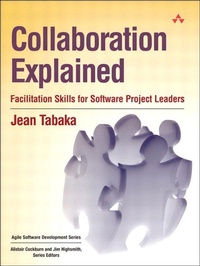
Collaboration Explained
Facilitation Skills for Software Project Leaders
1st Edition
Published on 6. January 2006
456 pages
978-0-321-63005-6 (ISBN)
Description

"Collaboration Explained is a deeply pragmatic book that helps agile practitioners understand and manage complex organizational and team dynamics. As an agile coach, I've found the combination of straightforward advice and colorful anecdotes to be invaluable in guiding and focusing interactions with my teams. Jean's wealth of experience is conveyed in a carefully struck balance of reference guides and prose, facilitating just-in-time learning in the agile spirit. All in all, a superb resource for building stronger teams that's fit for agile veterans and neophytes alike."
-Arlen Bankston, Lean Agile Practice Manager, CC Pace
"If Agile is the new 'what,' then surely Collaboration is the new 'how.' There are many things I really like about Jean's new book. Right at the top of the list is that I don't have to make lists of ideas for collaboration and facilitation anymore. Jean has it all. Not only does she have those great ideas for meetings, retrospectives, and team decision-making that I need to remember, but the startling new and thought-provoking ideas are there too. And the stories, the stories, the stories! The best way to transfer wisdom. Thanks, Jean!"
-Linda Rising, Independent Consultant
The Hands-On Guide to Effective Collaboration in Agile Projects
To succeed, an agile project demands outstanding collaboration among all its stakeholders. But great collaboration doesn't happen by itself; it must be carefully planned and facilitated throughout the entire project lifecycle. Collaboration Explained is the first book to bring together proven, start-to-finish techniques for ensuring effective collaboration in any agile software project.
Since the early days of the agile movement, Jean Tabaka has been studying and promoting collaboration in agile environments. Drawing on her unsurpassed experience, she offers clear guidelines and easy-to-use collaboration templates for every significant project event: from iteration and release planning, through project chartering, all the way through post-project retrospectives.
Tabaka's hands-on techniques are applicable to every leading agile methodology, from Extreme Programming and Scrum to Crystal Clear. Above all, they are practical: grounded in a powerful understanding of the technical, business, and human challenges you face as a project manager or development team member.
? Build collaborative software development cultures, leaders, and teams
? Prepare yourself to collaborate-and prepare your team
? Define clear roles for each participant in promoting collaboration
? Set your collaborative agenda
? Master tools for organizing collaboration more efficiently
? Run effective collaborative meetings-including brainstorming sessions
? Promote better small-group and pair-programming collaboration
? Get better information, and use it to make better decisions
? Use non-abusive conflict to drive positive outcomes
? Collaborate to estimate projects and schedules more accurately
? Strengthen collaboration across distributed, virtual teams
? Extend collaboration from individual projects to the entire development organization
-Arlen Bankston, Lean Agile Practice Manager, CC Pace
"If Agile is the new 'what,' then surely Collaboration is the new 'how.' There are many things I really like about Jean's new book. Right at the top of the list is that I don't have to make lists of ideas for collaboration and facilitation anymore. Jean has it all. Not only does she have those great ideas for meetings, retrospectives, and team decision-making that I need to remember, but the startling new and thought-provoking ideas are there too. And the stories, the stories, the stories! The best way to transfer wisdom. Thanks, Jean!"
-Linda Rising, Independent Consultant
The Hands-On Guide to Effective Collaboration in Agile Projects
To succeed, an agile project demands outstanding collaboration among all its stakeholders. But great collaboration doesn't happen by itself; it must be carefully planned and facilitated throughout the entire project lifecycle. Collaboration Explained is the first book to bring together proven, start-to-finish techniques for ensuring effective collaboration in any agile software project.
Since the early days of the agile movement, Jean Tabaka has been studying and promoting collaboration in agile environments. Drawing on her unsurpassed experience, she offers clear guidelines and easy-to-use collaboration templates for every significant project event: from iteration and release planning, through project chartering, all the way through post-project retrospectives.
Tabaka's hands-on techniques are applicable to every leading agile methodology, from Extreme Programming and Scrum to Crystal Clear. Above all, they are practical: grounded in a powerful understanding of the technical, business, and human challenges you face as a project manager or development team member.
? Build collaborative software development cultures, leaders, and teams
? Prepare yourself to collaborate-and prepare your team
? Define clear roles for each participant in promoting collaboration
? Set your collaborative agenda
? Master tools for organizing collaboration more efficiently
? Run effective collaborative meetings-including brainstorming sessions
? Promote better small-group and pair-programming collaboration
? Get better information, and use it to make better decisions
? Use non-abusive conflict to drive positive outcomes
? Collaborate to estimate projects and schedules more accurately
? Strengthen collaboration across distributed, virtual teams
? Extend collaboration from individual projects to the entire development organization
More details
Series
Edition
1. Auflage
Language
English
Place of publication
Hoboken
United States
Publishing group
Pearson Education (US)
Target group
College/higher education
ISBN-13
978-0-321-63005-6 (9780321630056)
Copyright in bibliographic data and cover images is held by Nielsen Book Services Limited or by the publishers or by their respective licensors: all rights reserved.
Schweitzer Classification
Other editions
Additional editions
Book
02/2006
Addison Wesley
€55.07
Article not available at the moment
Person
Jean Tabaka is an Agile Coach with Rally Software Development, specializing in creating, coaching, and mentoring collaborative, agile software teams. Jean brings over 25 years of experience in software development to the agile plate in a variety of organizational contexts including internal IT departments, ISVs, government agencies, and consulting organizations. Having implemented both plan-driven and agile development approaches for Sybase, Siebel Systems, and Qwest, as well as a variety of smaller ventures, her work has spanned industries and continents. As an agile mentor, Jean coaches software teams through training and facilitation to adopt agile principles and practices using a hybrid of the leading agile methods. With a passion for collaboration practices through facilitation techniques, she guides organizations in creating high-performance teams. She is the co-author of Physical Database Design for Sybase SQL Server (Prentice Hall, 1995) and is a frequent lecturer and contributor on the topic of collaboration practices in agile teams. A Certified ScrumMaster, as well as Certified ScrumMaster Trainer, and Certified Professional Facilitator, she holds a Master of Arts from Michigan State University and a Master of Computer Science from Johns Hopkins University.
Content
Acknowledgments xix
About the Author xxi
Foreword xxiii
Preface xxv
Overview xxix
Section I: Setting the Collaborative Context 1
Chapter 1: What Is Collaboration? 3
Chapter 2: What Are Collaborative Cultures? 7
Chapter 3: Who Are Collaborative Leaders? 13
Chapter 4: What Are Collaborative Teams? 23
Section II: Applying Collaboration 45
Chapter 5: Defining Project Collaboration Events 47
Chapter 6: Preparing Yourself as the Process Owner 71
Chapter 7: Preparing Participants for Collaboration 85
Chapter 8: Setting the Collaborative Agenda 97
Chapter 9: The Organizing Tools 109
Chapter 10: Starting the Collaborative Meeting 137
Chapter 11: Defining the Steps 147
Chapter 12: Gathering the Information-Brainstorming and Listing 155
Chapter 13: Dialogues, Small Groups, and Expert Input Approaches 167
Chapter 14: Team Estimating Approaches 185
Chapter 15: Processing the Information 193
Chapter 16: Visioning, Retrospection and Other Approaches 213
Chapter 17: Managing the Meeting Participants 227
Chapter 18: Managing Conflict 253
Chapter 19: Guerilla Collaboration 263
Chapter 20: Closing the Collaborative Meeting 269
Section III: Extending Collaboration 277
Chapter 21: Collaboration Practices for Small Teams 279
Chapter 22: Collaboration Practices for Distributed Teams 285
Chapter 23: Collaboration for Organizations 297
Section IV: Collaborative Facilitation Guides 301
Chapter 24: Generic Project Meetings 305
Chapter 25: Crystal Clear 325
Chapter 26: Scrum 341
Chapter 27: XP and Industrial XP 357
Bibliography 387
Index 391
About the Author xxi
Foreword xxiii
Preface xxv
Overview xxix
Section I: Setting the Collaborative Context 1
Chapter 1: What Is Collaboration? 3
Chapter 2: What Are Collaborative Cultures? 7
Chapter 3: Who Are Collaborative Leaders? 13
Chapter 4: What Are Collaborative Teams? 23
Section II: Applying Collaboration 45
Chapter 5: Defining Project Collaboration Events 47
Chapter 6: Preparing Yourself as the Process Owner 71
Chapter 7: Preparing Participants for Collaboration 85
Chapter 8: Setting the Collaborative Agenda 97
Chapter 9: The Organizing Tools 109
Chapter 10: Starting the Collaborative Meeting 137
Chapter 11: Defining the Steps 147
Chapter 12: Gathering the Information-Brainstorming and Listing 155
Chapter 13: Dialogues, Small Groups, and Expert Input Approaches 167
Chapter 14: Team Estimating Approaches 185
Chapter 15: Processing the Information 193
Chapter 16: Visioning, Retrospection and Other Approaches 213
Chapter 17: Managing the Meeting Participants 227
Chapter 18: Managing Conflict 253
Chapter 19: Guerilla Collaboration 263
Chapter 20: Closing the Collaborative Meeting 269
Section III: Extending Collaboration 277
Chapter 21: Collaboration Practices for Small Teams 279
Chapter 22: Collaboration Practices for Distributed Teams 285
Chapter 23: Collaboration for Organizations 297
Section IV: Collaborative Facilitation Guides 301
Chapter 24: Generic Project Meetings 305
Chapter 25: Crystal Clear 325
Chapter 26: Scrum 341
Chapter 27: XP and Industrial XP 357
Bibliography 387
Index 391
