

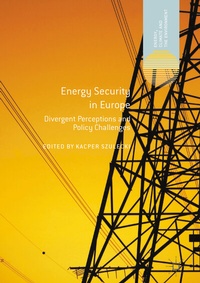
Energy Security in Europe
Description

This edited collection highlights the different meanings that have been attached to the notion of energy security and how it is taken to refer to different objects. Official policy definitions of energy security are broadly similar across countries and emphasize the reliability and affordability of access to sufficient energy resources for a community to uphold its normal economic and social functions. However, perceptions of energy security vary between states causing different actions to be taken, both in international relations and in domestic politics.
Energy Security in Europe moves the policy debates on energy security beyond a consideration of its seemingly objective nature. It also provides a series of contributions that shed light on the conditions under which similar material factors are met with very different energy security policies and divergent discourses across Europe. Furthermore, it problematizes established notions prevalent in energy securitystudies, such as whether energy security is 'geopolitical', and an element of high politics, or purely 'economic', and should be left for the markets to regulate.
This book will be of particular relevance to students and academics in the fields of energy studies and political science seeking to understand the divergence in perspectives and understandings of energy security challenges between EU member states and in multilateral relationships between the EU as a whole.
Reviews / Votes
"The book makes a valuable contribution to the study of energy security for both academics and practitioners." (Francesca Vantaggiato, JCMS Journal of Common Market Studies, Vol. 57 (5), September, 2019)
More details
Other editions
Additional editions
Person
Kacper Szulecki is Assistant Professor in the Department of Political Science at the University of Oslo, Norway.
Content
1. The Multiple Faces of Energy Security: An Introduction; Kacper Szulecki .- Section 1 .- 2. Energy Securitization: Applying the Copenhagen School's Framework to Energy; Andreas Heinrich and Kacper Szulecki .- 3. Securitization in the Gas Sector: Energy Security Debates Concerning the Example of the Nord Stream pipeline; Andreas Heinrich .- 4. Politics and Knowledge Production: Between Securitization and Riskification of the Shale Gas Issue in Poland and Germany; Aleksandra Lis .- 5. Energy Security and Energy Transition: Securitisation in the Electricity Sector; Kacper Szulecki and Julia Kusznir .- 6. Energy Securitization: Avenues for Future Research; Andrew Judge, Tomas Maltby and Kacper Szulecki .- Section 2 .- 7. Taking Security Seriously in EU Energy Governance? Crimean Catharsis and the Energy Union; Kacper Szulecki and Kirsten Westphal .- 8. Unpacking the Nexus Between Market Liberalisation and Desecuritisation in Energy; Irina Kustova .- 9. EU Gas Supply Security: Power ofthe Importer; Jakub M. Godzimirski and Zuzanna Nowak .- 10. Identities and Vulnerabilities: The Ukraine Crisis and the Securitization of the EU-Russia Gas Trade; Marco Siddi .- 11. Positive and Negative Security: A Consequentalist Approach to EU Gas Supply; Paulina Landry .- 12. The Global Oil Market and EU Energy Security; Dag Harald Claes .- 13. Conclusion; Kacper Szulecki.
