

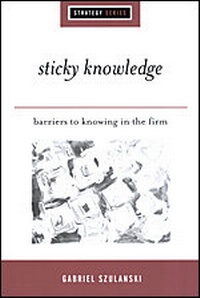
Sticky Knowledge
Barriers to Knowing in the Firm
1st Edition
Published on 3. December 2002
140 pages
978-1-4129-3357-5 (ISBN)
Description

Why don't best practices spread within firms?
What exactly is sticky knowledge?
Having recognized that knowledge assets are rapidly becoming their most precious source of competitive advantage, a large number of organizations are now attempting to transfer best practices. Yet best practices still remain stubbornly immobile.
Sticky Knowledge reveals that the transfer of practices is a complex phenomenon, and demonstrates the range of barriers to transferring best practices within the firm. Written in a brief and accessible format, Gabriel Szulanski defines the popular concept of stickiness and its operationalization, providing a roadmap for understanding and further researching this topical issue.
Taking a fresh look at accepted wisdom, and presenting research findings that conflict with some established views, the book will be essential reading for academics and students addressing issues related to knowledge and the firm. Practising managers and MBA students will also find it of immense value.
What exactly is sticky knowledge?
Having recognized that knowledge assets are rapidly becoming their most precious source of competitive advantage, a large number of organizations are now attempting to transfer best practices. Yet best practices still remain stubbornly immobile.
Sticky Knowledge reveals that the transfer of practices is a complex phenomenon, and demonstrates the range of barriers to transferring best practices within the firm. Written in a brief and accessible format, Gabriel Szulanski defines the popular concept of stickiness and its operationalization, providing a roadmap for understanding and further researching this topical issue.
Taking a fresh look at accepted wisdom, and presenting research findings that conflict with some established views, the book will be essential reading for academics and students addressing issues related to knowledge and the firm. Practising managers and MBA students will also find it of immense value.
Reviews / Votes
`The most helpful suggestion I can give potential readers is this: start reading. From the opening paragraphs, most readers will sense that they are safe in the hands of a skilled expositor who has hold of an important problem - and who, it subsequently turns out, has attacked that problem by deploying a substantial battery of research skills with notable theoretical and methodological sophistication. The result is a set of findings that challenge conventional wisdom about the problem ofintrafirm transfer of best practice, and provide important insights into related issues in the theory and practice of strategic management.
This is not only a fine contribution to the literature of strategic management, but also a welcome addition to the empirical literature relevant to evolutionary economics. There, it falls under the rubric of "replication of routines" - a rubric broad enough to encompass not only Szulanski's topic, but also the problem of sustaining an ongoing productive performance at a given site, the problem of creating a productive facility at a new site by copying an existing one, and the problem of moving from prototype levels of production to full production of a new product. Although these problems are far from identical, there is substantial overlap among the issues they raise, both in theoretical and practical terms.
Szulanski's work offers a uniquely valuable perspective; the companies he studies are aware of the potential benefits of intrafirm transfer of superior practices, and generally quite familiar with the use of benchmarking as a management tool. For several reasons, one should expect transfer to be substantially facilitated in Szulanski's setting relative to more typical settings. He finds, nevertheless, clear indications of the difficulty of transfer and provides a fascinating diagnosis of the sources of difficulty. These findings throw some light on the entire range of replication problems, and suggest fruitful lines for further inquiry into these important issues.
Although the author displays appropriate scholarly caution in interpreting his results, there is guidance available here even for the manager who must start planning a major transfer effort tomorrow morning. The rocks and the whirlpools are not convincingly located on the conventional maps; this new map is a better bet.
It has been my privilege to interact with Gabriel Szulanski as his work has progressed. I am now pleased to recommend this work to all scholars and managers who recognize that the creation and transfer of productive knowledge is central to their concerns, and are prepared to confront the subtle challenges that knowledge management presents' - Sidney G Winter, Deloitte and Touche Professor of Management, The Wharton School, University of Pennsylvania "This book presents much of the best thinking on the challenges of knowledge transfer...The book manages to explore complex theoretical issues in straightforward language, and provides the details of analysis in appendixes directed at active researchers. Szulanski combines an interesting set of studies on knowledge, and his book represents an excellent summation of what we currently know about the transfer of knowledge in organizations. This book will take its rightful place as a major contribution to research on organizational capabilities." -- Joseph T. Mahoney and Charles Williams * The Academy of Management Review *
All prices
More details
Series
Edition
First Edition
Language
English
Place of publication
London
United Kingdom
Publishing group
Sage Publications Ltd (Digital)
Target group
College/higher education
Professional and scholarly
ISBN-13
978-1-4129-3357-5 (9781412933575)
Copyright in bibliographic data and cover images is held by Nielsen Book Services Limited or by the publishers or by their respective licensors: all rights reserved.
Schweitzer Classification
Other editions
Additional editions
Book
12/2002
1st Edition
SAGE Publications Inc
€81.10
Shipment within 15-20 days
Person
Gabriel Szulanski is Professor of Strategy at INSEAD, which is where he earned his PhD in Strategy in 1995. He joined the faculty of INSEAD in 2002 after serving on the faculty of the Wharton School of the University of Pennsylvania (1995/02). Gabriel's research interests focus on strategic management, with a specific focus on the management of knowledge assets and the making of strategy
Content
Introduction
Stickiness, Best Practices and Knowledge Transfer
Stickiness and Firm Performance
Predictors of Stickiness
Types of Stickiness
Case Studies
Statistical Findings
Research and Practical Implications
Summary and Conclusion
Stickiness, Best Practices and Knowledge Transfer
Stickiness and Firm Performance
Predictors of Stickiness
Types of Stickiness
Case Studies
Statistical Findings
Research and Practical Implications
Summary and Conclusion
