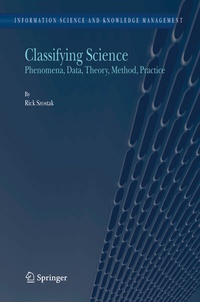
Classifying Science
Description

Classification is the essential first step in science. The study of science, as well as the practice of science, will thus benefit from a detailed classification of different types of science.
In this book, science - defined broadly to include the social sciences and humanities - is first unpacked into its constituent elements: the phenomena studied, the data used, the theories employed, the methods applied, and the practices of scientists. These five elements are then classified in turn. Notably, the classifications of both theory types and methods allow the key strengths and weaknesses of different theories and methods to be readily discerned and compared. Connections across classifications are explored: should certain theories or phenomena be investigated only with certain methods? What is the proper function and form of scientific paradigms? Are certain common errors and biases in scientific practice associated with particular phenomena, data, theories, or methods? The classifications point to several ways of improving both specialized and interdisciplinary research and teaching, and especially of enhancing communication across communities of scholars. The classifications also support a superior system of document classification that would allow searches by theory and method used as well as causal links investigated.
Reviews / Votes
From the reviews:
"Szostak proffers . an organized, internally consistent, method in the context of a Generic Philosophy of Science & Methodology - applicable in . any phase of problem-solving. The author utilizes a unique 'key deductive guideline throughout the book which is grounded in one of the simplest organizing principles possible: the 5W questions . Who, What, Where, When, and Why - are asked'. . Do get a copy of this excellent book!" (Karl H. Wolf, International Journal of General Systems, Vol. 35 (4), 2006)
"The Earth sciences encompass many disciplines, including Information Science and Knowledge Management. Here is Volume seven - to be cognitively cherished . . Science's definition has been much broadened, and since all disciplines use classifications, there is no limit: everyone engaged in problem solving ought to get Szostak's book: including all information technologist, librarians, basic and applied researchers, educationalists/teachers, as well as, post-graduates and motivated secondary school students. . This new book will definitely open your intellectual vision. Get it!" (Karl Wolf, The Australian Geologist Newsletter, Vol. 139, 2006)
More details
Other editions
Additional editions