

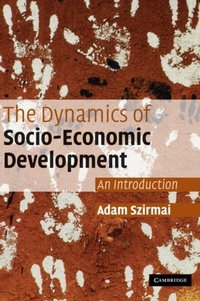
The Dynamics of Socio-Economic Development
An Introduction
Published on 20. January 2005
978-1-107-71076-4 (ISBN)
Description

Why are poor countries poor and rich countries rich? How are wealth and poverty related to changes in nutrition, health, life expectancy, education, population growth and politics? This modern, non-technical 2005 introduction to development studies explores the dynamics of socio-economic development and stagnation in developing countries. Taking a quantitative and comparative approach to contemporary debates within their broader context, Szirmai examines historical, institutional, demographic, sociological, political and cultural factors. Key chapters focus on economic growth, technological change, industrialisation, agricultural development, and consider social dimensions such as population growth, health and education. Each chapter contains comparative statistics on trends from a sample of twenty-nine developing countries. This rich statistical database allows students to strengthen their understanding of comparative development experiences. Assuming no prior knowledge of economics the book is suited for use in inter-disciplinary development studies programmes as well as economics courses, and will also interest practitioners pursuing careers in developing countries.
Why are poor countries poor and rich countries rich? How are wealth and poverty related to changes in nutrition, health, life expectancy, education, population growth and politics? This modern, non-technical 2005 introduction to development studies explores the dynamics of socio-economic development and stagnation in developing countries. Taking a quantitative and comparative approach to contemporary debates within their broader context, Szirmai examines historical, institutional, demographic, sociological, political and cultural factors. Key chapters focus on economic growth, technological change, industrialisation, agricultural development, and consider social dimensions such as population growth, health and education. Each chapter contains comparative statistics on trends from a sample of twenty-nine developing countries. This rich statistical database allows students to strengthen their understanding of comparative development experiences. Assuming no prior knowledge of economics the book is suited for use in inter-disciplinary development studies programmes as well as economics courses, and will also interest practitioners pursuing careers in developing countries.
Why are poor countries poor and rich countries rich? How are wealth and poverty related to changes in nutrition, health, life expectancy, education, population growth and politics? This modern, non-technical 2005 introduction to development studies explores the dynamics of socio-economic development and stagnation in developing countries. Taking a quantitative and comparative approach to contemporary debates within their broader context, Szirmai examines historical, institutional, demographic, sociological, political and cultural factors. Key chapters focus on economic growth, technological change, industrialisation, agricultural development, and consider social dimensions such as population growth, health and education. Each chapter contains comparative statistics on trends from a sample of twenty-nine developing countries. This rich statistical database allows students to strengthen their understanding of comparative development experiences. Assuming no prior knowledge of economics the book is suited for use in inter-disciplinary development studies programmes as well as economics courses, and will also interest practitioners pursuing careers in developing countries.
Reviews / Votes
'... a scholarly and comprehensive treatment of development economics that is accessible to a wide range of social science and development studies students. Its treatment of health issues, education policy, and rural development, along with its comprehensive data tables, are unsurpassed in the development economics field.' Kenneth A. Reinert, George Mason University 'This monumental study is historically grounded, balanced, nuanced, rigorous, eclectic, and reader-friendly. All serious scholars and practitioners of economic development will want to have a copy on their shelves. The volume is ideally suited as a text for a development economics course.' Hal Hill, Australian National University 'This textbook ... succeeds in achieving this aim in a comprehensive and masterly fashion. ... The book is written in a lucid non-technical style and is attractively laid out. Szirmai's text is the best that I have read on this subject and should be extensively used as a core text on development courses in all universities.' The Times Higher Education Supplement '... immensely rewarding. We have here a really excellent text: clearly written, well laid out and accessible, extremely wide-ranging in its coverage, rich in its use of sources ...' Development Policy Review 'It is an extremely rewarding read, holding well the tension between detail and generalisation, weaving into the text a wealth of research data and information, including the fascinating detail of micro-studies, to inform the overall argument.' Developmental Policy Review 'It is an impressive book. The fourteen chapters contain a wealth of information based on an extensive coverage of the relevant literature. ... the book will certainly serve well.' Development and Change'... a scholarly and comprehensive treatment of development economics that is accessible to a wide range of social science and development studies students. Its treatment of health issues, education policy, and rural development, along with its comprehensive data tables, are unsurpassed in the development economics field.' Kenneth A. Reinert, George Mason University
'This monumental study is historically grounded, balanced, nuanced, rigorous, eclectic, and reader-friendly. All serious scholars and practitioners of economic development will want to have a copy on their shelves. The volume is ideally suited as a text for a development economics course.' Hal Hill, Australian National University
'This textbook ... succeeds in achieving this aim in a comprehensive and masterly fashion. ... The book is written in a lucid non-technical style and is attractively laid out. Szirmai's text is the best that I have read on this subject and should be extensively used as a core text on development courses in all universities.' The Times Higher Education Supplement
'... immensely rewarding. We have here a really excellent text: clearly written, well laid out and accessible, extremely wide-ranging in its coverage, rich in its use of sources ...' Development Policy Review
'It is an extremely rewarding read, holding well the tension between detail and generalisation, weaving into the text a wealth of research data and information, including the fascinating detail of micro-studies, to inform the overall argument.' Developmental Policy Review
'It is an impressive book. The fourteen chapters contain a wealth of information based on an extensive coverage of the relevant literature. ... the book will certainly serve well.' Development and Change
More details
Language
English
Place of publication
Cambridge
United Kingdom
Target group
College/higher education
Illustrations
75 Tables, unspecified
File size
7,51 MB
ISBN-13
978-1-107-71076-4 (9781107710764)
Copyright in bibliographic data and cover images is held by Nielsen Book Services Limited or by the publishers or by their respective licensors: all rights reserved.
Schweitzer Classification
Other editions
Additional editions
Book
01/2005
Cambridge University Press
€55.70
Article exhausted; check for reprint
Book
01/2005
Cambridge University Press
€123.79
Article exhausted; check for reprint
Person
Adam Szirmai is Professor of Technology and Development Studies at Eindhoven University of Technology, the Netherlands, and one of the founders of the Eindhoven Centre for Innovation Studies.
Adam Szirmai is Professor of Technology and Development Studies at Eindhoven University of Technology, the Netherlands, and one of the founders of the Eindhoven Centre for Innovation Studies.
Adam Szirmai is Professor of Technology and Development Studies at Eindhoven University of Technology, the Netherlands, and one of the founders of the Eindhoven Centre for Innovation Studies.
Content
1. Developing countries and the concept of development; 2. Development of the international economic order, 1450-2000; 3. Growth and stagnation: theories and experiences; 4. Technology and development; 5. Population and development; 6. Health, health care and development; 7. Education and development; 8. Economic development, structural transformation and primary exports; 9. Industrial development; 10. Agricultural development and rural development; 11. State formation and political aspects of development; 12. Cultural dimensions of development; 13. The international economic and political order since 1945; 14. Foreign aid and development.
