

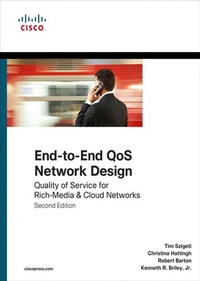
End-to-End QoS Network Design
Quality of Service for Rich-Media & Cloud Networks
2nd Edition
Published on 21. November 2013
1040 pages
978-0-13-311613-7 (ISBN)
Description

End-to-End QoS Network Design
Quality of Service for Rich-Media & Cloud Networks?Second Edition
New best practices, technical strategies, and proven designs for maximizing QoS in complex networks
This authoritative guide to deploying, managing, and optimizing QoS with Cisco technologies has been thoroughly revamped to reflect the newest applications, best practices, hardware, software, and tools for modern networks.
This new edition focuses on complex traffic mixes with increased usage of mobile devices, wireless network access, advanced communications, and video. It reflects the growing heterogeneity of video traffic, including passive streaming video, interactive video, and immersive videoconferences. It also addresses shifting bandwidth constraints and congestion points; improved hardware, software, and tools; and emerging QoS applications in network security.
The authors first introduce QoS technologies in high-to-mid-level technical detail, including protocols, tools, and relevant standards. They examine new QoS demands and requirements, identify reasons to reevaluate current QoS designs, and present new strategic design recommendations. Next, drawing on extensive experience, they offer deep technical detail on campus wired and wireless QoS design; next-generation wiring closets; QoS design for data centers, Internet edge, WAN edge, and branches; QoS for IPsec VPNs, and more.
Tim Szigeti, CCIE No. 9794 is a Senior Technical Leader in the Cisco System Design Unit. He has specialized in QoS for the past 15 years and authored Cisco TelePresence Fundamentals.
Robert Barton, CCIE No. 6660 (R&S and Security), CCDE No. 2013::6 is a Senior Systems Engineer in the Cisco Canada Public Sector Operation. A registered Professional Engineer (P. Eng), he has 15 years of IT experience and is primarily focused on wireless and security architectures.
Christina Hattingh spent 13 years as Senior Member of Technical Staff in Unified Communications (UC) in Cisco's Services Routing Technology Group (SRTG). There, she spoke at Cisco conferences, trained sales staff and partners, authored books, and advised customers.
Kenneth Briley, Jr., CCIE No. 9754, is a Technical Lead in the Cisco Network Operating Systems Technology Group. With more than a decade of QoS design/implementation experience, he is currently focused on converging wired and wireless QoS.
n Master a proven, step-by-step best-practice approach to successful QoS deployment
n Implement Cisco-validated designs related to new and emerging applications
n Apply best practices for classification, marking, policing, shaping, markdown, and congestion management/avoidance
n Leverage the new Cisco Application Visibility and Control feature-set to perform deep-packet inspection to recognize more than 1000 different applications
n Use Medianet architecture elements specific to QoS configuration, monitoring, and control
n Optimize QoS in rich-media campus networks using the Cisco Catalyst 3750, Catalyst 4500, and Catalyst 6500
n Design wireless networks to support voice and video using a Cisco centralized or converged access WLAN
n Achieve zero packet loss in GE/10GE/40GE/100GE data center networks
n Implement QoS virtual access data center designs with the Cisco Nexus 1000V
n Optimize QoS at the enterprise customer edge
n Achieve extraordinary levels of QoS in service provider edge networks
n Utilize new industry standards and QoS technologies, including IETF RFC 4594, IEEE 802.1Q-2005, HQF, and NBAR2
This book is part of the Networking Technology Series from Cisco Press (R), which offers networking professionals valuable information for constructing efficient networks, understanding new technologies, and building successful careers.
Quality of Service for Rich-Media & Cloud Networks?Second Edition
New best practices, technical strategies, and proven designs for maximizing QoS in complex networks
This authoritative guide to deploying, managing, and optimizing QoS with Cisco technologies has been thoroughly revamped to reflect the newest applications, best practices, hardware, software, and tools for modern networks.
This new edition focuses on complex traffic mixes with increased usage of mobile devices, wireless network access, advanced communications, and video. It reflects the growing heterogeneity of video traffic, including passive streaming video, interactive video, and immersive videoconferences. It also addresses shifting bandwidth constraints and congestion points; improved hardware, software, and tools; and emerging QoS applications in network security.
The authors first introduce QoS technologies in high-to-mid-level technical detail, including protocols, tools, and relevant standards. They examine new QoS demands and requirements, identify reasons to reevaluate current QoS designs, and present new strategic design recommendations. Next, drawing on extensive experience, they offer deep technical detail on campus wired and wireless QoS design; next-generation wiring closets; QoS design for data centers, Internet edge, WAN edge, and branches; QoS for IPsec VPNs, and more.
Tim Szigeti, CCIE No. 9794 is a Senior Technical Leader in the Cisco System Design Unit. He has specialized in QoS for the past 15 years and authored Cisco TelePresence Fundamentals.
Robert Barton, CCIE No. 6660 (R&S and Security), CCDE No. 2013::6 is a Senior Systems Engineer in the Cisco Canada Public Sector Operation. A registered Professional Engineer (P. Eng), he has 15 years of IT experience and is primarily focused on wireless and security architectures.
Christina Hattingh spent 13 years as Senior Member of Technical Staff in Unified Communications (UC) in Cisco's Services Routing Technology Group (SRTG). There, she spoke at Cisco conferences, trained sales staff and partners, authored books, and advised customers.
Kenneth Briley, Jr., CCIE No. 9754, is a Technical Lead in the Cisco Network Operating Systems Technology Group. With more than a decade of QoS design/implementation experience, he is currently focused on converging wired and wireless QoS.
n Master a proven, step-by-step best-practice approach to successful QoS deployment
n Implement Cisco-validated designs related to new and emerging applications
n Apply best practices for classification, marking, policing, shaping, markdown, and congestion management/avoidance
n Leverage the new Cisco Application Visibility and Control feature-set to perform deep-packet inspection to recognize more than 1000 different applications
n Use Medianet architecture elements specific to QoS configuration, monitoring, and control
n Optimize QoS in rich-media campus networks using the Cisco Catalyst 3750, Catalyst 4500, and Catalyst 6500
n Design wireless networks to support voice and video using a Cisco centralized or converged access WLAN
n Achieve zero packet loss in GE/10GE/40GE/100GE data center networks
n Implement QoS virtual access data center designs with the Cisco Nexus 1000V
n Optimize QoS at the enterprise customer edge
n Achieve extraordinary levels of QoS in service provider edge networks
n Utilize new industry standards and QoS technologies, including IETF RFC 4594, IEEE 802.1Q-2005, HQF, and NBAR2
This book is part of the Networking Technology Series from Cisco Press (R), which offers networking professionals valuable information for constructing efficient networks, understanding new technologies, and building successful careers.
More details
Series
Edition
2nd edition
Language
English
Place of publication
Indianapolis
United States
Publishing group
Pearson Education (US)
Target group
College/higher education
File size
96,47 MB
ISBN-13
978-0-13-311613-7 (9780133116137)
Copyright in bibliographic data and cover images is held by Nielsen Book Services Limited or by the publishers or by their respective licensors: all rights reserved.
Schweitzer Classification
Other editions
Additional editions
Tim Szigeti | Christina Hattingh | Robert Barton
End-to-End QoS Network Design
Quality of Service for Rich-Media & Cloud Networks
Book
12/2013
2nd Edition
Cisco Press
€93.64
Article exhausted; check different version
Persons
Tim Szigeti, CCIE No. 9794, is a senior technical leader in the Systems Design Unit at Cisco Systems, where his role is to design network architectures for enterprise mobility solutions. He has specialized in quality of service technologies for the past 15 years, during which time he has authored many technical papers, design guides, and two Cisco Press books: End-to-End QoS Network Design (version 1) and Cisco TelePresence Fundamentals.
Robert Barton, CCIE No. 6660, is located in Vancouver, where he lives with his wife and two children. He graduated from the University of British Columbia with a degree in engineering physics, and is a registered professional engineer. Rob holds dual CCIEs, in Routing and Switching and Security, and was also the first CCDE in Canada. Rob joined Cisco from ArrowPoint Communications, where he worked as a data center specialist supporting many of the largest corporations in Canada. In the time since ArrowPoint was acquired by Cisco, Rob has worked as a public sector systems engineer, primarily focused on wireless and security architectures. Currently, Rob is working on SmartGrid network technologies, including smart meter and intelligent substation design.
Christina Hattingh spent 13 years as a senior member of the technical staff in Unified Communications (UC) in the Enterprise Networking Routing Group (formerly Services Routing Technology Group or SRTG) at Cisco Systems. The SRTG products, including the Cisco 2900/3900 and 2800/3800 series ISR platforms and their predecessors, were the first Cisco platforms to converge voice, data, and video traffic and services on IP networks by offering TDM gateway interfaces, WAN interfaces, call control, and QoS features. The ISR series of routers often live at smaller remote offices and therefore at the edge of the WAN, where the need for QoS services is most sensitive. In this role, Christina spoke at Cisco Live conferences, trained Cisco sales staff and Cisco resale partners on router-based UC technologies, authored several Cisco Press books, and advised customers on UC network deployment and design, including QoS designs and helping them through the TDM to SIP trunk industry transition.
Kenneth Briley, Jr., CCIE No. 9754 is a technical lead in the Network Operating Systems Technology Group at Cisco Systems. For over 10 years, he has specialized in quality of service design and implementation in customer environments, alignment of QoS features and functions, and the marketing of new products that leverage QoS technologies. During this time, he has written several deployment guides and whitepapers, presented at Cisco Live, and most recently has focused on the convergence of wired and wireless quality of service.
Robert Barton, CCIE No. 6660, is located in Vancouver, where he lives with his wife and two children. He graduated from the University of British Columbia with a degree in engineering physics, and is a registered professional engineer. Rob holds dual CCIEs, in Routing and Switching and Security, and was also the first CCDE in Canada. Rob joined Cisco from ArrowPoint Communications, where he worked as a data center specialist supporting many of the largest corporations in Canada. In the time since ArrowPoint was acquired by Cisco, Rob has worked as a public sector systems engineer, primarily focused on wireless and security architectures. Currently, Rob is working on SmartGrid network technologies, including smart meter and intelligent substation design.
Christina Hattingh spent 13 years as a senior member of the technical staff in Unified Communications (UC) in the Enterprise Networking Routing Group (formerly Services Routing Technology Group or SRTG) at Cisco Systems. The SRTG products, including the Cisco 2900/3900 and 2800/3800 series ISR platforms and their predecessors, were the first Cisco platforms to converge voice, data, and video traffic and services on IP networks by offering TDM gateway interfaces, WAN interfaces, call control, and QoS features. The ISR series of routers often live at smaller remote offices and therefore at the edge of the WAN, where the need for QoS services is most sensitive. In this role, Christina spoke at Cisco Live conferences, trained Cisco sales staff and Cisco resale partners on router-based UC technologies, authored several Cisco Press books, and advised customers on UC network deployment and design, including QoS designs and helping them through the TDM to SIP trunk industry transition.
Kenneth Briley, Jr., CCIE No. 9754 is a technical lead in the Network Operating Systems Technology Group at Cisco Systems. For over 10 years, he has specialized in quality of service design and implementation in customer environments, alignment of QoS features and functions, and the marketing of new products that leverage QoS technologies. During this time, he has written several deployment guides and whitepapers, presented at Cisco Live, and most recently has focused on the convergence of wired and wireless quality of service.
Content
Part I: QoS Design Overview
Chapter 1 Introduction and Brief History of QoS and QoE
Chapter 2 IOS-Based QoS Architectural Framework and Syntax Structure
Chapter 3 Classification and Marking
Chapter 4 Policing, Shaping, and Markdown Tools
Chapter 5 Congestion Management and Avoidance Tools
Chapter 6 Bandwidth Reservation Tools
Chapter 7 QoS in IPv6 Networks
Chapter 8 Medianet
Chapter 9 Application Visibility Control (AVC)
Part II: QoS Design Strategies
Chapter 10 Business and Application QoS Requirements
Chapter 11 QoS Design Principles and Strategies
Chapter 12 Strategic QoS Design Case Study
Part III: Campus QoS Design
Chapter 13 Campus QoS Design Considerations and Recommendations
Chapter 14 Campus Access (Cisco Catalyst 3750) QoS Design
Chapter 15 Campus Distribution (Cisco Catalyst 4500) QoS Design
Chapter 16 Campus Core (Cisco Catalyst 6500) QoS Design
Chapter 17 Campus QoS Design Case Study
Part IV: Wireless LAN QoS Design
Chapter 18 Wireless LAN QoS Considerations and Recommendations
Chapter 19 Centralized (Cisco 5500 Wireless LAN Controller) QoS Design
Chapter 20 Converged Access (Cisco Catalyst 3850 and the Cisco 5760 Wireless LAN Controller) QoS Design
Chapter 21 Converged Access QoS Design Case Study
Part V: Data Center QoS Design
Chapter 22 Data Center QoS Design Considerations and Recommendations
Chapter 23 Data Center Virtual Access (Nexus 1000V) QoS Design
Chapter 24 Data Center Access/Aggregation (Nexus 5500/2000) QoS Design
Chapter 25 Data Center Core (Nexus 7000) QoS Design
Chapter 26 Data Center QoS Design Case Study
Part VI: WAN and Branch QoS Design
Chapter 27 WAN and Branch QoS Design Considerations and Recommendations
Chapter 28 WAN Aggregator (Cisco ASR 1000) QoS Design
Chapter 29 Branch Router (Cisco ISR G2) QoS Design
Chapter 30 WAN and Branch QoS Design Case Study
Part VII: MPLS VPN QoS Design
Chapter 31 MPLS VPN QoS Design Considerations and Recommendations
Chapter 32 Enterprise Customer Edge (Cisco ASR 1000 and ISR G2) QoS Desig
Chapter 1 Introduction and Brief History of QoS and QoE
Chapter 2 IOS-Based QoS Architectural Framework and Syntax Structure
Chapter 3 Classification and Marking
Chapter 4 Policing, Shaping, and Markdown Tools
Chapter 5 Congestion Management and Avoidance Tools
Chapter 6 Bandwidth Reservation Tools
Chapter 7 QoS in IPv6 Networks
Chapter 8 Medianet
Chapter 9 Application Visibility Control (AVC)
Part II: QoS Design Strategies
Chapter 10 Business and Application QoS Requirements
Chapter 11 QoS Design Principles and Strategies
Chapter 12 Strategic QoS Design Case Study
Part III: Campus QoS Design
Chapter 13 Campus QoS Design Considerations and Recommendations
Chapter 14 Campus Access (Cisco Catalyst 3750) QoS Design
Chapter 15 Campus Distribution (Cisco Catalyst 4500) QoS Design
Chapter 16 Campus Core (Cisco Catalyst 6500) QoS Design
Chapter 17 Campus QoS Design Case Study
Part IV: Wireless LAN QoS Design
Chapter 18 Wireless LAN QoS Considerations and Recommendations
Chapter 19 Centralized (Cisco 5500 Wireless LAN Controller) QoS Design
Chapter 20 Converged Access (Cisco Catalyst 3850 and the Cisco 5760 Wireless LAN Controller) QoS Design
Chapter 21 Converged Access QoS Design Case Study
Part V: Data Center QoS Design
Chapter 22 Data Center QoS Design Considerations and Recommendations
Chapter 23 Data Center Virtual Access (Nexus 1000V) QoS Design
Chapter 24 Data Center Access/Aggregation (Nexus 5500/2000) QoS Design
Chapter 25 Data Center Core (Nexus 7000) QoS Design
Chapter 26 Data Center QoS Design Case Study
Part VI: WAN and Branch QoS Design
Chapter 27 WAN and Branch QoS Design Considerations and Recommendations
Chapter 28 WAN Aggregator (Cisco ASR 1000) QoS Design
Chapter 29 Branch Router (Cisco ISR G2) QoS Design
Chapter 30 WAN and Branch QoS Design Case Study
Part VII: MPLS VPN QoS Design
Chapter 31 MPLS VPN QoS Design Considerations and Recommendations
Chapter 32 Enterprise Customer Edge (Cisco ASR 1000 and ISR G2) QoS Desig
