

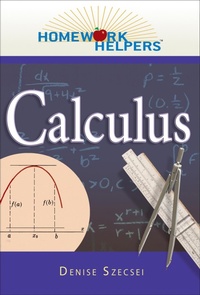
Homework Helpers: Calculus
Published on 23. June 2023
382 pages
978-1-60163-851-9 (ISBN)
Description

The essential help you need when your calculus textbook just isn't making the grade!
Homework Helpers: Calculus is a straightforward and understandable introduction to differential calculus and its applications. It covers all of the topics in a typical calculus class, including:
. Limits
. Continuity
. The product, quotient, and chain rules
. Implicit differentiation
. Related rates
. Graphical analysis
. Optimization
This book, from a longtime teacher with a PhD in mathematics, also contains a review of the pre-calculus concepts that form the foundation on which calculus is built.
Homework Helpers: Calculus is a straightforward and understandable introduction to differential calculus and its applications. It covers all of the topics in a typical calculus class, including:
. Limits
. Continuity
. The product, quotient, and chain rules
. Implicit differentiation
. Related rates
. Graphical analysis
. Optimization
This book, from a longtime teacher with a PhD in mathematics, also contains a review of the pre-calculus concepts that form the foundation on which calculus is built.
More details
Other editions
Additional editions
Content
- Intro
- Cover Page
- Title Page
- Copyright Page
- Dedication
- Acknowledgments
- Contents
- Preface
- Chapter 1: A Review of Functions
- Lesson 1-1: Representing Functions
- Lesson 1-2: The Domain of a Function
- Lesson 1-3: Operations on Functions
- Lesson 1-4: Transformations of Functions
- Lesson 1-5: Symmetry
- Lesson 1-6: Difference Quotients
- Lesson 1-7: Increasing and Decreasing Functions
- Chapter 2: Elementary Functions
- Lesson 2-1: Linear Functions
- Lesson 2-2: Quadratic Functions
- Lesson 2-3: Polynomials
- Lesson 2-4: Rational Functions
- Lesson 2-5: Power Functions
- Lesson 2-6: Piecewise-Defined Functions
- Chapter 3: Exponential and Logarithmic Functions
- Lesson 3-1: Exponential Functions
- Lesson 3-2: Inverse Functions
- Lesson 3-3: Logarithmic Functions
- Lesson 3-4: Exponential and Logarithmic Equations
- Chapter 4: Trigonometric Functions
- Lesson 4-1: Sine and Cosine
- Lesson 4-2: The Tangent Function
- Lesson 4-3: Secant, Cosecant and Cotangent Functions
- Lesson 4-4: Identities and Formulas
- Lesson 4-5: Inverse Trigonometric Functions
- Chapter 5: Limits
- Lesson 5-1: Evaluating Limits Numerically
- Lesson 5-2: Evaluating Limits Graphically
- Lesson 5-3: Evaluating Limits Algebraically
- Lesson 5-4: Evaluating Limits That Involve Infinity
- Chapter 6: Continuity
- Lesson 6-1: Continuity and Limits
- Lesson 6-2: Types of Discontinuities
- Lesson 6-3: The Intermediate Value Theorem
- Chapter 7: The Derivative
- Lesson 7-1: Secant Lines and Difference Quotients
- Lesson 7-2: Tangent Lines
- Lesson 7-3: The Definition of the Derivative
- Lesson 7-4: The Existence of the Derivative
- Lesson 7-5: The Derivative and Tangent Line Equations
- Lesson 7-6: Notation
- Chapter 8: Rules For Differentiation
- Lesson 8-1: Sums and Differences
- Lesson 8-2: The Power Rule
- Lesson 8-3: The Product Rule
- Lesson 8-4: The Quotient Rule
- Chapter 9: Derivatives of Exponential and Trigonometric Functions
- Lesson 9-1: Exponential Functions
- Lesson 9-2: Hyperbolic Functions
- Lesson 9-3: Trigonometric Functions
- Chapter 10: The Chain Rule
- Lesson 10-1: The Power Form of the Chain Rule
- Lesson 10-2: The General Chain Rule
- Lesson 10-3: Implicit Differentiation
- Lesson 10-4: Inverse Functions
- Lesson 10-5: Logarithmic Functions
- Lesson 10-6: Inverse Trigonometric Functions
- Lesson 10-7: Parametric Derivatives
- Chapter 11: Applications of the Derivative
- Lesson 11-1: Using the Tangent Line
- Lesson 11-2: Derivatives and Motion
- Lesson 11-3 Differentials
- Lesson 11-4 Rolle's Theorem and the Mean Value Theorem
- Chapter 12: Further Applications of the Derivative
- Lesson 12-1: Related Rates
- Lesson 12-2: L'Hopital's Rule
- Lesson 12-3: The Extreme Value Theorem and Optimization
- Chapter 13: Graphical Analysis Using the First Derivative
- Lesson 13-1: The First Derivative
- Lesson 13-2: Using the First Derivative
- Lesson 13-3: Relating the Graphs of f(x) and f'(x)
- Chapter 14: Graphical Analysis Using the Second Derivative
- Lesson 14-1: The Second Derivative and Concavity
- Lesson 14-2: Inflection Points
- Lesson 14-3: Using the Second Derivative
- Lesson 14-4: Relating the Graphs of f(x), f'(x), and f"(x)
- Chapter 15: Integration
- Lesson 15-1: Anti-Derivatives
- Lesson 15-2: Substitution
- Lesson 15-3: Integration by Parts
- Lesson 15-4: Integrating Rational Functions
- Lesson 15-5: A Strategy for Integration
- Lesson 15-6: Area and the Riemann Sum
- Lesson 15-7: The Fundamental Theorem of Calculus
- Index
- About the Author
