

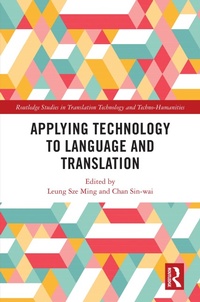
Applying Technology to Language and Translation
1st Edition
Published on 31. December 2024
192 pages
978-1-040-30179-1 (ISBN)
Description

A cutting-edge collection of work on the influence and application of new technologies on the study and practice of language and translation.
This book analyzes the relationship between technology, language, and translation in the digital age. Language issues covered include an automatic football commentary system, the use of digital humanities in the versification of Classical Chinese poetry, the application of corpus linguistics in identity construction in Hong Kong, Cantonese speech recognition, and the use of AI in a Chabot system. Other chapters look at translation matters, such as technologies for interpreting, neural machine translation for press releases, computer-aided annotation for translator and interpreter training, and artificial intelligence and translation. As language and translation are closely intertwined, together, these chapters illustrate the drastic changes that technology has brought to these combined areas.
A vital resource for scholars and students studying the impact of technology on language and translation.
This book analyzes the relationship between technology, language, and translation in the digital age. Language issues covered include an automatic football commentary system, the use of digital humanities in the versification of Classical Chinese poetry, the application of corpus linguistics in identity construction in Hong Kong, Cantonese speech recognition, and the use of AI in a Chabot system. Other chapters look at translation matters, such as technologies for interpreting, neural machine translation for press releases, computer-aided annotation for translator and interpreter training, and artificial intelligence and translation. As language and translation are closely intertwined, together, these chapters illustrate the drastic changes that technology has brought to these combined areas.
A vital resource for scholars and students studying the impact of technology on language and translation.
More details
Series
Edition
1. Auflage
Language
English
Place of publication
London
United Kingdom
Publishing group
Taylor & Francis Ltd
Target group
College/higher education
Professional and scholarly
Illustrations
44 Tables, black and white; 15 Line drawings, black and white; 10 Halftones, black and white; 25 Illustrations, black and white
ISBN-13
978-1-040-30179-1 (9781040301791)
Copyright in bibliographic data and cover images is held by Nielsen Book Services Limited or by the publishers or by their respective licensors: all rights reserved.
Schweitzer Classification
Other editions
Additional editions
Leung Sze Ming | Chan Sin-Wai
Applying Technology to Language and Translation
Book
05/2026
1st Edition
Routledge
€57.00
Shipment within 10-20 days

Leung Sze Ming | Chan Sin-Wai
Applying Technology to Language and Translation
Book
02/2025
Taylor & Francis
Unfortunately, price unknown
Available (delivery time upon request)
Leung Sze Ming | Chan Sin-Wai
Applying Technology to Language and Translation
Book
12/2024
1st Edition
Routledge
€195.90
Shipment within 10-20 days
Persons
Leung Sze Ming is Vice-President (Administration) at the Saint Francis University in Hong Kong. She earned her PhD in Education at The Chinese University of Hong Kong. Her research interests include teacher feedback, writing instruction, and the use of ICT in language teaching and learning.
Chan Sin-wai holds a PhD from London University, UK. He is Professor-cum-Dean of the Ip Ying To Lee Yu Yee School of Humanities and Languages, Saint Francis University, Hong Kong. His research interests are translation technology and bilingual lexicography. He has published 95 academic books in 116 volumes to date.
Chan Sin-wai holds a PhD from London University, UK. He is Professor-cum-Dean of the Ip Ying To Lee Yu Yee School of Humanities and Languages, Saint Francis University, Hong Kong. His research interests are translation technology and bilingual lexicography. He has published 95 academic books in 116 volumes to date.
Content
Introduction
1. Time allocation matters in the football commentary: A Hong Kong case
2. "In my later phase I gradually get more precise with poetry's rules?": Du Fu's recent style prosody revisited
3. Identity construction of Hong Kong's Chief Executive in blogs: A corpus-informed study
4. Exploring a model for ensuring language learner autonomy via technological buttressing
5. Improving Cantonese speech-to-text (STT) recognition by using a pronunciation model
6. Where neural machine translation and translation memories meet: Domain adaptation for the translation of HKSAR Government press releases
7. Computer-aided annotation of lexical cohesive devices in parallel texts for translator and interpreter training
8. Exploring creativity in ChatGPT and human translated literature: A case study of The Old Man and the Sea in Chinese
9. Making sense of how machines should show human-like emotions
10. Explainability of machine translation models: A survey
1. Time allocation matters in the football commentary: A Hong Kong case
2. "In my later phase I gradually get more precise with poetry's rules?": Du Fu's recent style prosody revisited
3. Identity construction of Hong Kong's Chief Executive in blogs: A corpus-informed study
4. Exploring a model for ensuring language learner autonomy via technological buttressing
5. Improving Cantonese speech-to-text (STT) recognition by using a pronunciation model
6. Where neural machine translation and translation memories meet: Domain adaptation for the translation of HKSAR Government press releases
7. Computer-aided annotation of lexical cohesive devices in parallel texts for translator and interpreter training
8. Exploring creativity in ChatGPT and human translated literature: A case study of The Old Man and the Sea in Chinese
9. Making sense of how machines should show human-like emotions
10. Explainability of machine translation models: A survey
