

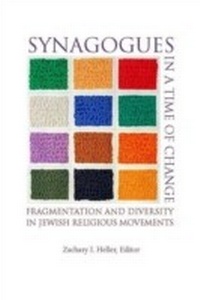
Synagogues in a Time of Change
Fragmentation and Diversity in Jewish Religious Movements
Rowman & Littlefield Publishers
1st Edition
Published on 22. June 2009
266 pages
978-1-56699-643-3 (ISBN)
Description

The synagogue remains a central institution in Jewish life as a place of study, worship, and assembly, but each day brings word of a new challenging development within each of the larger movements to which synagogues belong-Orthodox, Conservative, Reform, and Reconstructionist. Jewish religious communities today share a number of challenges, from the increase in secular or unaffiliated Jews to emerging Jewish spiritual communities forming outside the synagogue. There has never been a more compelling need for a wide-ranging discussion of the diverse issues facing American Judaism.
Brought together by Zachary I. Heller, associate director of the National Center for Jewish Policy Studies, and an editorial team which included Rabbis David Gordis, Hayim Herring, and Sanford Seltzer, twenty of the leading Jewish thinkers-rabbis, scholars, authors, professors, activists, and experts in the study of the American synagogue-have contributed to this comprehensive collection of essays. Each writer brings unique expertise and perspective in describing the development of contemporary religious movements (denominations) in American Judaism, their interrelationships and tensions, and their prospects for the future. Their combined voices create a timely discussion of the many urgent issues bearing down on American synagogues.
Contributors to Synagogues in a Time of Change take on the changing dynamics of synagogue life, its organization into movements, and the organic changes taking place that are causing those movements to lose their coherence and strength, both internally and as an attractive force for seekers of Jewish religious tradition and expression. They address the current fiscal issues that face the movement organizations and the broader questions of their future stability as well as their significance and continued relevance to individual congregations. Ultimately, the book is a catalyst for personal reflection and public discussion on the past, present and future of the American synagogue.
The issues faced by Judaism in America are not unique to Jewish religious movements. Many of the issues facing synagogues will be familiar to those of all faiths. Indeed, the book includes an essay by Rodney L. Petersen of the Boston Theological Institute on denominationalism, nondenominationalism, and postdenominationalism in American Christian communities that helps us see these parallels. Religious groups of all kinds will find reflections of common struggles that can provide a vehicle for constructive conversations about their own pressing issues.
Brought together by Zachary I. Heller, associate director of the National Center for Jewish Policy Studies, and an editorial team which included Rabbis David Gordis, Hayim Herring, and Sanford Seltzer, twenty of the leading Jewish thinkers-rabbis, scholars, authors, professors, activists, and experts in the study of the American synagogue-have contributed to this comprehensive collection of essays. Each writer brings unique expertise and perspective in describing the development of contemporary religious movements (denominations) in American Judaism, their interrelationships and tensions, and their prospects for the future. Their combined voices create a timely discussion of the many urgent issues bearing down on American synagogues.
Contributors to Synagogues in a Time of Change take on the changing dynamics of synagogue life, its organization into movements, and the organic changes taking place that are causing those movements to lose their coherence and strength, both internally and as an attractive force for seekers of Jewish religious tradition and expression. They address the current fiscal issues that face the movement organizations and the broader questions of their future stability as well as their significance and continued relevance to individual congregations. Ultimately, the book is a catalyst for personal reflection and public discussion on the past, present and future of the American synagogue.
The issues faced by Judaism in America are not unique to Jewish religious movements. Many of the issues facing synagogues will be familiar to those of all faiths. Indeed, the book includes an essay by Rodney L. Petersen of the Boston Theological Institute on denominationalism, nondenominationalism, and postdenominationalism in American Christian communities that helps us see these parallels. Religious groups of all kinds will find reflections of common struggles that can provide a vehicle for constructive conversations about their own pressing issues.
More details
Edition
1. Auflage
Language
English
Place of publication
New York
United States
Publishing group
Bloomsbury Publishing Plc
ISBN-13
978-1-56699-643-3 (9781566996433)
Copyright in bibliographic data and cover images is held by Nielsen Book Services Limited or by the publishers or by their respective licensors: all rights reserved.
Schweitzer Classification
Other editions
Additional editions
Zachary I. Heller
Synagogues in a Time of Change
Fragmentation and Diversity in Jewish Religious Movements
Book
06/2009
Alban Institute, Inc
€50.95
Article exhausted; check different version
Persons
Rabbi Zachary I. Heller was a congregational rabbi for over thirty years before joining the National Center for Jewish Policy Studies as associate director. He has served in several international leadership roles, including as president of the World Council of Conservative/Masorti Synagogues, and has lectured and taught in twenty-two countries from Russia and the Ukraine to Australia. Among his recent publications is Re-envisioning the Synagogue.
Content
Acknowledgments
Introduction, Zachary I. Heller
PART 1: The History and Context of Jewish Religious Life in America
Chapter 1: History as Prophecy: Narrating the American Synagogue, David B. Starr
Chapter 2: Denominations in American Judaism: The Dynamics of Their Relationships, Lawrence Grossman
Chapter 3: Denominationalism and Its Discontents: The Changing Face of Synagogue Affiliation, Sanford Seltzer
Chapter 4: American Dissonance: Christian Communities in the United States and Their Cultural Context, Rodney L. Petersen
PART 2: Fragmentation or Diversity?
Chapter 5: Thoughts on American Jewish Denominationalism Today: Culture and Identity, David Ellenson
Chapter 6: Thoughts on American Jewish Denominationalism Today: A Tradition of Unity and Diversity, Arnold M. Eisen
Chapter 7: Jewish Denominations: Transformation or Demise?, David M. Gordis
Chapter 8: Postdenominational American Judaism: Reality or Illusion?, Rela Mintz Geffen
PART 3: Prescriptions
Chapter 9: Synagogue Renewal in an Age of Extreme Choice: Anything, Anyone, Anytime, Anywhere, Hayim Herring
Chapter 10: Jewish Education: Postdenominationalism and the Continuing Influence of Denominations, Jonathan Woocher
Chapter 11: Rabbinic Training and Transdenominationalism: Some Personal Perspectives, Arthur Green
PART 4: Personal Reflections and Community Stories
Chapter 12: Reconciling Individualism and Community: A Common Challenge, Carl A. Sheingold
Chapter 13: A Personal Reflection on Contemporary Trends in American Judaism, Sanford (Sandy) Cardin
Chapter 14: Challenges to Jewish Community, Judy Beck
Chapter 15: Does a Synagogue Need a Denomination?, Clifford Kulwin
Chapter 16: Same Shul, New Shul: Affiliation and Focus, Cheri Scheff Levitan
Chapter 17: The TBZ Story, Moshe Waldoks
PART 5: Independents and the Transitional Generation
Chapter 18: A New Generation of Seekers, Zachary I. Heller
Chapter 19: On Independent Jewish Communities and the Movements, Gordon Tucker
Chapter 20: The Riverway Project: One Model for Reaching a New Generation of Young Adults, Jeremy S. Morrison
Notes
Glossary
Contributors
Introduction, Zachary I. Heller
PART 1: The History and Context of Jewish Religious Life in America
Chapter 1: History as Prophecy: Narrating the American Synagogue, David B. Starr
Chapter 2: Denominations in American Judaism: The Dynamics of Their Relationships, Lawrence Grossman
Chapter 3: Denominationalism and Its Discontents: The Changing Face of Synagogue Affiliation, Sanford Seltzer
Chapter 4: American Dissonance: Christian Communities in the United States and Their Cultural Context, Rodney L. Petersen
PART 2: Fragmentation or Diversity?
Chapter 5: Thoughts on American Jewish Denominationalism Today: Culture and Identity, David Ellenson
Chapter 6: Thoughts on American Jewish Denominationalism Today: A Tradition of Unity and Diversity, Arnold M. Eisen
Chapter 7: Jewish Denominations: Transformation or Demise?, David M. Gordis
Chapter 8: Postdenominational American Judaism: Reality or Illusion?, Rela Mintz Geffen
PART 3: Prescriptions
Chapter 9: Synagogue Renewal in an Age of Extreme Choice: Anything, Anyone, Anytime, Anywhere, Hayim Herring
Chapter 10: Jewish Education: Postdenominationalism and the Continuing Influence of Denominations, Jonathan Woocher
Chapter 11: Rabbinic Training and Transdenominationalism: Some Personal Perspectives, Arthur Green
PART 4: Personal Reflections and Community Stories
Chapter 12: Reconciling Individualism and Community: A Common Challenge, Carl A. Sheingold
Chapter 13: A Personal Reflection on Contemporary Trends in American Judaism, Sanford (Sandy) Cardin
Chapter 14: Challenges to Jewish Community, Judy Beck
Chapter 15: Does a Synagogue Need a Denomination?, Clifford Kulwin
Chapter 16: Same Shul, New Shul: Affiliation and Focus, Cheri Scheff Levitan
Chapter 17: The TBZ Story, Moshe Waldoks
PART 5: Independents and the Transitional Generation
Chapter 18: A New Generation of Seekers, Zachary I. Heller
Chapter 19: On Independent Jewish Communities and the Movements, Gordon Tucker
Chapter 20: The Riverway Project: One Model for Reaching a New Generation of Young Adults, Jeremy S. Morrison
Notes
Glossary
Contributors
