

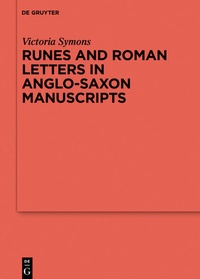
Runes and Roman Letters in Anglo-Saxon Manuscripts
Description

This book presents the first comprehensive study of Anglo-Saxon manuscript texts containing runic letters. To date there has been no comprehensive study of these works in a single volume, although the need for such an examination has long been recognized. This is in spite of a growing academic interest in the mise-en-page of early medieval manuscripts. The texts discussed in this study include Old English riddles and elegies, the Cynewulfian poems, charms, Solomon and Saturn I, and the Old English Rune Poem. The focus of the discussion is on the literary analysis of these texts in their palaeographic and runological contexts. Anglo-Saxon authors and scribes did not, of course, operate within a vacuum, and so these primary texts are considered alongside relevant epigraphic inscriptions, physical objects, and historical documents. Victoria Symons argues that all of these runic works are in various ways thematically focused on acts of writing, visual communication, and the nature of the written word. The conclusion that emerges over the course of the book is that, when encountered in the context of Anglo-Saxon manuscripts, runic letters consistently represent the written word in a way that Roman letters do not.
Reviews / Votes
"La synthèse que propose ce livre est donc á la fois utile, intelligente, argumentée et agréable à lire."
Alban Gautier in: Le Moyen Age 2 (2018), 466-467
More details
Other editions
Additional editions
Person
Content
- Intro
- Table of contents
- Acknowledgements
- List of Abbreviations
- 0. Introduction
- 0.1 Anglo-Saxons and writing: a brief introduction
- 0.2 Runic writing before the fifth century
- 0.3 The runic and roman writing systems
- 0.4 English runes before and after the conversion
- 0.5 Methodology
- 1. Runes in Old English Manuscripts: The Exeter Book Manuscript as a Case Study
- 1.1 Runes in the Exeter Book
- 1.1.1 Marginal runes
- 1.1.2 Runic abbreviations
- 1.1.3 Textual runes
- 1.2 Runes, riddles, and revelation
- 1.3 Conclusion
- 2. Reading and Writing in the Runic Riddles and The Husband's Message
- 2.1 Runes in the Exeter Book riddles
- 2.1.1 Speech and the material word: Riddle 24
- 2.1.2 Talking about writing in Riddles 42 and 58
- 2.1.3 Hidden in plain sight: re-reading Riddles 19 and 64
- 2.2 The Husband's Message
- 2.2.1 The identity of the speaker
- 2.2.2 Interpreting the runes of The Husband's Message
- 2.3 Conclusion
- 3. Cynewulf's Signatures and the Materiality of the Letter
- 3.1 Cynewulf's epilogues
- 3.1.1 Cynewulf's runic signatures
- 3.1.2 Problem runes and playful language
- 3.2 Names in manuscripts: scribal colophons and authorial signatures
- 3.3 Names in epigraphy
- 3.4 Writing the cross: visual signifiers in Elene
- 3.5 The purpose of Cynewulf's epilogues
- 3.6 Conclusion
- 4. The Power of the Letter in Runic Charms and Solomon and Saturn I
- 4.1 Anglo-Saxon charms and the story of Imma
- 4.1.1 Letters and divine power
- 4.1.2 Runes in Old English charms
- 4.1.3 Imma meets Ælfric
- 4.1.4 Runic charms and the power of language
- 4.2 Solomon and Saturn I
- 4.3 Conclusion
- 5. Rune Lists and Alphabet Poems: Studying the Letter in Later Anglo-Saxon England
- 5.1 The Old English Rune Poem
- 5.2 Letter lists and Rune poems
- 5.2.1 The Abecedarium Nordmannicum
- 5.2.2 Icelandic Rune Poem(s)
- 5.2.3 The Norwegian Rune Poem
- 5.2.4 The Rune poems together
- 5.3 Alphabet psalms
- 5.4 Visual ambiguities in the Old English Rune Poem
- 5.5 Conclusion
- 6. Conclusion
- 6.1 Medieval writing and the internet
- Bibliography
- Index
