
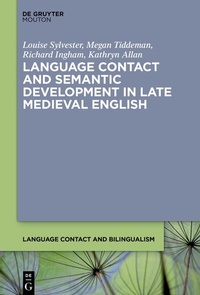
Language Contact and Semantic Development in Late Medieval English
Description
Alles über E-Books | Antworten auf Fragen rund um E-Books, Kopierschutz und Dateiformate finden Sie in unserem Info- & Hilfebereich.
The multilingual context of medieval Britain has been a focus of historical linguistic scholarship for some time, but Middle English has often been examined in isolation. This book analyzes a large dataset of English vocabulary from the late Middle Ages, a time when the language was gaining new importance, with attention paid to parallel lexical developments in French and Latin. It explores lexical and semantic innovations and losses, and its findings challenge the notion that native and borrowed words were in competition during the period. The book presents a new picture of ongoing bilingualism in the late medieval period and a growth in vocabulary that heralded the beginnings of standardization in English.
More details
Other editions
Additional editions
Persons
Louise Sylvester , Megan Tiddeman and Richard Ingham , University of Westminster, London; Kathryn Allan ; University College, London.

System requirements
File format: ePUB
Copy protection: Watermark-DRM (Digital Rights Management)
System requirements:
- Computer (Windows; MacOS X; Linux): Use a reading software that can process the file format ePUB: e.g., Adobe Digital Editions or FBReader – both free (see eBook Help).
- Tablet/Smartphone (Android; iOS): Before downloading, install the free app Adobe Digital Editions (see eBook Help).
- E-reader: Bookeen, Kobo, Pocketbook, Sony, Tolino and many more (not Kindle).
The file format ePUB works well for novels and non-fiction books – i.e., „flowing” text without complex layout. On an e-reader or smartphone, line and page breaks automatically adjust to fit the small displays.
This eBook uses Watermark-DRM, a „soft” copy protection. This means that there are no technical restrictions to prevent illegal distribution. However, there is a personalised watermark embedded in the eBook that can be used to identify the purchaser of the eBook in the event of misuse and to provide evidence for legal purposes.
For more information, see our eBook Help page.