

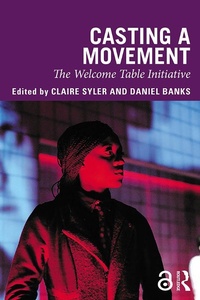
Casting a Movement
The Welcome Table Initiative
1st Edition
Published on 17. July 2019
266 pages
978-0-429-94828-2 (ISBN)
Description

Casting a Movement brings together US-based actors, directors, educators, playwrights, and scholars to explore the cultural politics of casting.
Drawing on the notion of a "welcome table"-a space where artists of all backgrounds can come together as equals to create theatre-the book's contributors discuss casting practices as they relate to varying communities and contexts, including Middle Eastern American theatre, Disability culture, multilingual performance, Native American theatre, color- and culturally-conscious casting, and casting as a means to dismantle stereotypes. Syler and Banks suggest that casting is a way to invite more people to the table so that the full breadth of US identities can be reflected onstage, and that casting is inherently a political act; because an actor's embodied presence both communicates a dramatic narrative and evokes cultural assumptions associated with appearance, skin color, gender, sexuality, and ability, casting choices are never neutral. By bringing together a variety of artistic perspectives to discuss common goals and particular concerns related to casting, this volume features the insights and experiences of a broad range of practitioners and experts across the field.
As a resource-driven text suitable for both practitioners and academics, Casting a Movement seeks to frame and mobilize a social movement focused on casting, access, and representation.
Chapter 2 of this book is freely available as a downloadable Open Access PDF at http://www.taylorfrancis.com under a Creative Commons Attribution-Non Commercial-No Derivatives (CC-BY-NC-ND) 4.0 license.
Drawing on the notion of a "welcome table"-a space where artists of all backgrounds can come together as equals to create theatre-the book's contributors discuss casting practices as they relate to varying communities and contexts, including Middle Eastern American theatre, Disability culture, multilingual performance, Native American theatre, color- and culturally-conscious casting, and casting as a means to dismantle stereotypes. Syler and Banks suggest that casting is a way to invite more people to the table so that the full breadth of US identities can be reflected onstage, and that casting is inherently a political act; because an actor's embodied presence both communicates a dramatic narrative and evokes cultural assumptions associated with appearance, skin color, gender, sexuality, and ability, casting choices are never neutral. By bringing together a variety of artistic perspectives to discuss common goals and particular concerns related to casting, this volume features the insights and experiences of a broad range of practitioners and experts across the field.
As a resource-driven text suitable for both practitioners and academics, Casting a Movement seeks to frame and mobilize a social movement focused on casting, access, and representation.
Chapter 2 of this book is freely available as a downloadable Open Access PDF at http://www.taylorfrancis.com under a Creative Commons Attribution-Non Commercial-No Derivatives (CC-BY-NC-ND) 4.0 license.
Reviews / Votes
"a must-read title for any theatre professional, educator or student [...] Readers will walk away inspired to interrogate their own theatrical practice, engage in conversation with other theatre makers, and seek to create theatre where all have a seat and voice at the table."- Derrick Vanmeter, Southern Theatre
"a timely work whose significance goes beyond the discipline of theater to add to the national conversation on institutionalized racism. Read alongside recent political, social and artistic developments, including the Black Lives Matter movement, theatre closures precipitated by COVID-19 and the political upheavals of the Trump presidency, it remaps the field."
- Erith Jaffe-Berg, The Journal of American Drama and Theatre
"As this volume reaches classrooms and institutions around the globe, the voices echoing through its pages will challenge theatre-makers to remember the implications that bodies of colour and other-ableness carry with them into production and to rethink the ways they welcome all communities to the table."
- Collin Vorbeck, Theatre Research International
More details
Edition
1. Auflage
Language
English
Place of publication
London
United Kingdom
Publishing group
Taylor & Francis Ltd
Target group
College/higher education
Professional and scholarly
Illustrations
4 Tables, black and white; 19 Halftones, black and white; 23 Illustrations, black and white
File size
9,57 MB
ISBN-13
978-0-429-94828-2 (9780429948282)
Copyright in bibliographic data and cover images is held by Nielsen Book Services Limited or by the publishers or by their respective licensors: all rights reserved.
Schweitzer Classification
Other editions
Additional editions
Book
07/2019
1st Edition
Routledge
€47.50
Shipment within 10-20 days
Book
07/2019
1st Edition
Routledge
€193.50
Shipment within 10-20 days
Persons
Claire Syler is Assistant Professor of Theatre at the University of Missouri and previously the Education Director at the Nashville Shakespeare Festival. Her research focuses on the intersection of theatre and education and has appeared in HowlRound; Theatre, Dance and Performance Training; Theatre Topics; and Youth Theatre Journal.
Daniel Banks is co-director of DNAWORKS, an arts and service organization dedicated to using the arts as a catalyst for dialogue and healing, engaging topics of representation, identity, and heritage. He served on the faculties of Tisch School of the Arts, NYU, the M.A. in Applied Theatre, CUNY, and as Chair of Performing Arts, Institute of American Indian Arts, Santa Fe, NM. He is the editor of Say Word! Voices from Hip Hop Theater (University of Michigan).
Daniel Banks is co-director of DNAWORKS, an arts and service organization dedicated to using the arts as a catalyst for dialogue and healing, engaging topics of representation, identity, and heritage. He served on the faculties of Tisch School of the Arts, NYU, the M.A. in Applied Theatre, CUNY, and as Chair of Performing Arts, Institute of American Indian Arts, Santa Fe, NM. He is the editor of Say Word! Voices from Hip Hop Theater (University of Michigan).
Content
List of Figures
List of Contributors
Foreword: From "I Love Your Freckles" to "Representation Matters"
Acknowledgments
Introduction
The Welcome Table: Casting for an Integrated Society
Part One: Culturally Conscious Casting
Part Two: Approaches to Casting Middle Eastern American Theatre
Part Three: Casting and Disability Culture
Part Four: Casting and Multilingual Performance
Part Five: Casting Contemporary Native American Theatre
Part Six: Dismantling Stereotypes
Part Seven: Casting Across Identities
Afterword
List of Contributors
Foreword: From "I Love Your Freckles" to "Representation Matters"
Acknowledgments
Introduction
The Welcome Table: Casting for an Integrated Society
Part One: Culturally Conscious Casting
Part Two: Approaches to Casting Middle Eastern American Theatre
Part Three: Casting and Disability Culture
Part Four: Casting and Multilingual Performance
Part Five: Casting Contemporary Native American Theatre
Part Six: Dismantling Stereotypes
Part Seven: Casting Across Identities
Afterword
