

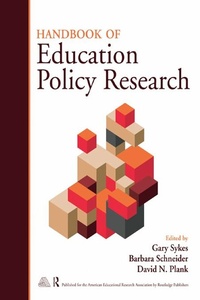
Handbook of Education Policy Research
1st Edition
Published on 10. September 2012
1064 pages
978-1-135-85646-5 (ISBN)
Description

Co-published by Routledge for the American Educational Research Association (AERA)
Educational policy continues to be of major concern. Policy debates about economic growth and national competitiveness, for example, commonly focus on the importance of human capital and a highly educated workforce. Defining the theoretical boundaries and methodological approaches of education policy research are the two primary themes of this comprehensive, AERA-sponsored Handbook.
Organized into seven sections, the Handbook focuses on (1) disciplinary foundations of educational policy, (2) methodological perspectives, (3) the policy process, (4) resources, management, and organization, (5) teaching and learning policy, (6) actors and institutions, and (7) education access and differentiation.
Drawing from multiple disciplines, the Handbook's over one hundred authors address three central questions: What policy issues and questions have oriented current policy research? What research strategies and methods have proven most fruitful? And what issues, questions, and methods will drive future policy research? Topics such as early childhood education, school choice, access to higher education, teacher accountability, and testing and measurement cut across the 63 chapters in the volume. The politics surrounding these and other issues are objectively analyzed by authors and commentators.
Each of the seven sections concludes with two commentaries by leading scholars in the field. The first considers the current state of policy design, and the second addresses the current state of policy research.
This book is appropriate for scholars and graduate students working in the field of education policy and for the growing number of academic, government, and think-tank researchers engaged in policy research.
For more information on the American Educational Research Association, please visit: http://www.aera.net/.
Educational policy continues to be of major concern. Policy debates about economic growth and national competitiveness, for example, commonly focus on the importance of human capital and a highly educated workforce. Defining the theoretical boundaries and methodological approaches of education policy research are the two primary themes of this comprehensive, AERA-sponsored Handbook.
Organized into seven sections, the Handbook focuses on (1) disciplinary foundations of educational policy, (2) methodological perspectives, (3) the policy process, (4) resources, management, and organization, (5) teaching and learning policy, (6) actors and institutions, and (7) education access and differentiation.
Drawing from multiple disciplines, the Handbook's over one hundred authors address three central questions: What policy issues and questions have oriented current policy research? What research strategies and methods have proven most fruitful? And what issues, questions, and methods will drive future policy research? Topics such as early childhood education, school choice, access to higher education, teacher accountability, and testing and measurement cut across the 63 chapters in the volume. The politics surrounding these and other issues are objectively analyzed by authors and commentators.
Each of the seven sections concludes with two commentaries by leading scholars in the field. The first considers the current state of policy design, and the second addresses the current state of policy research.
This book is appropriate for scholars and graduate students working in the field of education policy and for the growing number of academic, government, and think-tank researchers engaged in policy research.
For more information on the American Educational Research Association, please visit: http://www.aera.net/.
More details
Language
English
Place of publication
London
United Kingdom
Publishing group
Taylor & Francis Ltd
Target group
College/higher education
Product notice
Reflowable
Illustrations
73 s/w Tabellen
73 Tables, black and white
File size
7,03 MB
ISBN-13
978-1-135-85646-5 (9781135856465)
Copyright in bibliographic data and cover images is held by Nielsen Book Services Limited or by the publishers or by their respective licensors: all rights reserved.
Schweitzer Classification
Other editions
Additional editions
Gary Sykes | Barbara Schneider | David N. Plank
Handbook of Education Policy Research
Book
04/2009
1st Edition
Routledge
€550.58
Shipment within 15-20 days
Gary Sykes | Barbara Schneider | David N. Plank
Handbook of Education Policy Research
Book
04/2009
1st Edition
Routledge
€183.50
Shipment within 15-20 days
Persons
Gary Sykes is a Professor of Educational Administration and Teacher Education at Michigan State University. He specializes in educational policy relating to teaching and teacher education. His research interests center on policy issues associated with the improvement of teaching and teacher education, on the development of leadership preparation programs, and on educational choice as an emerging policy issue.
Barbara Schneider is a John A. Hannah University Distinguished Professor in the College of Education and Department of Sociology at Michigan State University. She holds research appointments at the University of Chicago and NORC, where she is Principal Investigator of the Data Research and Development Center (DRDC). She has published 12 books and over 100 articles and reports on family, social context of schooling, and sociology of knowledge. Professor Schneider is currently conducting a collaborative study with the Michigan Department of Education on using administrative data to make state education policy decision. She was selected by the American Sociological Association as the editor of Sociology of Education.
David N. Plank is Executive Director of Policy Analysis for California Education (PACE), an independent policy research center based at the University of California-Berkeley, Stanford University, and the University of Southern California. He was previously a professor at Michigan State University, where he founded and directed the Education Policy Center. He received his Ph.D. from the University of Chicago in 1983. In addition to his work on education policy in the U.S., he has served as a consultant in the areas of educational policy and finance to international organizations including the World Bank, the UNDP, the OECD, USAID, and the Ford Foundation, and also to governments in Africa and Latin America.
Barbara Schneider is a John A. Hannah University Distinguished Professor in the College of Education and Department of Sociology at Michigan State University. She holds research appointments at the University of Chicago and NORC, where she is Principal Investigator of the Data Research and Development Center (DRDC). She has published 12 books and over 100 articles and reports on family, social context of schooling, and sociology of knowledge. Professor Schneider is currently conducting a collaborative study with the Michigan Department of Education on using administrative data to make state education policy decision. She was selected by the American Sociological Association as the editor of Sociology of Education.
David N. Plank is Executive Director of Policy Analysis for California Education (PACE), an independent policy research center based at the University of California-Berkeley, Stanford University, and the University of Southern California. He was previously a professor at Michigan State University, where he founded and directed the Education Policy Center. He received his Ph.D. from the University of Chicago in 1983. In addition to his work on education policy in the U.S., he has served as a consultant in the areas of educational policy and finance to international organizations including the World Bank, the UNDP, the OECD, USAID, and the Ford Foundation, and also to governments in Africa and Latin America.
Content
Foreword Acknowledgments Introduction, Gary Sykes, Barbara Schneider, and Timothy G. Ford Section I: Social Science Disciplines and Education Policy Research Section Editors: Barbara Schneider and David N. Plank 1. Historians and Educational Policy Research in the United States, Maris A. Vinovskis 2. Policy Research in Education: The Economic View, Martin Carnoy 3. The Economic Value of Education and Cognitive Skills, Eric A. Hanushek 4. A Political Science Perspective on Education Policy Analysis, Lorraine M. McDonnell 5. Perspectives from the Disciplines: Sociological Contributions to Education Policy Research and Debates, Douglas Lee Lauen and Karolyn Tyson 6. Current Approaches to Research in Anthropology and Education, Maressa L. Dixon, Kathryn M. Borman, and Bridget A. Cotner 7. Making Education Research More Policy-Analytic, David L. Weimer 8. Commentary: Disciplined Education Policy Research, Michael J. Feuer 9. Commentary: The Disciplinary Foundations of Education Policy Research, Adam Gamoran Section II: Conducting Policy Research: Methodological Perspectives Section Editors: Barbara Schneider and David N. Plank 10. Separate Orbits: The Distinctive Worlds of Educational Research and Policymaking, Martin Orland 11. The Use of Randomized Trials to Inform Education Policy, Geoffrey D. Borman 12. Causal Inference in Non-Experimental Educational Policy Research, David Kaplan 13. Research Synthesis and Education Policy, Therese D. Pigott 14. Complementary Methods for Policy Research, Laura M. Desimone 15. Assessment Policy: Making Sense of the Babel, Joan L. Herman and Eva L. Baker 16. Scale-Up as a Framework for Intervention, Program, and Policy Evaluation Research, Sarah-Kathryn McDonald 17. Commentary: Conducting Policy Research: Methodological Perspectives, Spyros Konstantopoulos 18. Commentary: An Applied Perspective on Research, Method, and Policy, Christopher B. Swanson Section III: Politics and the Policy Process Section Editor: Jane Clark Lindle 19. Education and Domination: Reforming Policy and Practice through Critical Theory, Carlos Alberto Torres and Richard Van Heertum 20. Race, Ethnicity, and Education, Roslyn Arlin Mickelson 21. Race(ing), Class(ing), and Gender(ing) Our Work: Critical Race Theory, Critical Race Feminism, Epistemology, and New Directions in Educational Policy Research, David O. Stovall 22. Rhetoric and Symbolic Action in the Policy Process, Lisa Rosen 23. The Role of Law in Educational Policy Formation, Implementation, and Research, Julie F. Mead 24. Teacher Collective Bargaining: What We Know and What We Need to Know, Julia E. Koppich and Mary Alice Callahan 25. The Voice of the People in Education Policy, Rebecca Jacobsen 26. Assessment Policy and Politics of Information, Jane Clark Lindle 27. What Works in Defining "What Works" in Educational Improvement: Lessons from Education Policy Implementation Research, Directions for Future Research, Meredith I. Honig 28. Conceptualizing Policy Implementation: Large-Scale Reform in an Era of Complexity, Amanda Datnow and Vicki Park 29. Public Choice and the Political Economy of American Education, Martin West 30. Research in the Policy Process, Marshall S. Smith and Matthew L. Smith 31. Commentary: Politics and the Policy Process, Jane Hannaway 32. Commentary: Getting "Critically Real" About the State of Education Politics and Policy Process Research, V. Darleen Opfer Section IV: Policy Implications of Educational Resources, Management, and Organization Section Editor: Linda Skrla 33. Notes on Reframing the Role of the Organizations in Policy Implementation: Resources for Practice, in Practice, James P. Spillane, Louis M. Gomez, and Leigh Mesler 34. What Do We Know About Reducing Class and School Size? June Ahn and Dominic J. Brewer 35. Conceptions, Measurement and Application of Educational Adequacy and Equal Educational Opportunity, Bruce D. Baker and Preston C. Green, III 36. Whether and How Money Matters in K-12 Education, Margaret L. Plecki and Tino A. Castaneda 37. School Reconstitution and School Improvement: Theory and Evidence, Betty Malen and Jennifer King Rice 38. Charter School Policy Issues and Research Questions, Sandra Vergari 39. Vouchers, John F. Witte 40. A Market for Knowledge? Frederick M. Hess 41. Market Reforms in Education, Clive R. Belfield and Henry M. Levin 42. Commentary: A Call to Studied Action: Lessons from Research on Policies Designed to Improve the Organization and Management of Schooling, Steve Cantrell 43. Commentary: Improvement or Reinvention: Two Policy Approaches to School Reform, Rodney T. Ogawa Section V: Teaching and Learning Policy Section Editor: Gary Sykes 44. Opportunity to Learn, William H. Schmidt and Adam Maier 45. The Reading and Math Wars, Alan H. Schoenfeld and P. David Pearson 46. Language Policy in Education, Patricia Gandara and M. Cecilia Gomez 47. Teacher Quality and Teacher Labor Markets, Tara Beteille and Susanna Loeb 48. Teacher Preparation and Teacher Learning: A Changing Policy Landscape, Linda Darling-Hammond, Ruth Chung Wei, with Christy Marie Johnson 49. School Improvement by Design: Lessons from a Study of Comprehensive School Reform Programs, Brian P. Rowan, Richard J. Correnti, Robert J. Miller, and Eric M. Camburn 50. Measurement and Improvement of Teacher-Child Interactions: Implications for Policy and Accountability Frameworks of Standardized Observation, Robert C. Pianta and Bridget K. Hamre 51. Closing Achievement Gaps, George Farkas 52. New Technology, Yong Zhao and Jing Lei 53. Education and the Shrinking State, David N. Plank and Venessa Keesler 54. Commentary: Research on Teaching and Learning, Barbara R. Foorman 55. Commentary: Informing Teaching and Learning Policy, Robert E. Floden Section VI: Actors and Institutions in the Policy Process Section Editor: Carolyn Herrington 56. International and Transnational Policy Actors in Education: A Review of the Research, Karen Mundy with Mona Ghali 57. New Approaches to Understanding Federal Involvement in Education, Lora Cohen-Vogel and Michael K. McLendon 58. The Expansion of State Policy Research, Kathryn A. McDermott 59. The District Role in Instructional Improvement, Gary Sykes, Jennifer O'Day, and Timothy G. Ford 60. Pushing on the Paradigm: Research on Teachers' Organizations as Policy Actors, Nina Bascia 61. Local Democracy in Education, Michael Mintrom 62. The Politics of (Im)Prudent State-Level Homeschooling Policies, Catherine A. Lugg and Andrea K. Rorrer 63. Student Voice and Student Roles in Education Policy and Policy Reform, Dana L. Mitra 64. Looking Forward: Toward a New Role in Promoting Educational Equity for Students with Disabilities from Low-Income Backgrounds, Thomas Hehir 65. Commentary: Research on Actors and Institutions Involved in Education Policy: Themes, Tensions, and Topics to Explore, Martha McCarthy 66. Commentary: Nested Actors and Institutions: The Need for Better Theory, Data and Methods to Inform Education Policy, Mark Berends Section VII: Educational Access and Differentiation Section Editor: Barbara Schneider 67. Policy and Place-Learning from Decentralized Reforms, Bruce Fuller 68. Early Childhood Education, Lawrence J. Schweinhart and Rachel Fulcher-Dawson 69. Social Stratification and Educational Opportunity, Nathan D. Jones and Barbara Schneider 70. Shadow Education Systems, Chong-Jae Lee, Hyun-Jeong Park, and Heesook Lee 71. K-16 Transitions and Higher Education Access, Frankie Keels Williams 72. Permeability and Transparency in the High School-College Transition, Jennifer L. Stephan and James E. Rosenbaum 73. Governmental Policy and the Organization of Postsecondary Education, James C. Hearn and T. Austin Lacy 74. The Invisible Hand of World Education Culture: Thoughts for Policy Makers, David P. Baker 75. Commentary: Access and Differentiation, C. Kent McGuire 76. Commentary: Access and Differentiation: Structuring Equality and Inequality in Education Policy, Jeannie Oakes
