

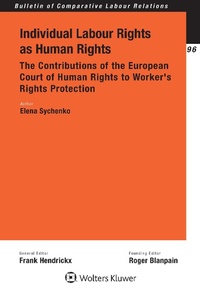
Individual Labour Rights as Human Rights
The Contributions of the European Court of Human Rights to Worker's Rights Protection
Published on 1. March 2017
274 pages
978-90-411-8646-1 (ISBN)
Description

In recent years there has been a substantial debate over the interconnection between labour rights and human rights. Consequently, the jurisprudence of the European Court of Human Rights (ECtHR) concerning substantive individual labour rights, or 'rights at work', is coming to greater prominence at the national level throughout the forty-seven Member States of the Council of Europe. This is the first book in English to provide a thorough analysis of the Court's most recent case law - cases considered in the period from 1963 to 2016 - on fundamental employment rights such as the right to wages, protection from discrimination and unfair dismissal, the right to occupational safety at work, and civil liberties such as the freedom of association, the freedom of religion and expression, and the right to privacy.
Drawing on close scrutiny of 347 cases since 1963, the author traces the evolutionary development of the Court's positions on labour rights as human rights through case analyses, commentary, and general conclusions in each of several categorical groupings. Recent trends are treated in substantial detail. Among the issues and topics raised are the following:
- - interrelation of ECtHR case law and national labour rights protection;
- - benefits for employees of reference to ECtHR case law in national proceedings;
- - role of International Labour Organization conventions and of the European Social Charter in the Court's reasoning;
- - application of balancing and proportionality test in relevant to labour law cases;
- - public criticism of employer, disclosure of information, and standards of whistle-blowers' protection; and
- - positive obligations of the State in the ¬field of occupational safety and health.
This book offers the most detailed and considered analysis available of how individual labour rights have been referred to in the human rights jurisprudence of the ECtHR. Given that the Court's positions have already changed certain aspects of some national labour laws, this peerless volume will prove indispensable for practitioners and scholars monitoring the growing applicability of human rights law in matters of labour and employment, especially in the areas of protection of wages, unjust dismissal, and occupational safety.
Drawing on close scrutiny of 347 cases since 1963, the author traces the evolutionary development of the Court's positions on labour rights as human rights through case analyses, commentary, and general conclusions in each of several categorical groupings. Recent trends are treated in substantial detail. Among the issues and topics raised are the following:
- - interrelation of ECtHR case law and national labour rights protection;
- - benefits for employees of reference to ECtHR case law in national proceedings;
- - role of International Labour Organization conventions and of the European Social Charter in the Court's reasoning;
- - application of balancing and proportionality test in relevant to labour law cases;
- - public criticism of employer, disclosure of information, and standards of whistle-blowers' protection; and
- - positive obligations of the State in the ¬field of occupational safety and health.
This book offers the most detailed and considered analysis available of how individual labour rights have been referred to in the human rights jurisprudence of the ECtHR. Given that the Court's positions have already changed certain aspects of some national labour laws, this peerless volume will prove indispensable for practitioners and scholars monitoring the growing applicability of human rights law in matters of labour and employment, especially in the areas of protection of wages, unjust dismissal, and occupational safety.
More details
Other editions
Additional editions
Elena Sychenko
Individual Labour Rights as Human Rights
The Contributions of the European Court of Human Rights to Worker's Rights Protection
Book
03/2017
Kluwer Law International
€193.13
Shipment within 10-20 days
Persons
Content
- Intro
- Notes on Author
- Introduction
- PART IThe Integration of Labour Rights in the European Convention on Human Rights
- CHAPTER 1History of the Convention: A Long Way to European Quasi-Constitutional Court
- §1.01 Drafting of the ECHR
- [A] Dispute on Definition of Rights
- [B] Dispute on the List of Rights
- [C] Dispute on Establishment of the Process of Supervision and the Right for Individual Petition
- §1.02 Development of the Convention System
- §1.03 Accession of the EU to the Council of Europe
- CHAPTER 2Integration of Labour Rights into the ECHR
- §2.01 Indivisibility of Human Rights and Integrated Approach to the Interpretation of the ECHR
- §2.02 ECHR as a 'Living Instrument'
- [A] The Use of Other International Instruments and Opinions of Other International Bodies
- [B] The Use of Comparative Research as the Basis of Reasoning
- §2.03 Margin of Appreciation, Balancing and Proportionality Test
- [A] The Margin of Appreciation
- [B] The Proportionality Test
- [C] The Balancing Exercise
- §2.04 Conclusions
- PART IIThe Prohibition of Forced or Compulsory Labour and Discrimination in Employment
- CHAPTER 3The Prohibition of Slavery, Servitude, Forced or Compulsory Labour
- §3.01 Slavery, Servitude and Human Trafficking
- [A] Definitions
- [B] Positive Obligations of the States
- §3.02 Forced or Compulsory Labour
- [A] Definition
- [B] Elements of Forced or Compulsory Labour
- [C] Analysis of Cases Considered Under Article 4-3
- [D] The Lack of the ECtHR's Attention to the Factor of Remuneration
- [E] The Obligation to Accept Any Job as a Criterion of Eligibility for Unemployment Benefits
- §3.03 Conclusions
- CHAPTER 4Prohibition of Discrimination
- §4.01 General Aspects of the ECtHR's Approach to Discrimination
- [A] The Way of Adjudication of Applications Alleging Discrimination
- [B] The Court's Approach to the Legitimate Aim in Cases of Discrimination
- [C] The Research on Proportionality of Interference
- §4.02 Indirect Discrimination
- [A] The Definition of Indirect Discrimination
- [B] Thlimmenos v. Greece and the Value of the Court's Legal Positions for Russia
- §4.03 Positive Obligations of the State Under Article 14
- §4.04 Conclusions
- PART IIIRights of Employees under the ECHR and Unfair Dismissal
- CHAPTER 5Employee's Right to Respect for Private Life
- §5.01 Protection of an Employee's Privacy Under Article 8 of the ECHR
- [A] Private Life and the Emergence of the Protection of Employee's Privacy on the European Scene
- [B] Reasonable Expectation of Privacy
- [C] In Accordance with Law
- [D] Necessary in Democratic Society
- [E] Positive Obligations of the States
